AI drives productivity, not cost savings. Eighty-one percent of AI adoption starts in IT, focused on throughput gains rather than workforce reduction.
IT's leadership moment in the autonomization era. CIOs must shift from reactive to strategic mode, leading AI transformation with a "yes AND" approach that embraces innovation while governing security, data readiness and risk.
Upskilling is more likely than replacement. AI will create 170 million net new jobs globally by 2030. The real challenge is workforce development. Employees who use AI will outperform those who don't, making talent training the critical bottleneck to value realization.
LAS VEGAS -- The headlines can't be missed: AI will save you money. AI will take your job. IT will no longer be needed. However, is this really the case? The AI hype cycle has created excitement -- but also panic -- creating a challenge for business leaders.
"The work ahead of us is not about chasing the newest tool; it's about creating value," said Timothy Galluzi, CIO of the state of Nevada, in his welcome speech at the Info-Tech Research Group LIVE event in Las Vegas. "It's about whether technology helps people to do their jobs better. Whether it makes government services faster, safer and easier to use. Whether it gives our teams time back. Whether it helps us make better decisions. And whether it can adapt the tools responsibly."
Before adopting AI, organizations need the right mindset on what it can really do. The hype cycle can lead to overpromises, resulting in underwhelming results.
"AI has a ton of hype. We need to dig into the data to really understand what is going on," said Tom Zehren, CEO of Info-Tech Research Group.
Zehren explored these common AI hypes, going beyond the headlines and into the facts, during his opening presentation at the Info-Tech Live conference.
Hype 1: AI will save you millions
Zehren said that Klarna was one of the first companies that went public, stating they were going to reduce head count in favor of AI. They outsourced their contact center and said they saved $60 million. However, customer satisfaction decreased significantly due to a lack of human interaction when it was needed most.
Info-Tech Research surveyed executives to take a deeper look at the software development lifecycle (SDLC) of AI adoption. According to this research, 58% of organizations have adopted and embedded AI programs across various departments.
Another statistic Zehren pointed out was that 81% of AI adoption in an organization starts in IT. He went on to say that these IT leaders are not using cost-cutting as a use case for AI. The primary driver of implementing AI use cases is to increase productivity and throughput. Cost-cutting was the last reason these leaders implemented AI. Only 11% of those surveyed stated AI was a cost-cutting measure. AI adoption should center on productivity, which can lead to cost savings if applied appropriately.
Tom Zehren, CEO of Info-Tech Research Group, presents research to debunk AI myths during the opening keynote.
Hype 2: AI will take your job
Zehren pointed to a Sam Altman quote from the CNBC's David Faber interview, "The companies that I know that have adopted AI the most are the ones that are hiring the most. And the companies, as a general rule, that are talking about doing layoffs because of AI are the ones adopting AI the least."
"There are significantly more jobs being created all the time, and Altman is in line with the World Economic Forum," said Zehren.
The World Economic Forum said that by 2030, there will be about 190 million jobs created globally, and only 92 million jobs will be displaced. This gives a net gain of about 78 million jobs.
According to an Info-Tech Research study, only 17% of executives believe AI will drive significant workforce reductions in the next two years. Zehren said that this shows:
AI will create jobs. In the next five years, it will create more jobs than it destroys.
Upskilling becomes a priority and a challenge. Companies need to train employees to keep ahead. The skills gap is real, and employers need to match workers with open jobs.
Employees need to use AI. "AI is not going to take your job; someone who knows how to use AI will take your job," Zehren said.
"The demand is there … as IT executives and leaders, you can drive that and get value out of that for your organization," said Zehren.
AI is not going to take your job; someone who knows how to use AI will take your job.
Tom Zehren, CEO, Info-Tech Research Group
Hype 3: AI will disrupt SaaS
Seventy-eight percent of surveyed IT leaders believe AI will cause SaaS disruption. Why?
There will be fewer users. Companies will have to measure usage versus people signed up.
Tools will become unnecessary if they get absorbed by agents. Automating workflows may make companies questions the need for a CRM or SaaS system.
Building may become cheaper than buying. If a company can build a system that covers their needs, that will put pressure on the market. Zehren doesn't think it will happen overnight, and the big SaaS companies will still have the power to evolve their models and build AI features within.
Token prices are also a concern, as the prices will most likely increase and eventually stabilize, but that is still a concern.
Hype 4: Coding is dead
Info-Tech data shows that a large percentage of software development employees are using AI today -- 84% say they use it across the entire SDLC (not just coding). However, AI needs oversight -- 66% of software development specialists say AI requires more oversight and presents more challenges than human-generated code.
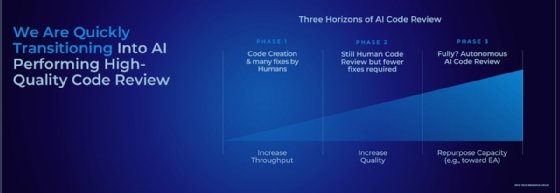
Most AI-generated code requires human oversight. Companies are moving to various levels of human oversight and AI coding. Leading software companies have figured out how to create AI-generated code more quickly and accurately. The three-model horizon shows that eventually humans may be taken out of the review process, and companies can deploy this talent in other areas.
This chart shows the coding review cycle and how some companies can remove human review from AI-generated code review.
Hype 5: IT is doomed
Info-Tech believes the opposite of this statement.
"We believe this is actually IT's moment to step up to lead the organization," said Zehren.
He went on to say that businesses have entered a new era -- the era of autonomization, where IT can take the stage and get out of the "pull mode." IT can get into "push mode" because they understand the technology best and transform from an organizational partner to an organizational leader.
Agentic AI is a super trend. However, several survey respondents were bullish on AI. According to Info-Tech's study, 46% say AI will be absolutely transformative. Leaders need to become a "CIO-yes AND" rather than a "CIO-no," which means managing AI strategy separately. It needs to be governed. The "and" is important when saying yes to address security, AI-ready data, architecture and other risks of AI.
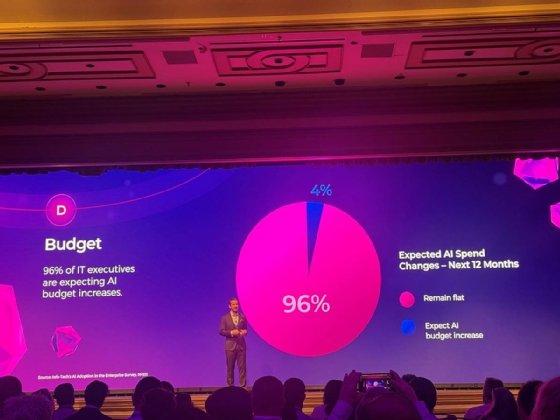
Budgets will need to be increased -- possibly 25% or more, according to Zehren. Partnerships need to be examined as most companies will choose to buy over build due to talent and time constraints.
Implementing an agentic IT framework without the hype
CIOs need to drive exponential value through technology. IT demands have typically outpaced supply. AI is changing that. To implement AI or other automated programs, departments need to understand the business workflow and the technology. The goal is to create more employees who understand both concepts to get to the value part, said Zehren.
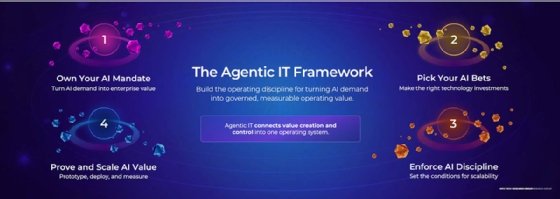
He added that the biggest bottleneck for organizations to realize AI value is the understanding of the workflows to deploy the technology against. He said that IT leaders need to work through these four steps below to realize the value of agentic IT.
This chart outlines the steps IT leaders should take to lead their organizations in implementing agentic IT.
Amanda Hetler is a senior editor and writer for Informa TechTarget, covering IT strategy and CIO topics, including AI, security and risk management, and digital transformation.