Getty Images/iStockphoto
How AI-powered learning affects the IT skills gap
While AI helped create the current IT skills gap, AI-powered learning can also shrink it. The right tools can help IT leaders improve skills development and anticipate challenges.

All too often, organizations view skills development as both a time sink and a cost center. The reality is far different.
Maintaining a skilled and knowledgeable IT staff is a strategic imperative, and failing to treat it as such is a business risk. Business agility is directly tied to digital transformation, AI adoption and cybersecurity readiness. AI is a critical tool in this process and a board-level concern.
Traditional approaches to skills development fail to keep pace with modern IT advances. Legacy practices quickly show their limitations, including the following:
- Classroom training. This approach is often stagnant, generic, expensive and time-consuming.
- Static learning management system content. LMS content is limited and becomes outdated quickly.
- Vendor-level certifications. This approach fails to recognize the tightly integrated hybrid nature of today's IT landscapes.
Instead, digital skills training must be continuous and adaptive, just like real-world IT environments.
Organizations that effectively use AI-powered learning platforms as standard skills-development tools can excel. So, how do IT leaders position their businesses for success?
The current state of the IT skills gap
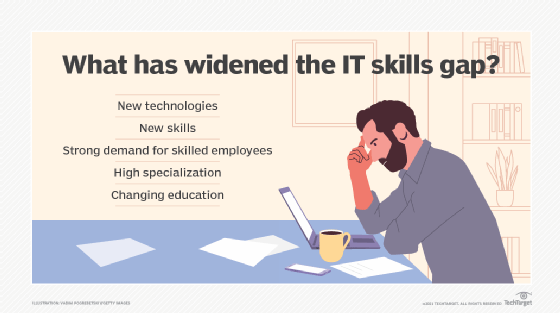
Today's IT skills gap is a widening chasm between the skills businesses need to operate and innovate and the capabilities workforces currently possess. Additionally, this era of AI, cloud computing and extensive cybersecurity threats has exacerbated the skills gap. It presents an existential threat to organizations that fail to adapt.
Some high-demand skills for this era include the following:
- AI and machine learning, including generative AI (GenAI).
- Data engineering, analytics and big data.
- Cloud and hybrid architecture and platform engineering.
- Cybersecurity and information assurance.
- DevOps, site reliability engineering and automation.
- Software engineering and full-stack development.
While this list varies by organization and industry, it consistently focuses on large-scale, cloud-based and AI-integrated skills. It also emphasizes all aspects of cybersecurity, including compliance, risk management and privacy.
The skills gap manifests as a growing lag between technology adoption cycles, hindering business agility and competitive advantage in a rapidly evolving market. This gap makes workforce readiness and skills validation challenging, but they are essential for success.
Traditional, one-size-fits-all training programs exhibit significant limitations, including the following:
- Generic curricula that only delve into basic configuration options.
- Low participant engagement and satisfaction.
- Poor knowledge retention.
- Minimal alignment of training topics with business outcomes.
These programs can develop generic, foundational skills, but they cannot address the broader, environment-specific needs of modern businesses.
Much like the DevOps concept of continuous integration/continuous deployment, skills development and maintenance are ongoing tasks that reflect the IT industry's innovative and agile nature. Overall, the skills gap is a structural challenge, not a temporary one.
What is AI-powered learning?
AI-powered learning offers continuous skills assessments, personalized learning and improved alignment with defined business outcomes to avoid static, unfocused training. These platforms dynamically adapt to each learner and align with the organization's evolving skills requirements. They also offer continuous feedback loops, ensuring alignment, progress and skills applicability.
AI-powered learning platforms can manage training. Understanding these tools -- and their role in narrowing the skills gap -- makes implementation more effective.
Components of these tools include the following:
- Learning management system. The LMS is designed for learning administration, compliance, and content tracking to show who completed which training.
- Learning experience platform. The LXP curates training content from multiple sources, making it available to learners while retaining a high degree of self-direction.
- AI-powered or adaptive learning platforms. These tools proactively identify skills gaps, offer insights into workforce readiness and recommend next steps.
Some businesses may use all three platforms for different aspects of their skills development plans.
AI-based learning ingests training activity, assessment results, role requirements and business objectives. Expect the platform to offer extensive feedback based on these results, and make sure the input aligns with compliance regulations and business goals.
Analytics for these tools typically include the following:
- Behavioral data.
- Performance data.
- Business and role-based context.
These results enable real-time adjustments, system improvements and data-driven decision-making.
How AI-powered learning is changing skills development
For CIOs to understand the advantages of AI-based learning, they must recognize the necessary changes to how their businesses approach learning. Following that, they can define expected business outcomes and identify potential challenges. A successful and scalable AI-powered learning platform requires deliberation, governance and integration.
Core transformation
Start with specific transformations to core skills development approaches. These include the following:
- Personalized learning paths. Tailored by role, skill level, performance and career goals to ensure targeted development.
- Real-time analysis of strengths and weaknesses. Continuous measurement of staff capabilities and predictive planning that aligns with upcoming initiatives and technology roadmaps.
- Improved onboarding and continuous upskilling. Targets new hires to reduce time-to-productivity and integrates learning into daily tasks.
Organizational benefits
A carefully integrated and well-governed learning system with AI capabilities offers organizations multiple benefits, including the following:
- Alignment between business strategy and IT talent.
- Increased retention through career growth and satisfaction.
- Resilient teams that can adapt to evolving technology and business opportunities.
A dynamic, effective learning platform can support an organization's overall strategy and well-being.
Challenges and risks
No new technology is without its risks, so a realistic plan includes addressing the following potential challenges:
- Data quality and bias. Poor inputs lead to flawed recommendations, especially early in the process.
- Integration. IT teams may struggle to connect AI learning platforms to existing LMS, HR and IT systems.
- Privacy and functionality concerns. Employees may worry about privacy and transparency regarding personal data and training results.
AI-powered learning offers effective upskilling at scale, but it requires organizational discipline and careful integration.
The skills gap that AI created
Users already take advantage of GenAI tools -- for example, ChatGPT, Perplexity and Claude -- which has led to accelerated adoption before organizations could offer training. This phenomenon led to a new skills gap: AI usability in the workplace.
Issues include the following:
- Working with AI tools effectively in specific job roles.
- Establishing prompt, validation and human-in-the-loop best practices.
- Creating efficient and compliant coding workflows in AI-assisted development.
- Conceptual and practical understanding of AI system functionality.
AI continues to close some skills gaps while simultaneously opening others. The growing availability of specialized AI tools and the delayed development of AI literacy and responsible use threaten to make organizations deploy AI tools that supporting personnel cannot administer effectively.
What IT leaders should do next
AI-powered learning platforms let organizations breathe new life into IT reskilling, upskilling and onboarding. However, they must establish AI-driven training as a strategic infrastructure investment rather than an add-on to HR or IT budgets.
Specific recommendations include the following:
- Prioritize platforms that support adaptive learning, skills intelligence and AI-driven analytics.
- Establish governance policies that define data usage, privacy, bias mitigation and business outcome alignment.
- Encourage a culture of continuous digital skills training that places learning opportunities into standard workflows and includes executive visibility.
Closing the IT skills gap requires more than AI-based technology. It needs executive leadership and participation.
Wrap up: From skills shortage to skills strategy
The IT skills gap is persistent, ever-evolving and dependent on both new technologies and changes in business direction. AI capabilities strengthen skills development, so IT workers can respond to changing conditions.
AI-based adaptive learning platforms can help organizations do the following:
- Move faster when adopting new technologies or business opportunities.
- Reduce risk in skills development.
- Build IT teams ready for emerging technologies.
- Onboard and retain IT team members for greater efficiency and less turnover.
The IT skills gap will not close on its own, and it cannot be solved with legacy training approaches. Business leaders who treat AI-powered learning as a strategic capability will position their organizations to build resilient teams, accelerate innovation and compete in an AI-driven market.
The time to modernize the skills development and technical capabilities of IT teams is now.
Damon Garn owns Cogspinner Coaction and provides freelance IT writing and editing services. He has written multiple CompTIA study guides, including the Linux+, Cloud Essentials+ and Server+ guides, and contributes extensively to TechTarget Editorial, The New Stack and CompTIA Blogs.
Dig Deeper on Upskilling & Certifications
-
![]()
Continuous IT learning in the age of AI, cloud and automation
By: Damon Garn
-
![]()
Study finds two hours a week could close the AI skills gap
By: Alison Roller
-
![]()
AI workforce training: How BDO USA trains its employees
By: Tim Murphy
-
![]()
Gap between upskilling intent and execution in business, says Pluralsight
By: Clare McDonald