How to ensure AI transparency, explainability and trust
Transparency, explainability and trust are critical for enterprise AI. Learn how organizations can embed these principles to build accountable, ethical and reliable systems.
Once a back-office tool, AI now drives critical decisions across businesses. However, technical prowess doesn't directly translate to trustworthy products. A joint report by SAS and IDC surveying over 2,300 global leaders revealed a striking gap: While 78% of organizations claim to trust AI, only 40% have invested in making those systems truly trustworthy by implementing safeguards.
This gap between perceived trust and accountability has consequences. Limited transparency into how AI systems are built and governed leaves organizations blind to the mechanisms driving decisions. Moreover, when AI delivers decisions without explaining how it reached them, hidden biases and operational risks can go undetected, eroding trust over time. Large language models (LLMs) trained on massive, uncurated data sets often make this opacity unavoidable.
Alex Lisle, CTO of Reality Defender, a cybersecurity company that detects deepfakes and AI-generated content, noted that LLMs' fluent outputs create an illusion of understanding, making them appear more human and reliable than they are.
This reality is reshaping how today's C-suite defines AI success. Accuracy and speed of AI models remain important, but they're no longer enough. Success now hinges on three core principles that determine whether AI can be trusted in practice:
Transparency provides visibility into how AI systems are designed, trained, deployed and governed.
Explainability enables humans to understand and defend individual AI-driven outcomes.
Trust emerges only when transparency and explainability are sustained over time through accountability and oversight.
For executives, these principles are far from abstract. They directly determine whether AI initiatives can scale, withstand regulatory scrutiny and earn acceptance across the business.
The need for transparency, explainability and trust in AI
Transparency, explainability and trust are often grouped under the banner of responsible AI, but they play distinct roles in enterprise systems. Confusing them can create false confidence in systems.
These distinctions matter because organizations often equate these concepts with model performance and accuracy, assuming strong model results serve as a proxy for trust, said Pranav Dalal, CEO and founder of Office Beacon LLC, a global remote staffing provider.
"In reality, trust comes from understanding and ownership, not just accuracy," he said.
In reality, trust comes from understanding and ownership, not just accuracy.
Pranav DalalCEO and founder, Office Beacon LLC
With that distinction in mind, transparency becomes the starting point. It offers visibility into how AI systems are designed, trained, deployed and governed across their lifecycle -- including where outputs surface in daily workflows and what assumptions shape them. Transparency goes beyond documentation, requiring insight into how systems behave in practice and the quality of the data that feeds them.
Without this level of visibility, leaders often find themselves unable to answer even basic questions when an automated decision is challenged, Dalal said.
However, even when AI systems are transparent, their decisions can still be hard to explain, making it unclear why a specific outcome occurred. Many AI systems operate as black boxes, meaning their internal workings -- how inputs are transformed into outputs -- aren't directly observable or understandable by humans. Consequently, tracing how an AI system makes a particular decision can be challenging.
"Any organization relying on black box models for non-trivial decisions without human supervision is operating at the edge of explainability," Lisle said.
Explainability, therefore, builds on transparency by clarifying why a system produced a specific outcome. While transparency provides access to information, explainability translates that information into usable insight. This capability is critical in high-stakes areas such as finance, healthcare, hiring and compliance, where decisions must be defensible.
Explainability can also help organizations define accountability. Ali Yilmaz, co-founder and CEO of Aitherapy, an AI-powered mental health support platform, warned that messy data pipelines, opaque AI systems and rapid iteration cycles make it nearly impossible to pinpoint who is responsible when AI goes wrong.
When accountability breaks down in this way, trust erodes quickly. Trust can't be engineered directly -- it's built over time through reliable performance, clear ownership and effective oversight. It takes hold when AI behaves predictably, risks are actively managed and organizations can clearly show who's responsible for automated decisions.
Together, transparency, explainability and trust shape an organization's ability to assess and manage AI risk, satisfy regulators and maintain confidence among stakeholders. Without these principles, AI initiatives often stall or quietly retreat from production.
Challenges in achieving transparency, explainability and trust
Despite growing awareness of their importance, achieving transparency, explainability and trust in AI systems remains a challenge. Modern AI technologies are powerful but complex, and the very features that make them effective often make them difficult to understand, govern and explain to stakeholders.
The biggest challenges organizations face are often structural rather than technical, said Vin Mitty, senior director of data science and AI at LegalShield, a legal services company. Many businesses don't clearly know what data their models use or where it comes from, and these knowledge gaps only worsen after deployment.
Transparency disappears once a model is live if no one monitors it, tracks changes or intervenes when it fails.
Vin MittySenior director of data science and AI, LegalShield
"Transparency disappears once a model is live if no one monitors it, tracks changes or intervenes when it fails," he said.
Key obstacles organizations face include the following:
AI system complexity. Advanced models, such as deep neural networks, analyze massive volumes of data but provide little insight into how they produce specific results. These systems often outperform simpler models, yet their lack of transparency makes it difficult for organizations to explain decisions, troubleshoot failures or justify outcomes. Lisle cautioned that even fine-tuned models remain far from deterministic, producing different answers to the same question and limiting accountability when outcomes are disputed.
Regulatory pressure. Governments are introducing AI-specific regulations, including the EU AI Act, NIST AI Risk Management Framework and ISO/IEC standards that demand transparency and human oversight. The EU AI Act, for example, requires organizations to document high-risk AI systems, explain automated decisions and demonstrate risk management controls. For businesses operating across multiple regions, keeping up with these rules can be difficult, especially when many legacy systems weren't built with explainability or auditability in mind.
Stakeholder concerns. Employees often worry that AI will replace jobs. Customers are sensitive to how their data is collected, used and shared, especially when AI decisions directly affect them. Business partners are paying closer attention to whether AI systems meet ethical standards, putting pressure on organizations to develop responsible AI practices. AI adoption often struggles when stakeholders cannot see clear safeguards.
Bias and fairness. AI models can produce biased outcomes when trained on skewed, incomplete or historically biased data. Bias often emerges after deployment, when AI systems interact with real-world data and decisions affect access to services or opportunities. Reducing AI bias requires continuous monitoring and clear ownership, not just one-time testing.
Organizational and cultural challenges. When teams work in silos with little input from legal, compliance or business leaders, organizations struggle to justify AI-driven decisions. When accountability is unclear, transparency and explainability efforts often become fragmented, reducing confidence both inside the business and among external stakeholders.
Data quality and governance challenges. Inconsistent, incomplete or poorly documented data limits visibility into how models are trained and why they behave as they do. Without strong data governance practices, even well-designed AI systems can produce unreliable results that are difficult to justify or audit.
Privacy-transparency tension. While transparency requires openness, visibility into training data can expose sensitive customer information or PII, discouraging organizations from offering complete insight into their AI systems. To address this, organizations must balance transparency with privacy-preserving techniques such as synthetic data or differential privacy, ensuring decisions can be explained without revealing underlying data.
Strategies for ensuring AI transparency, explainability and trust
Building successful AI systems requires more than powerful models. Organizations also need the right governance structures, cultural readiness and stakeholder alignment. Transparency, explainability and trust are interdependent and must be embedded across the AI lifecycle, from design and deployment to ongoing monitoring.
The following strategies offer practical steps for embedding each principle.
Strategies for ensuring transparency
Achieving transparency means making AI systems understandable and visible to all relevant stakeholders. "Transparency starts with knowing where the system is being used and what decisions it actually affects," Dalal said. That understanding, he added, extends to data sources, how the model was built and where its output surfaces in day-to-day work.
The following strategies can help organizations ensure transparency:
Open communication. Transparency begins with open communication. Organizations should clearly document how AI systems function, their intended purpose and the data they rely on. This includes model documentation, data lineage and decision boundaries, all of which help demystify AI behavior for both internal and external audiences.
Stakeholder understanding. Employees, customers and business partners should have a clear view of what AI systems can and cannot do. Setting realistic expectations about AI capabilities and limitations helps prevent misuse, overreliance and confidence erosion when systems behave unexpectedly.
Third-party audits. Third-party audits provide an additional layer of assurance. Independent assessments can validate the fairness, accuracy and reliability of AI systems, offering credibility that internal reviews alone might not achieve. These audits are increasingly valuable in regulated environments and in industries where transparency is a competitive differentiator.
Governance frameworks. Strong AI governance policies define accountability, establish oversight mechanisms and ensure transparency requirements are consistently applied throughout the AI lifecycle. Without governance, transparency efforts often remain inconsistent and difficult to sustain.
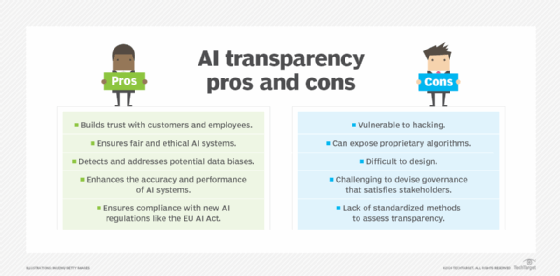
AI transparency can bring companies many benefits, but it is hard to achieve -- and there are tradeoffs.
Strategies for enhancing explainability
Explainability ensures that humans can interpret, understand and justify AI decisions, giving stakeholders the clarity they need to trust AI. Explainability is the rationale behind an AI's output, Yilmaz said. It enables people to evaluate not just what a system decided, but why it reached that conclusion.
The following strategies can help organizations enhance explainability in their AI models:
Interpretable models. Where possible, organizations should favor simpler, interpretable models that make decision logic easier to understand. While complex models might offer higher performance in some cases, they're not always appropriate, especially in high-stakes or regulated use cases.
Post-hoc explainability tools. For more complex systems, post-hoc explainability tools play a critical role. Techniques such as SHAP, LIME and other explainable AI frameworks help surface the factors driving specific outcomes, translating complex algorithms into insights that humans can evaluate and challenge.
Education and training. Employees and stakeholders need the skills to interpret AI outputs and understand their implications. Training programs focused on AI literacy can help non-technical users ask better questions, spot anomalies and participate more effectively in decision-making.
Algorithmic drift and monitoring. Maintaining explainability over time requires ongoing monitoring for algorithmic drift. As data changes and models evolve, explanations can degrade alongside accuracy. Real-time dashboards that track explainability metrics, model behavior and performance enable organizations to identify when systems begin to diverge from expected behavior and intervene before trust is compromised.
Strategies for building trust
Trust is the cumulative result of ethical, transparent and explainable AI practices applied consistently over time. Trust grows when employees feel supported rather than displaced by AI. Building trust also requires keeping humans in control of high-impact decisions and creating environments where employees can question or override AI outputs without fear of negative consequences.
The following strategies can help organizations foster and sustain confidence in their AI systems:
Long-term relationships. Trust begins when organizations consistently apply transparent and explainable AI practices. By demonstrating a commitment to clarity, accountability and ethical decision-making, organizations lay the foundation for stakeholder confidence, showing that AI systems are reliable and aligned with organizational values.
Ethical AI practices. Trust is built through consistent, responsible action. Systems should be designed, deployed and evaluated with fairness and accountability, ensuring AI outcomes are not only technically sound but also aligned with ethical values.
Earning trust internally. Employees are often the first to experience and question AI-driven changes. Their skepticism can signal gaps in communication or understanding. Organizations can build confidence by investing in AI literacy and demonstrating how AI systems augment the workforce rather than replace it.
Stakeholder engagement. Involving employees, customers and partners throughout the AI lifecycle through consultations, feedback loops and collaborative decision-making helps surface concerns early and strengthens accountability.
The future of building trust in an AI-driven world
In an increasingly AI-driven world, trust has become the goal most businesses strive for. Transparency and explainability are essential aspects, but they are not the end goal. What leaders ultimately seek is confidence that AI systems will behave predictably, align with organizational values and withstand scrutiny from regulators, customers, employees and partners.
"[Trust] must be designed into data governance, observability and lifecycle management from the start," said Bakul Banthia, co-founder of Tessell, a database-as-a-service platform. Organizations that take this approach gain an advantage not by deploying the most advanced models, but by building systems people can rely on consistently.
A design-first mindset is also changing how trust is evaluated. Yilmaz expects trust to evolve from aspiration to evidence. "Trust will move from marketing language to measurable standards, auditability, monitoring maturity, incident response and real accountability," he said. As AI becomes standard enterprise infrastructure, organizations will be judged less on test performance and more on their ability to prove systems behave responsibly.
Ultimately, trust is earned through predictable systems, explainable decisions and clear governance. Organizations that sustain these practices will scale AI successfully, while those that fail to demonstrate trust risk scrutiny.
"In the coming years, the most successful companies won't be the ones with the most AI," Mitty said. "They'll be the ones that people trust."
Kinza Yasar is a technical writer for Informa TechTarget's AI and Emerging Tech group and has a background in computer networking.