Early AI enthusiasm centered on experimentation. Internal copilots, chatbots and agent pilots proliferated across departments. Some delivered visible value. Many did not.
Experimentation is not the same as operationalization.
As generative and agentic AI move from novelty into embedded enterprise workflows, a clearer pattern is emerging: AI becomes durable only when it is treated as infrastructure -- governed, measured, integrated and aligned with how work actually gets done.
That shift usually shows up in a handful of practical ways.
Experimentation must mature into accountable operating models
The venture-capital analogy shows up frequently in early AI deployments: Run many experiments, expect most to fail and count on a few breakthrough wins.
That logic might surface promising ideas, but it cannot govern live enterprise systems indefinitely. As AI begins to touch revenue workflows, customer interactions and compliance-bound processes, the tolerance for uncontrolled iteration shrinks.
Organizations are increasingly pairing experimentation with measurable value frameworks -- tracking quota attainment, productivity lift, support deflection or time compression. AI is no longer evaluated as novelty. It is evaluated as performance. That shift is what turns pilots into programs -- and programs into enterprise capability.
AI becomes durable only when it is treated as infrastructure -- governed, measured, integrated and aligned with how work actually gets done.
Governance is not a brake on AI -- it is the condition for scale
Highly regulated industries make this visible first, but the principle applies broadly. AI systems that influence claims handling, customer advice, financial outcomes or compliance-sensitive workflows must be governed from the outset -- not retrofitted after issues surface.
When governance is designed right out of the gate, enterprises can expand agentic use cases without creating compliance and trust failures that force rollback. It clarifies something deeper: governance is not simply about constraint. It provides the trust layer that allows AI to expand safely.
When organizations treat governance as an enabling layer -- tied to data management, validation and human oversight -- they make scale possible without creating risk that forces rollback.
Workforce redesign signals that AI has moved from tool to layer
When analysts predict that most enterprise workflows will be augmented by AI rather than replaced by it, the implication is structural.
AI becomes embedded in daily work -- not as a separate tool, but as a constant presence in development, sales, service and operations processes. That changes hiring, upskilling and role design. It also introduces enduring operational costs: reskilling, retraining and redesigning workflows around AI augmentation.
Reliable production infrastructure determines durability
Pilot AI can tolerate loose integration and imperfect data. Production AI cannot.
As organizations move beyond narrow deployments, AI stops behaving like a "tool" and becomes a dependency -- something other workflows rely on and assume will work consistently. That changes the infrastructure bar in three ways.
AI requires sturdier data pathways. In pilots, teams can manually curate sources, tolerate inconsistencies and patch errors. At scale, AI depends on repeatable access patterns: stable retrieval pipelines, consistent definitions and reliable refresh cycles. This is where earlier problems -- fragmented content, unclear ownership, mismatched schemas -- stop being background noise and start driving visible failure modes.
It also pushes lifecycle management into the foreground. Models drift. Prompts evolve. Retrieval sources change over time. Policies tighten. If there is no clear operating model for updates, testing and rollback, reliability erodes over time -- not necessarily at launch, but as usage expands and earlier architectural decisions begin to compound.
And in production, infrastructure must control how knowledge is accessed, tested and governed. It is not enough to "connect the data." The enterprise needs layers that control how AI accesses it, redacts sensitive information, enforces policy and creates repeatable workflows that can be tested.
This is why vendors that want AI to endure are building platform layers that treat data access, governance and orchestration as core capabilities -- not add-ons. When AI begins depending on an underlying content layer that is made visible, structured and policy-aware, reliability becomes achievable.
That is what production-grade AI looks like: not just a smarter model, but a more disciplined environment. Durable AI behaves like an operational system -- monitored, updated and remediated through defined lifecycle processes.
When a zero-copy data layer makes enterprise content visible and accessible for AI workflows, it signals a shift from AI experimentation toward AI operationalization -- because the organization is building an environment that assumes AI will persist.
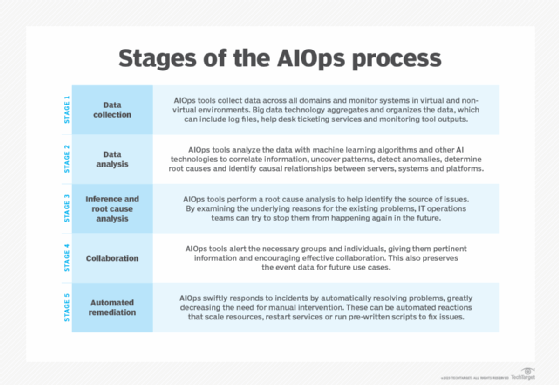
Enterprise AI durability depends on lifecycle discipline across data, analysis, remediation and collaboration -- not just model capability.
Shared discipline minimizes fragmentation before interoperability begins
It is tempting to jump straight to interoperability and orchestration -- but the durability problem shows up earlier than that.
Before enterprises can coordinate agents across stacks, they must stop creating internal fragmentation inside their own AI programs: multiple tools doing overlapping work, inconsistent governance, uneven usage policies and duplicate experiments that cannot be compared.
Durability requires shared operating discipline across teams:
Shared evaluation criteria, or what counts as success.
Shared policy baselines, or what counts as safe.
Shared ownership models, or who maintains what after rollout.
Shared escalation paths, or what happens when AI fails.
This is the step that reduces chaos before any cross-vendor orchestration is even realistic. And it is also where many organizations begin moving from "innovation pockets" to consolidated programs -- because they realize that AI adoption, once it expands, becomes infrastructure, whether they intend it to or not.
A continuous funnel of AI experiments paired with explicit value metrics is not just a strategy for discovering wins. It becomes the mechanism enterprises use to prevent internal AI sprawl from turning into permanent fragmentation.
The Experimentation Paradox
A common narrative in AI discourse is to experiment broadly, fail often and let the best use cases rise.
In sandboxed environments, that mindset can generate learning. But enterprise AI does not operate in isolation. It touches live data, regulated workflows and customer relationships.
Responsible organizations do not bypass governance to discover value. They build controlled experimentation environments, measure rigorously and promote only validated systems into production.
Exploration may spark adoption. But discipline is what sustains it.
Across experimentation, governance, workforce redesign and infrastructure readiness, a consistent lesson emerges. Durability depends on operationalization.
Earlier briefs in this series established that foundation, architecture and governance must precede intelligence. This brief extends that logic: Once AI is embedded, it must be sustained -- measured, governed and structurally integrated into work itself.
The next threshold is harder -- and more architectural.
As enterprises move from internal discipline to cross-platform coordination, they will need shared context, standards and orchestration that prevent AI from becoming a new source of fragmentation.
At scale, coordination across agents, systems and vendors becomes the defining operational constraint.
James Alan Miller is a veteran technology editor and writer who leads Informa TechTarget's Enterprise Software group. He oversees coverage of ERP & Supply Chain, HR Software, Customer Experience, Communications & Collaboration and End-User Computing topics.