4 structural foundations of reliable enterprise AI
Enterprise AI reliability is shaped less by model advances and more by structural alignment. Integration, process logic and visibility determine whether AI can scale.
Much of the discussion around generative AI reliability centers on hallucination -- the tendency of large language models to generate confident but incorrect responses. The explanation is often technical: model limitations, insufficient training data or poor input quality.
In enterprise environments, however, hallucination frequently signals something deeper. AI systems do not operate in isolation. They sit inside ERP platforms, HR systems, analytics environments and customer applications. When outputs are unreliable, the cause is often structural fragmentation -- inconsistent data definitions, unresolved integration work or insufficient visibility into system behavior.
Intelligence reflects the environment in which it operates, and reliability depends as much on how well systems line up as on model sophistication.
That distinction becomes more visible in operational settings, where AI is expected to function inside systems that were not originally designed for probabilistic decision-making. This is where the conversation tends to shift.
In those environments, reliability is rarely a problem confined to the model alone.
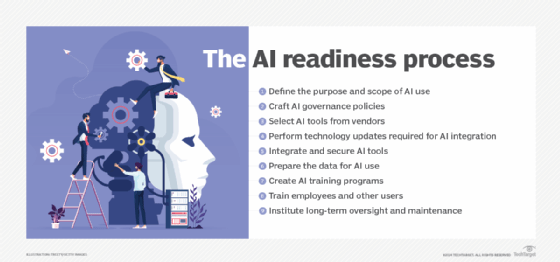
AI reliability depends on structural readiness -- from governance and data preparation to integration and long-term oversight.
Integration discipline determines AI reliability
Enterprise systems rarely fail because the software is incapable. More often, things break because the pieces do not line up the way people assumed they would. The same pattern shows up with AI.
At the pilot stage, those gaps are easy to miss. The demo works. The model responds. But the integration work underneath -- across ERP platforms, HR systems, analytics environments and emerging generative AI (GenAI) tools -- is usually still incomplete. That work shapes outcomes long before anyone declares deployment finished.
Enterprise integration rollout challenges emerge early and continue compounding over time, influencing planning, ownership and sequencing before systems even go live.
As GenAI tools expand beyond isolated pilots and begin functioning as shared infrastructure, fragmentation becomes visible. Different departments adopt different models, data definitions begin to diverge and governance standards shift across teams. Hallucination in this context is often the surface symptom of systems not built to work together.
System-to-system data flows, application connectivity, operational ownership, policy enforcement and lifecycle maintenance are foundational requirements. Together, they shape whether AI behaves predictably over time. Without them, AI operates across gaps in definition and accountability.
Industry process models constrain AI before it scales
Teams often assume that if the data is cleaner, AI will behave more reliably. In practice, that assumption quickly breaks down. Predictable behavior usually depends on the structure surrounding the data -- the business logic, sequencing rules and process boundaries that determine what the system is allowed to do.
In environments where industry-specific process models developed over years of standard business practices keep AI agents from straying beyond compliance guardrails, reliability improves not because models are more creative, but because their behavior is constrained by structured process rules.
Orchestration layers and middleware do not make AI more intelligent. Instead, they function as control infrastructure. They mediate access to data, enforce process guardrails and translate across incompatible systems.
In this context, autonomy remains conditional. Agents operate independently only within encoded process frameworks that reflect industry norms, regulatory requirements and operational sequencing.
Scaling AI across ERP landscapes depends less on deploying more agents than on embedding them within stable process models. In practice, that often slows expansion more than model limitations do.
That reality often surprises teams who expected scaling to be primarily a modeling challenge.
Legacy architecture and data readiness determine scalability
Even when integration improves and domain models constrain behavior, AI cannot scale effectively if the underlying architecture is misaligned with modern requirements.
Many organizations discover that legacy infrastructure might not be well-suited for AI integration, particularly as AI systems are embedded more deeply into operational workflows.
This is more than a data-cleaning issue. Legacy systems often define entities differently, rely on rigid schemas, or depend on brittle connectors that were never designed to support prediction-driven systems. When AI is layered onto that foundation, reliability depends on whether the architecture can support predictive, context-driven execution.
In practice, that can look like reconciling conflicting customer IDs across CRM and ERP systems before an AI-driven recommendation engine can operate reliably. The model may be capable, but the identifiers still must match.
As AI moves from experimentation into operational infrastructure, scaling exposes architectural weaknesses that were previously manageable. Data availability and quality become structural concerns rather than tactical ones. Whether AI scales often comes down to the condition of the systems it runs on.
Observability and control surfaces shape how AI expands
As AI agents become embedded across enterprise systems, reliability increasingly depends on something more basic: whether anyone can actually see how those systems behave.
The shift away from AI operating as a black box toward environments where agent observability dashboards expose latency, error rates and escalation patterns reflects a broader architectural requirement: enterprises must be able to see how AI interacts with data and workflows before expanding its role.
These control surfaces are instrumentation layers. They are rarely glamorous. They are necessary anyway. They provide insight into system performance, enable refinement and prevent silent drift. Without visibility into how agents perform -- and where they fail -- scaling introduces opacity rather than efficiency.
Integration aligns systems. Process models constrain behavior. Observability keeps expansion from drifting.
What structural feedback loops mean for enterprise AI
AI performance does not improve simply because models get smarter; it improves when enterprises can see how those models behave inside real systems.
In practical terms, a structural feedback loop typically unfolds in stages:
An AI agent performs a task.
The system records what data it accessed, how long it took and whether errors occurred.
Performance metrics are reviewed and failure points are identified.
Configurations or guardrails are adjusted.
The agent performs again under refined conditions.
The cycle repeats as conditions change.
Without visibility into latency, error rates and escalation patterns, drift compounds silently. Observability tools are more than dashboards; they function as structural control surfaces. They allow enterprises to manage AI as infrastructure rather than as an experiment.
Feedback loops do not limit intelligence. They keep it from drifting as scale increases.
Across integration discipline, domain constraint, whether the systems can actually support it and structural visibility, a pattern becomes difficult to ignore: AI reliability tends to follow enterprise structure.
AI reliability tends to follow enterprise structure.
Hallucination, drift and rework are rarely isolated model failures. They are usually signs that intelligence has been layered onto systems that were not fully aligned, instrumented or modernized for probabilistic decision-making.
Enterprises that prioritize structural alignment tend to expand AI with greater confidence. When the order is reversed, teams often find themselves circling back to foundational work after deployment -- sometimes under pressure.
Structural readiness, however, does not resolve every constraint. As AI becomes embedded in customer-facing processes and operational decision-making, questions of oversight, accountability and institutional control begin to surface.
Structure may come first. Governance determines how far intelligence is allowed to extend.
James Alan Miller is a veteran technology editor and writer who leads Informa TechTarget's Enterprise Software group. He oversees coverage of ERP & Supply Chain, HR Software, Customer Experience, Communications & Collaboration and End-User Computing topics.