Enterprise AI may move fast, but institutional accountability does not. Governance and structural alignment determine how safely AI expands into customer-facing systems.
Enterprise AI maturity is not defined solely by model capability. As organizations move from experimentation to embedded deployment, governance architecture becomes the defining constraint.
Autonomy introduces risk. Scale increases coordination pressure. Operational reliance, in turn, expands accountability requirements well beyond early use cases.
The progression from experimentation to structural dependency changes how AI must be governed.
Regulated environments anchor AI accountability early
In highly regulated industries, governance precedes experimentation. Enterprises in finance, insurance and other compliance-driven sectors cannot deploy AI without first defining oversight boundaries.
Human-in-the-loop controls, model validation against operational processes and explicit governance planning become structural requirements rather than best practices.
In these environments, AI is not deployed simply because it is capable. It is deployed when it can be governed.
Risk tolerance defines deployment boundaries
Governance is not abstract caution. It is a formal assessment of exposure. As AI agents interact with finance, HR, supply chain, and customer systems, enterprises evaluate which data is exposed, which models are appropriate and how validation occurs before expanding autonomy.
Platforms now include trust and security frameworks alongside validation and testing tools to verify AI-driven workflows.
Even with those controls, questions of explainability, bias and regulatory compliance persist. Autonomy becomes a risk decision, not merely a technical one.
The progression from experimentation to structural dependency changes how AI must be governed.
Human oversight becomes structural, not optional
As AI becomes embedded in core workflows, human involvement does not disappear. It formalizes.
Organizations are introducing new supervisory and support roles because intelligent systems operating at scale require monitoring, training and refinement. The intelligence of the model does not eliminate the need for structured oversight.
This shift is visible in environments where AI deployment creates new support roles, such as orchestrators, trainers and CX data analysts who guide, monitor and refine agent behavior.
AI can process information at scale, but judgment, ambiguity resolution and accountability remain human functions. Oversight becomes embedded in the operating model itself.
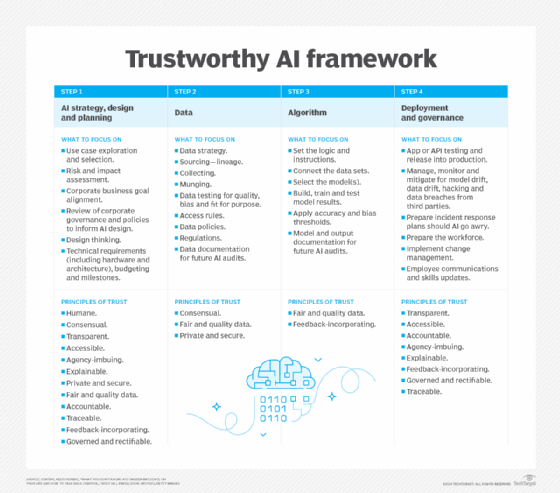
Enterprise AI governance frameworks align strategy, data, model design and deployment controls to ensure reliability at scale.
Governance strain increases as agents multiply
The governance burden compounds as agents expand across applications. A single contained deployment presents manageable oversight requirements. But as enterprises introduce copilots, autonomous task agents and cross-platform automation, coordination complexity increases sharply.
Vendors now offer tools designed to orchestrate agent teams -- including those built by other providers -- while enforcing guardrails and safety controls. This shift is evident in platforms that support AI orchestration and agentic interoperability standards, allowing multiple agents to coordinate across CRM, service, billing and other enterprise applications.
At this stage, governance shifts from supervising one model to coordinating ecosystems of agents.
Shared context and interoperability become prerequisites for safe scale
As agents operate across dozens or hundreds of enterprise systems, shared context becomes critical.
Without standardized interfaces, dependency mapping and structured integration layers, autonomous systems risk triggering unintended downstream effects. Emerging platforms now include embedded configuration management databases that map enterprise assets and dependencies to determine the extent of incidents and perform root-cause analyses.
Interoperability standards are not simply innovation accelerators. They function as stabilizers. They enable multiple agents to coordinate actions while maintaining policy enforcement and structured data access.
Scale without shared standards increases fragility. Scale with structured interoperability enables sustainable autonomy.
Why emerging AI standards matter
As agentic systems expand, two standards are gaining traction:
• Agent2Agent (A2A). This enables agents from different vendors to coordinate actions and exchange context. • Model Context Protocol (MCP). This governs how agents access structured enterprise data safely.
These standards function as control layers, not performance enhancements. They establish rules for interaction, data exposure and policy enforcement across heterogeneous environments.
Without shared standards, interoperability becomes bespoke integration work. With them, enterprises can coordinate multi-agent systems without sacrificing governance discipline.
Standards will not eliminate complexity. But they reduce the fragility that accompanies scale.
As AI capability advances, governance architecture becomes the true differentiator between experimentation and sustainable deployment.
Regulated accountability, risk-defined boundaries, embedded human oversight and multi-agent coordination pressures all point to the same conclusion: AI maturity increases structural responsibility.
The question is no longer whether AI can perform tasks autonomously. It is whether organizations are prepared to sustain the governance, oversight and interoperability layers that autonomy requires.
The next phase of enterprise AI adoption shifts from capability to endurance -- the operational and organizational commitments required to keep intelligent systems reliable over time.
James Alan Miller is a veteran technology editor and writer who leads Informa TechTarget's Enterprise Software group. He oversees coverage of ERP & Supply Chain, HR Software, Customer Experience, Communications & Collaboration and End-User Computing topics.