Enterprise AI does not scale through experimentation alone. It requires structural integration, governance enforcement and disciplined architectural alignment.
Artificial intelligence is advancing quickly, while enterprise adoption is unfolding much more slowly. Most companies are not ripping out core systems or redesigning operations in one sweep. Instead, AI is finding narrow openings inside procurement workflows, alongside ERP upgrades, within HR platforms and across customer service environments, typically one narrow use case at a time.
Across industries, AI tends to work best when it is inserted into existing systems rather than positioned as a wholesale replacement. In narrow use cases – such as spend classification, underwriting documentation, internal knowledge retrieval or help desk automation -- it strengthens workflows that are already in place. Those deployments often avoid dramatic architectural change, but they still require integration work that sits behind the scenes and is rarely visible in the marketing narrative.
Procurement shows this clearly. When AI in procurement is applied within established sourcing processes, it can improve supplier information and reinforce governance. When it is positioned as a replacement for those processes, results tend to be far less predictable -- and sometimes harder to unwind than expected.
In these early deployments, workflow compatibility often matters more than raw model capability.
Architecture shapes AI reliability
Sustainable deployments are influenced more by architectural compatibility than by model sophistication.
Enterprise systems are layered and interdependent in ways that do not fully reveal themselves until change begins. ERP environments encode financial controls, compliance sequencing and operational logic built up over years of customization. When modernization efforts start, those dependencies surface quickly. It is common for ERP rollout timelines to absorb unresolved integration work long before new capabilities actually go live.
AI must work within those realities rather than being treated as a clean overlay added after the fact.
Payroll timing cycles, benefits eligibility logic and compliance reporting requirements define where automation can operate safely and where it cannot. Those constraints live inside workflow sequencing and system dependencies. They are not abstract policy issues; they are operational mechanics.
HR platforms carry regulatory obligations and workforce data structures that shape how decisions are executed. As vendors introduce embedded AI capabilities into these systems, leaders are reminded that HR technology strategy cannot revolve solely around feature expansion. Integration discipline and enforceable governance become central. These dependencies are not theoretical -- they determine whether automation behaves predictably under real conditions.
It is easier to talk about model improvement than integration debt. Most roadmaps emphasize capability. Compatibility receives less attention.
When integration work is deferred, problems do not wait politely. Ownership ambiguities, inconsistent data definitions and governance gaps start shaping outcomes before automation is even introduced. AI does not create those weaknesses. It exposes them.
AI does not create those weaknesses. It exposes them.
AI as a structural stress test
In most enterprise environments, AI performance is shaped more by the surrounding conditions than by incremental improvements in model capability. Fragmented data, inconsistent schemas and legacy integrations that were tolerable at a human pace can become destabilizing once automation accelerates decision-making and reduces the margin for error.
This becomes especially visible in supply chain environments. Predictive optimization may improve at the model level, but it still runs into structural realities. Legacy infrastructure and uneven data availability do not disappear as models advance. They become more visible as AI is embedded deeper into planning and execution systems.
The observation that legacy infrastructure might not be well-suited for AI integration is not a minor caveat. It reflects a structural constraint that surfaces repeatedly when organizations attempt to operationalize AI within existing environments.
At this stage, AI does not resemble a sweeping revolution. It feels more like a stress test -- sometimes an uncomfortable one. Under that pressure, architectural debt becomes visible. Governance inconsistencies surface. What looked manageable at a slower pace can become brittle once automation is introduced.
That diagnostic role helps explain why narrow use cases tend to succeed first -- not because they are inherently superior, but because they expose fewer dependencies at once. When deployments stay contained, organizations can validate data quality, access controls and process alignment before attempting broader scale.
Moving from contained deployments to enterprise-scale AI requires disciplined integration planning and coordinated governance -- themes explored further in the discussion below.
From containment to operational discipline
As AI moves from experimentation into operational systems, the internal tone shifts. Curiosity gives way to accountability. Monitoring can no longer be occasional; performance must be measured against defined outcomes, and access controls must adapt to changing context rather than rely on static configurations.
What begins as augmentation gradually embeds itself into core workflows and inherits the same reliability expectations as those applied to financial systems, payroll processing and customer data management.
Once AI routinely drafts documentation, summarizes transactions, recommends actions and initiates workflows, it no longer behaves like a peripheral tool. It begins functioning as an operating layer, whether organizations formally acknowledge that shift or not. Even if only a minority of tasks are fully automated, most may be augmented.
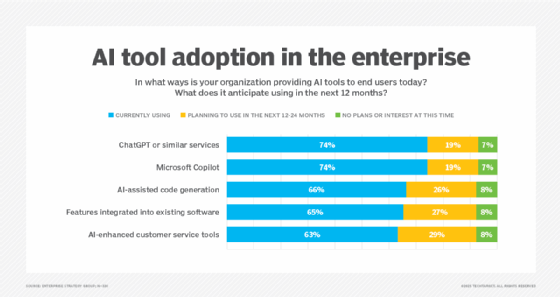
Enterprise AI tools are widely used, but most deployments remain embedded within existing systems rather than replacing them outright.
As decisions move faster, tolerance for inconsistency narrows and accountability structures tighten -- even as oversight requirements expand and skill expectations shift across the enterprise.
In a claims environment, that might mean approvals moving in minutes instead of days. In HR, it might mean automated eligibility decisions affecting thousands of employees at once.
At that point, integration cannot remain ad hoc. It becomes embedded in the operating model itself. Governance cannot live in policy documents alone; it must be wired into the systems where decisions are actually executed.
Observability shifts from troubleshooting toward ongoing operational oversight. Workforce roles move more toward supervision and exception management. Vendors, meanwhile, begin aligning -- unevenly in some cases -- around shared identity models, contextual enforcement requirements and workable interoperability standards.
That alignment is uneven and, in some cases, aspirational, but it reflects where scale eventually forces coordination.
Structural pressures beneath AI expansion
AI behaves differently once it moves beyond pilots. The tolerance for ambiguity narrows, sometimes faster than teams expect.
In early trials, gaps can be tolerated. In production, they can't. Performance expectations stop being implied and start being defined. Access controls need to be adjusted as situations change, not just when policies are updated.
When systems begin drafting documents, summarizing transactions or initiating workflows at scale, even small inconsistencies can ripple outward. Dependencies that once seemed loosely connected turn out to be tightly coupled.
At that point, careful integration work and embedded governance stop sounding strategic. They simply become part of the cost of operating safely.
Intelligence does not scale without structure
As AI moves from pilot efforts into production, ambiguity becomes less tolerable. Systems require defined performance thresholds, active oversight and access controls that adjust in context rather than by static rule.
When AI routinely drafts documentation, summarizes transactions and initiates workflows at scale, it no longer sits at the edge of operations. Even if only a minority of tasks are fully automated, most may be augmented. Decision velocity increases. Errors move faster through interconnected systems. Dependencies tighten. Accountability becomes harder to diffuse.
Under those conditions, integration stops being reactive and becomes part of how the enterprise functions day to day. Governance cannot rest on policy statements alone; it must be embedded directly into the technical environment where decisions are executed. That realization tends to arrive gradually, and usually after a few uncomfortable lessons.
Observability moves beyond troubleshooting into continuous oversight. Workforce roles tilt toward supervision and exception management. Vendors are beginning to align -- unevenly -- around shared identity models and contextual enforcement requirements.
Eventually, coordination across agents, systems and vendors becomes the defining constraint on safe scale -- and the place where early optimism tends to meet operational reality.
James Alan Miller is a veteran technology editor and writer who leads Informa TechTarget's Enterprise Software group. He oversees coverage of ERP & Supply Chain, HR Software, Customer Experience, Communications & Collaboration and End-User Computing topics.