10 AI business use cases that produce measurable ROI
When justifying their investments in AI deployments, business leaders know keeping up with the Joneses isn't enough without uncovering a positive ROI. Here's where to find it.

Despite rumblings in some quarters of an AI bubble, enterprise AI investments continue to rise. Large corporations are allocating millions of dollars to infrastructure that supports strategic AI use cases. While the scope and complexity of AI initiatives are expanding, there's limited visibility into how consistently these projects progress beyond the experimental and pilot stages to deliver measurable, long-term outcomes, namely ROI.
Many businesses are grappling with what Frederic Giron, vice president and senior research director at Forrester, calls the AI adoption paradox: "the disconnect between ubiquitous AI adoption at the individual level and the absence of transformational business impact at the organizational level."
Despite these challenges, AI adoption is now common in at least one core business function at 88% of companies, according to McKinsey & Company's "State of AI in 2025" survey. Many businesses are moving beyond task-oriented chatbots, based on generative AI (GenAI) to explore agentic AI. In these systems, AI agents can take actions and execute workflows with minimal human oversight. McKinsey's research indicated that 23% of respondents report expanding the adoption of agentic-based systems in at least one business function within their enterprise.
Business and technology decision-makers responsible for planning, purchasing, implementing and monetizing AI initiatives are under increasing pressure to deliver tangible business value from these investments. For AI initiatives, measurable gains often appear within 6 to 24 months for operational efficiency or cost reduction, while strategic advantages, such as competitive edge and speed to market, can take longer.
This article is part of
What is enterprise AI? A complete guide for businesses
Even with an estimated $30 billion to $40 billion in enterprise investment in GenAI, MIT researchers examining more than 300 public AI implementations found that the vast majority of initiatives have yet to show measurable profit and loss impact. Only 5% of the integrated AI pilots they studied generated millions of dollars in value. MIT's report "The GenAI Divide: The State of AI in Business 2025" also noted that nearly half of GenAI investments went to sales and marketing, even though back-office automation delivers stronger ROI. which reflects "easier metric attribution, not actual value, and keeps organizations focused on the wrong priorities."
Businesses increase failure and financial risks when they invest in AI projects without a clear use case or business value. Such investments include pilots that rely on short-term customer development models, poor and unstructured data, or transformational projects that take years to implement.
AI-driven applications producing ROI
Business use cases with the strongest ROI focus on automating repetitive tasks, improving decision-making through predictive analytics and personalizing customer experiences. AI applications that deliver the most measurable business value span customer service, IT operations, process automation, supply chain and inventory management, and financial planning. Here are 10 of the top enterprise AI use cases that more often produce measurable ROI.
1. Customer service automation
Many businesses have invested in AI to enhance customer experience and contact center operations, using AI-driven knowledge retrieval and chatbots to assist customers and reduce average handle times. Sentiment analysis, which uses AI models and natural language processing (NLP) to classify content as positive, negative or neutral, can further improve brand marketing and customer service across emails, tech support and social media channels. Measurable ROI is realized through lower support and crisis-management costs, faster issue resolution and reduced customer churn.
Customer operation use cases generally fall into two categories: proven AI and emerging AI, said Eric Buesing, a partner at McKinsey. Proven AI, he explained, shows high maturity and demonstrated value, while emerging AI has strong potential with measurable impact that's yet to be widely captured. Providing AI assistance to contact center and customer service agents is a proven use case with applications, such as pre-call history summaries, AI agent copilots that offer real-time guidance for cross-selling or upselling and automated post-call note taking.
"These are proven AI use cases that are starting to drive value," Buesing noted. "There are also operational improvements that are driving value like AI-powered workforce management. This goes beyond just looking at the incoming demand for calls, which is capacity management, to keeping that capacity throughout the day. When things happen -- a call volume spike or a site goes down because of weather -- how do they manage and maintain their use of agents? That is a great use case for AI."
2. Sales and marketing optimization
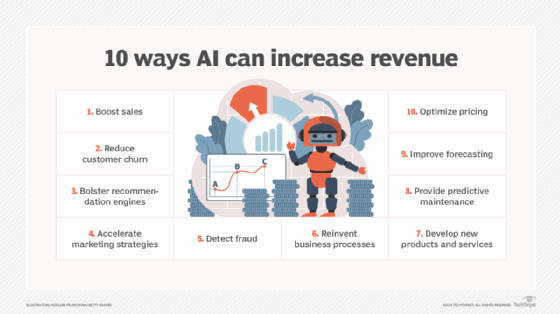
It's no surprise that many businesses prioritize AI initiatives aimed at increasing revenue, with sales and marketing accounting for about 50% of GenAI investments based on executives' estimates, according to MIT. Sales and marketing use cases include AI systems for lead scoring and prioritizing prospects most likely to convert; recommendation engines that enable personalized offers; and models that optimize marketing spend, channel allocation and pricing, especially in transaction-heavy and dynamic pricing environments.
Specifically, applications that directly influence purchasing decisions and reduce wasted effort yield the strongest ROI. Therefore, lead prioritization and customer retention, personalization, spend optimization and churn prediction typically outperform experimental or brand-only AI initiatives. MIT research also found "wins" in back-office deployments like automation, including companies using AI to limit business process outsourcing, lower agency spend and bring financial risk checks in-house rather than outsourcing risk management.
3. Personalized customer experiences
AI models help businesses segment customers and tailor experiences based on behaviors, purchases and interactions across channels. Common applications include recommendation engines driven by browsing or online purchase history, personalized content and offers, and dynamic pricing and upselling.
ROI is measured by quantifying incremental revenue and engagement improvements attributable to personalization, such as increases in conversion rates, average order value, customer lifetime value and retention relating to the cost of deploying and operating the AI models. Attribution is typically established through A/B testing or control group comparisons.
4. Predictive analytics
A mature enterprise AI application that predates GenAI, predictive analytics applies machine learning (ML) models and statistical techniques to real-time and historical data to forecast demand, risk and performance outcomes based on patterns across multiple data sources. The outputs typically include scores, forecasts and probability-based insights that support data-driven decision-making. Common applications include fraud prediction and credit scoring in financial services; predictive maintenance to reduce equipment failures in manufacturing and industrial environments; and customer analytics to anticipate buying behavior and predict customer churn.
The ROI for predictive analytics applications is measured by quantifying the business impact enabled through forecasts and scores, such as cost avoidance, revenue uplift and risk reduction relative to the total cost of deploying the models. Predictive analytics applications are typically built using established techniques like forecasting, regression and classification that tie directly to measurable business outcomes and quantifiable KPIs, including cost per transaction and fraud loss reduction. As a result, predictive analytics is often considered an ROI-positive AI investment, because its value is generally easier to quantify than that of many GenAI initiatives.
5. Predictive maintenance
AI-driven predictive maintenance uses ML to anticipate equipment failures before they occur. In industrial deployments, AI models are trained on historical sensor data, operational logs and maintenance records. By generating timely AI alerts, companies can schedule maintenance when needed, reducing unplanned downtime and production failures. Predictive maintenance also helps businesses limit unnecessary inspections, reduce labor costs, and improve safety and compliance.
ROI is calculated by comparing the cost of the AI implementation, including software, sensors, integration and training, with savings in reduced downtime, fewer emergency repairs, labor efficiency and extended asset life. In some industrial AI deployments, measurable ROI is demonstrated in 6 to 18 months.
6. Automating IT operations
At many companies, AI adoption first emerged in their IT operations. Today, businesses are increasingly integrating AI into IT workflows, including AI-powered service desks, automated ticket summarization and routing, and log analysis and anomaly detection. Quantifiable ROI metrics include labor cost reductions in areas such as ticket handling, provisioning, patching and monitoring; faster detection, resolution and remediation of incidents (mean time to resolution); and infrastructure and cloud cost optimization. The strongest ROI comes from automating high volume, repeatable, operational tasks and using AI-driven remediation to prevent incidents before users are impacted.
7. Document and workflow automation
AI models are increasingly being used for intelligent document processing, enabled by optical character recognition, NLP and vision models. These AI-powered systems can extract, classify and read data from documents with structured and unstructured data. Applications include resume screening, legal contract analysis, claims intake and healthcare authorizations.
Organizations often see the highest ROI in invoice and accounts payable automation, with measurable improvements, such as reductions in costs per invoice, shorter processing cycle times, lower error and exception rates, and reduced manual effort in full-time equivalent hours saved. Additional AI benefits are realized in claims processing cycle times and throughput, as well as in employee onboarding through faster document handling and workflow completion.
In highly regulated industries, the use of AI for autonomous decision-making, such as denying insurance claims, introduces compliance risks and must be carefully controlled. As a result, quantifiable ROI is typically measured through operational efficiency metrics, including cost savings, cycle time reduction, productivity gains and error reduction. The biggest gains come from automating high-volume, document-heavy processes with clear decision paths.
8. Software development
The adoption of AI for code generation, namely boilerplate code and refactoring, code review such as style violations and simple logic errors, and automated test generation and maintenance is transforming low-level development tasks. Businesses are evaluating whether these capabilities can reduce their development costs, accelerate release cycles, lower defect rates and deliver measurable ROI.
Cost reductions aren't automatic, however. Savings depend on adoption maturity, governance and whether AI outputs reduce rework or introduce new technical debt. ROI is highly context-dependent and varies by team size, codebase complexity and integration with existing DevOps pipelines. Organizations reported the highest cost-reduction benefits over the past 12 months were realized in individual AI software engineering, manufacturing and IT use cases, according to the McKinsey survey.
9. Supply chain and inventory management
AI-driven optimization of supply chains raises the question of whether AI models for demand forecasting, inventory placement, and transportation and logistics optimization can outperform traditional forecasting methods (time-series models) in complex, high variability environments. Potential AI benefits include reduced excess inventory and fewer stockouts with downstream impact on inventory levels, production and labor planning, and revenue performance.
ROI is measured in inventory carrying cost reductions driven by lower average inventory levels, as well as savings from reduced warehousing, insurance, obsolescence and shrink. Additional metrics include fewer out-of-stock events, higher service levels and improved fill rates. Best use cases encompass AI-based demand forecasting, inventory optimization, predictive replenishment and predicting supplier risks to cut disruption costs.
10. Fraud detection and risk management
ML algorithms have been used to detect anomalies and pattern deviations in financial services transactions since the mid-to-late 1990s. What has changed over the past several decades is the sophistication of the models -- and the threats themselves. AI-generated scams, including deep fakes, synthetic identities and sophisticated phishing attempts, are increasingly used to commit fraud. Adaptive, AI-powered detection systems can identify anomalies and stop potential threats in real time by using techniques like hybrid deep learning, behavioral biometrics and federated AI. ROI for these systems is measured by reduced fraud losses, lower false-positive rates, improved customer trust, and decreased compliance and operational costs.
Prioritizing AI projects and ROI
Wharton School's 2025 AI adoption survey "GenAI Fast-Tracks into the Enterprise" reported that 72% of the 800 U.S. executives surveyed are measuring ROI for GenAI investments, mainly through productivity gains and incremental profits. Investment levels vary widely: 23% of tier 1 enterprises surveyed are investing $20 million or more, while roughly two-thirds of companies, often smaller businesses, are investing $5 million or more. About three-fourths of respondents reported positive returns from GenAI functionality integrated into workflows in areas such as coding, writing and data analysis, but C-suite executives expressed a more positive outlook than middle managers. The survey also noted that 60% of enterprises now have a chief AI officer, either as a dedicated function or as an added responsibility to an existing role.
Barriers to AI persist, with security risks, operational complexity and inaccurate results topping many organizations' concerns, Wharton's findings revealed. As AI projects shift from experimental to operational, companies are also scrutinizing regulatory risk and compliance.
When prioritizing AI projects that produce measurable ROI, business and technology leaders face critical decisions, particularly whether to focus on efficiency, automation or growth through new products. AI adoption raises key strategic questions: How should organizations budget for AI? What are the true costs? Which skills and roles are needed? And how can AI initiatives move successfully beyond pilots?
Business strategies are shifting, McKinsey's Buesing said, "from buying the technology and finding a place where it works to looking at how work gets done today and where can large swaths of work be removed or assisted better with AI."
Kathleen Richards is a freelance journalist and industry veteran. She's a former features editor for TechTarget's Information Security magazine.