
putilov_denis - stock.adobe.com
Workday's new (old) CEO reveals Sana agentic AI updates
Doing work in Workday could become simpler with agentic AI.

One of the co-founders of Workday has returned as CEO, just in time to unveil the platform's agentic AI strategy.
Last month, Aneel Bhusri, CEO and board chair at Workday, replaced former Dell and Sequoia Capital exec Carl Eschenbach, who had served as CEO since 2022. Today, the company released agents built from Sana, an agent-building platform acquired last year.
"The world of the future is a hybrid world where the best of enterprise apps are paired with the best of AI," Bhusri said. "This gentrification of business means that low-level, rote work is going to get replaced by agents and drive the business processes underneath."
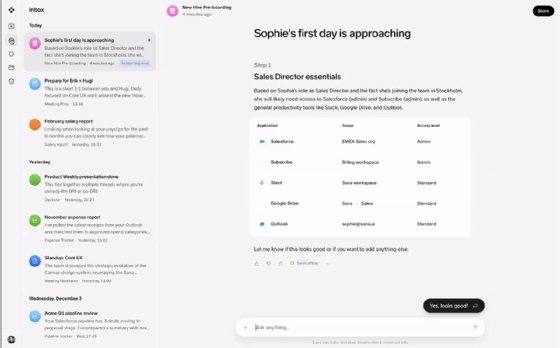
In press demos, Workday showed numerous prebuilt agents for tasks such as employee onboarding, expense reporting, contract intelligence, exit interview analysis, and performance review prep. Workday users can also build and configure their own agents in Sana. Also available are connectors to platforms including Microsoft SharePoint and Outlook, Google Drive and Calendar, Slack and Salesforce.
Independent analyst Josh Bersin said that the Sana agents dramatically upgrade the Workday interface and give users a more straightforward -- and less costly -- way to build apps. A Sana Enterprise license will extend the reach of Sana agents beyond Workday in new ways through its connectors to other enterprise apps.
"Companies have hidden Workday from their users and then built things on top of it because it's so complex," Bersin said. "[Agents] unleash the opportunity for companies and vendors to build apps to enhance Workday."
Moreover, Sana, as a company, brings AI know-how, models, and infrastructure to Workday that it didn't have before, which will benefit users building apps, third-party partners building agents, and Workday itself.
"A lot of the AI projects that Workday has been doing will now move over to Sana and be done in the Sana AI infrastructure," Bersin said. "That gives, I would think, all the other groups building AI agents in Workday a better tool set, more expertise and a more integrated platform to work on."
Workday vs. the 'SaaSpocalypse'
The agents could simplify the process of customization of the notoriously complex Workday platform to an individual company's workflows, Bersin said, bringing relief to users. That also brings up another topic on the minds of tech buyers nowadays -- the so-called SaaSpocalypse. The theory goes that prompt-based AI tools will eventually replace the current ecosystem of SaaS apps that comprise most enterprise IT stacks -- an idea that some industry observers question.
But the conversation raises questions such as, "How will the old guard survive challenges from AI upstarts such as OpenAI's OpenClaw and its competitors from LLM makers such as Anthropic?" or "When every company has a prompt for an interface, how will the SaaS vendors differentiate themselves?"
Gerrit Kazmaier, president of product and technology at Workday, said that while LLM vendors provide "great general-purpose reasoning," SaaS vendors won't differentiate on the prompt, but the data behind it.
"Our edge is that our AI runs on the richest, most trusted HR and finance data in the world, inside the system of record our customers already use to run their business," Kazmaier said. "That means when someone types a prompt into Workday, Sana understands who they are, what they're allowed to do, how HR and finance processes actually work, and what a compliant outcome looks like."
Combining probabilistic AI with deterministic HR and finance business processes makes platforms like Workday and its peers, such as SAP and Oracle, more powerful, Bhusri said. That is something that vibe-coded apps from scratch can't replace.
"You think about a payroll process: You launch the payroll process, you end the payroll process. You can't get it mostly right; you have to get it right every time," Bhusri said. "AI, for all of its power, is really a probabilistic reasoning engine, and it will help come up with solutions and answers on what step to take next. But it's actually not the underlying system of record."
Don Fluckinger is a senior news writer for Informa TechTarget. He covers customer experience, digital experience management and end-user computing. Got a tip? Email him.
Dig Deeper on HR Software
-
![]()
Interview: Workday’s Joel Hellermark on making everyone a Leonardo
By: Brian McKenna
-
![]()
UK employees using AI regularly lose more than seven hours a week
By: Anna Mahtani
-
![]()
Workday embeds Sana AI for HR inside Microsoft Copilot
By: Don Fluckinger
-
![]()
Workday majors on Sana acquisition to forward agentic AI programme
By: Mark Samuels