
Kalawin - stock.adobe.com
State of the Cloud report shows shift from cost-cutting to value
The CTO of Flexera shares his expert insights into the 2026 State of the Cloud Report’s findings and highlights a pivotal shift in enterprise priorities.

As cloud adoption matures and AI-driven workloads become more prevalent, enterprises are facing new challenges in managing costs, governance and innovation. Is your enterprise on the right track or is it lagging behind?
The "Flexera 2026 State of the Cloud Report," the 15th edition of the annual publication, sheds light on current cloud computing trends, the challenges IT professionals face and the strategic initiatives they are using to stay competitive.
The report includes the following key findings:
- Organizations are moving beyond cost-cutting to focus on business value.
- Cost challenges remain, with 29% of estimated cloud spend wasted.
- AI adoption accelerates, and enterprises recognize the increased need for governance.
- Centralization is becoming more prominent as cloud centers of excellence (CCOEs) and FinOps teams broaden their influence.
To unpack some of the report's findings, we spoke with Brian Shannon, CTO of Flexera.
What created an increased focus on business value instead of just savings?
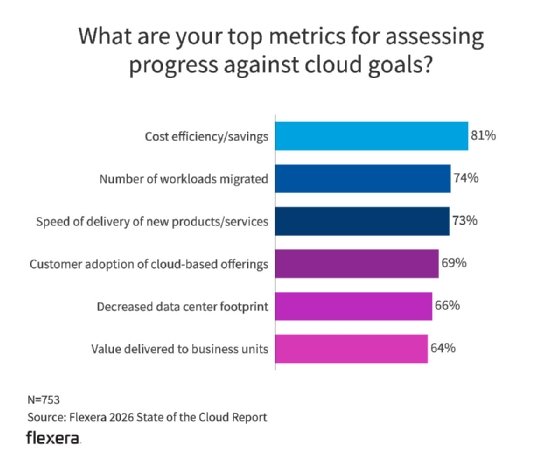
Brian Shannon: Today, it's about cloud maturity and the reality check from AI. For years, organizations focused on savings because cloud adoption was still about proving efficiency. Now, leaders are analyzing which cloud investments are actually making the business more productive and advancing outcomes. The report shows a 12-percentage-point year-over-year increase in organizations reporting value delivered to business units, which is telling. Teams are starting to understand their cost per service and align their spending more closely with outcomes.
How should organizations shift from a sole cost-reduction strategy to value-based cost optimization?
Shannon: Cost control is more of an evolution. Companies should not move away from cost-cutting, as it’s an important asset of the larger picture. Rather, they should focus on centralized oversight that brings together FinOps, IT asset management and governance. This allows them to balance savings with risk, performance and what matters to the business, so ROI becomes measurable and repeatable.
What strategies should executives adopt to optimize cloud spending?
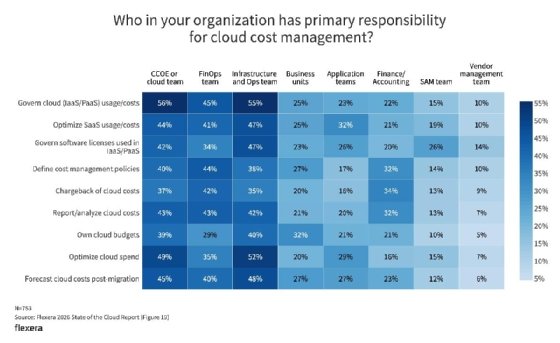
Shannon: The industry is witnessing a big shift in cloud cost management -- with it becoming less of an engineering concern and more of a leadership and governance priority. That said, executives should have a sharp focus on centralizing accountability through a CCOE, DevOps and/or a FinOps team, paying close attention to advising, managing and executing cloud cost optimization.
The "2026 State of the Cloud Report" data support this, showing an uptick in CCOE adoption compared to last year, rising from 69% to 71%. It's clear that enterprises are heavily relying on dedicated cost management teams more than ever to ensure business ROI is met accurately. This trend reflects the growing maturity of organizations as they progress in their cloud cost management journey.
When it comes to cloud cost management, can there be 'too many cooks in the kitchen?'
Shannon: Cloud cost management is more about whether roles and accountability are clearly defined. Cloud cost management breaks down when ownership is fragmented, but it becomes far more effective when FinOps, CCOEs and software asset management (SAM) teams are working from a shared view of spend, usage, and business priorities.
The report shows there was a four-point increase in organizations with a FinOps team focused on advising, managing and executing cloud cost optimization strategies. And an increase of SAM teams' participation in cloud cost management responsibilities, overseeing software usage in the cloud. The most mature organizations avoid "too many cooks" by aligning each team around what it does best.
What role should innovation play in a cloud strategy, and how can CTOs foster it within their teams?
Shannon: Innovation should always be a part of any cloud strategy, and we’re seeing the urgency to move faster and turn ideas into real business impact accelerate with GenAI. The report shows 45% of respondents using GenAI extensively, up from 36% last year. But as innovation speeds up, so does the risk of cost sprawl if cloud usage isn’t actively managed.
To strike the right balance with AI, CTOs -- and leaders alike -- should encourage teams to experiment and innovate, while also putting the right governance structures in place. With AI investments showing no signs of slowing down, many large organizations are moving the needle on having dedicated AI governance leaders to ensure innovation is secure, scalable and set up for success against business goals.
Are companies rushing into AI initiatives too quickly, and how should they rein in AI?
Shannon: The early days of cloud have shown us a lot, especially as organizations move to quickly capture the promise of GenAI. AI workloads are highly dynamic, which makes costs difficult to forecast, and new consumption‑based pricing models reduce visibility just when teams need it most. Rightsizing for both cost and performance to remain competitive becomes a delicate balance.
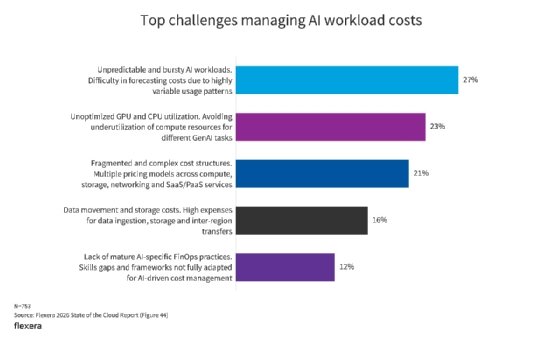
Organizations need to bring governance and cost discipline in earlier when it comes to handling AI workloads. Things like establishing clear ownership, measuring usage and value from the start, and applying FinOps and governance practices before spend scales. Organizations can avoid repeating early cloud mistakes while still moving fast enough to be innovative.
Were there any surprising or unexpected insights in the report?
Shannon: The report findings are always interesting year over year, spanning the 15 years this report has been published. One of the insights that stood out was the sharp increase in SaaS spending. This year, the most common reported range by most organizations was more than $200k-$500k per month on SaaS. This was a significant increase from last year's report where the most common spending tier was $50-$100k per month.
That change indicates that organizations are spending significantly more on SaaS. Much of that growth is likely tied to AI‑driven features and new consumption‑based pricing models, which accelerate value but make costs harder to predict and control.
What’s one key takeaway from the report that every C-suite leader should know?
Shannon: As the cloud continues to evolve and shift into new phases, success will hinge upon aligning governance, business value and AI oversight. In 2026 and beyond, organizations that take a strategic approach to FinOps, embrace disciplined discounting and establish strong AI controls will not only keep costs in check, but they’ll be able to fully unlock the potential of cloud to fuel resilience, growth and innovation.
Editor's note: This Q&A has been edited for clarity and length.
Kathleen Casey is the site editor for SearchCloudComputing. She plans and oversees the site, and covers various cloud subjects including infrastructure management, development and security.