
tashatuvango - stock.adobe.com
The hidden costs of technical debt in infrastructure
Technical debt is a strategic leadership issue rather than a budgeted maintenance concern. Orgs that actively manage technical debt innovate faster and reduce operational risk.

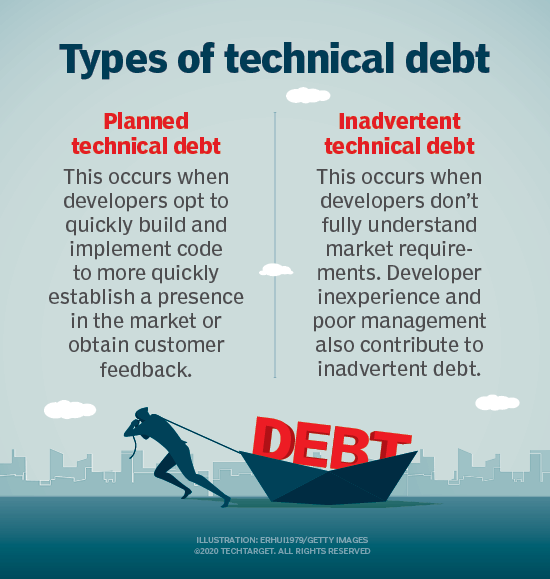
Technical debt represents more than just outdated hardware, older software or cumbersome manual workarounds; it is a business risk that threatens an organization's growth, agility and exposure. Technical debt is the accumulated inefficiencies and risks from outdated systems or deferred maintenance that require future remediation. According to Gartner, some 40% of infrastructure has potential technical debt issues.
However, IT leaders can frame technical debt as a strategic opportunity rather than a business risk. Addressing technical debt unlocks many possibilities, including opportunities for the following:
- Innovation capacity.
- Operational efficiency.
- Reduced long-term cost of ownership.
- Resiliency and scalability.
This article helps leaders recognize the causes and impact of technical debt. It also provides actionable recommendations for moving beyond legacy infrastructure components.
What are the causes of technical debt in infrastructure?
Technical debt is typically the result of rational short-term decisions that accumulate long-term costs or inefficiencies. The decisions often occur in response to emergency workarounds, unanticipated obstacles or unexpected budgetary constraints. Examples include:
- Legacy systems and outdated technology. Systems that remain in production beyond their intended lifecycle or that have compatibility limitations that block modernization. Example: Mission-critical workloads running on unsupported OS versions requiring custom patches or remaining unpatched.
- Short-term solutions that become permanent. Tactical fixes are deployed under deadline pressure with a "we'll fix it later" approach or temporary integrations that become core components. For example, a rapid pandemic-era remote-workforce infrastructure that remains in place without redesign.
- Poorly designed or fragmented architecture. Siloed infrastructure environments that lack scalability or interoperability. Example: Separate environments for business units that create data fragmentation or format issues.
- Overreliance on manual processes. Human-dependent provisioning, monitoring or remediation leading to increased error rates and operational overhead. Example: Manual software testing techniques.
- Lack of documentation and knowledge continuity. Loss of institutional knowledge when key staff leave, leading to slower incident response and modernization efforts. Example: Lead developer leaves the organization, taking undocumented troubleshooting practices and workarounds with them.
- Vendor lock-in. Proprietary platforms limit flexibility and cost control, adding expensive migration barriers. Example: Business units using different cloud service providers with high cost implications for consolidating to one provider.
- Weak governance and standards. Lack of a lifecycle management framework with inconsistent procurement and configuration practices. Example: No hardware lifecycle plan for scheduled enterprise laptop replacement.
- Skills gaps and resource constraints. Teams lack expertise or time to modernize, with maintenance tasks crowding out transformation initiatives. Example: Operations teams cannot implement automated workflows because they are constantly firefighting.
These issues accumulate quietly until their impact on the business becomes unacceptable, often leading to expensive, but unavoidable, modernization efforts.
What is the business impact of technical debt in legacy environments?
The business impact of legacy components is simple. They impede growth, increase costs, compromise security and stifle innovation. Failing to address these issues exposes organizations to security risks, adds friction to business agility, and slows the daily tasks of IT operations teams.
Consider the following impediments and pain points.
Maintenance work displaces innovation investment, consuming valuable engineering time supporting and maintaining legacy systems that cannot take advantage of or integrate into automated workflows. This leads to slower product releases and market responsiveness. The cost of lost opportunity is invisible but substantial.
One aspect of lost opportunity is the integration of modern technologies such as AI and data management. Modernization is a prerequisite for AI strategy execution. Failing to address modernization stalls critical AI integrations. Legacy infrastructure lacks the architecture to work with newer technologies, leaving data trapped in silos.
Engineers prefer modern environments that reduce fatigue and offer interesting projects, rather than reactive maintenance work that takes them backward rather than forward. Attracting modern talent brings current ideas and knowledge into the environment.
Unsupported and unpatched systems create vulnerability gaps, increasing breach risk and remediation costs. They also increase the complexity of auditing and compliance. Finally, they demonstrate a lack of responsible governance that may lead to reputational damage.
Organizations seeking to acquire -- or be acquired by -- other companies may face increased challenges due to hidden remediation costs and slower integration, reducing the acquisition's value due to modernization liabilities, operational costs and security risks.
Operational costs escalate, including higher maintenance, licensing and energy expenses, often due to inefficient infrastructure utilization. These inefficiencies directly impact green IT and energy-aware infrastructure initiatives.
However, IT leaders can manage identifiable and measurable technical debt strategically if they understand the concerns and prepare the organization to address them.
How can leaders identify and quantify infrastructure technical debt?
IT leaders can take a three-pronged approach to quantifying technical debt and preparing the enterprise to address it.
Step 1. Monitor indicators
- Percentage of unsupported or end-of-life systems.
- Maintenance vs. innovation spend ratio.
- Incident frequency and mean time to resolution.
- Manual vs. automated operations.
- Integration complexity metrics.
Step 2. Establish business-aligned measurements
- Risk-adjusted cost of product delays.
- Legacy vs. modern total cost of ownership comparison.
- Modernization backlog valuation.
Step 3. Implement governance practices
These practices must assign ownership and define action items to mitigate technical debt.
- Technical debt registers.
- Lifecycle management policies.
- Infrastructure health scorecards.
Measuring technical debt is a prerequisite for prioritization and funding, preparing the organization for an action plan that manages the issue.
What are strategic approaches to managing infrastructure technical debt?
Now that technical debt has been identified and quantified, the next phase is to establish a decision-making framework for managing it. Use the following five approaches while remediating legacy systems and practices:
- Adopt a portfolio-based modernization strategy. Treat infrastructure as a financial portfolio, prioritizing risk, cost and strategic value.
- Implement structured lifecycle governance for infrastructure. Define refresh cycles and decommissioning policies to create an infrastructure roadmap aligned with the business strategy.
- Invest in platform standardization and automation. Consistent, automated infrastructure management practices reduce operational complexity, improve scalability and enhance resilience.
- Build cross-functional ownership. Ownership spanning IT, security, finance and business units provides shared accountability and expectations, tying modernization to measurable business outcomes.
- Fund modernization as value creation. Shift the mindset from a cost center to a growth enabler by defining modernization as a positive strategic investment rather than a maintenance cost.
Establishing an action plan to manage technical debt sets the organization up for future growth and cost-efficient operations.
Damon Garn owns Cogspinner Coaction and provides freelance IT writing and editing services. He has written multiple CompTIA study guides, including the Linux+, Cloud Essentials+ and Server+ guides, and contributes extensively to TechTarget Editorial, The New Stack and CompTIA Blogs.