IT vs. OT: Key differences explained
IT and OT have long been independent disciplines, but technical developments and new processing requirements -- particularly for AI and IoT -- are compelling IT/OT convergence.

IT is all about data, while operational technology focuses on the physical devices that control industrial operations and processes. Although they can run independently of each other, there are real benefits to IT/OT convergence when each side shares its strengths, including cost and security controls.
The convergence of IT and OT is largely due to the growing adoption of IoT infrastructure and how IoT merges the processes and data types that OT oversees with those of traditional IT. IoT's allure is the potential for greater efficiencies, insights and monetization opportunities that merging devices, data and people into a single environment can engender.
But IoT isn't the only compelling reason for IT/OT convergence. AI is pervasive in contemporary data centers and related computing resources, and it ups the IoT ante when it comes to integrating data sources, data processing and applications that can easily span multiple IT and OT environments within a single organization.
IT vs. OT: Key differences
IT and OT are both network-based technical structures that link hundreds or thousands of pieces of equipment, but beyond that basic topology, there are more differences than similarities.
This article is part of
What is IT/OT convergence? Everything you need to know
- Which also includes:
- Industry 4.0
- information technology (IT)
- operational technology (OT)
Even the networks bear distinguishing differences. IT networks typically run atop a handful of standardized OSes, including Windows and Linux. Industrial IoT environments supporting OT might run on IT network OSes, but several proprietary OSes are more role-based and often tailored to specific industries or industrial processes. In some cases, companies will modify an off-the-shelf OS to develop one that fits their unique needs.
The communication protocols that IT and OT infrastructures use can vary as well. Most IT networks are Ethernet-based, whether connected by cable -- copper or optical -- or wireless. All or part of an OT network can also use Ethernet as its protocol. However, because a single IoT implementation can potentially cover a much wider geographic area than an IT network, other protocols are used, such as LTE -- mostly 4G, with 5G adoption growing -- and low-power WAN communications in several implementations, including narrowband IoT and LoRa.
Those non-Ethernet protocols and carriers are often used to connect the remote devices to edge servers and edge storage before tapping into the organization's Ethernet infrastructure or a cloud service to store the collected data in a more centralized location.
Although both IT and OT networks are conduits for data transfer, the size of the data packets and the speed at which they're transmitted, analyzed and used differ. IT systems are based on block-, file- or object-oriented file systems, which means they must support acceptable access performance for a variety of data types that can vary significantly in size and format. The data transmitted over an OT network might be extremely small -- even just a few bits at a time that easily describe a piece of gear's current state.
OT is more device-focused than IT and uses data in real time to monitor and control physical devices -- in some cases, exercising that control instantaneously to ensure that processes are running correctly without interruption, and that worker safety systems aren't compromised.
IT is user- and data-centric and often uses historical data for analyses related to customer support, back-office reporting and marketing. Generally, IT admins are more attentive to security risks that could jeopardize data than to their users' physical well-being.
What is IT?
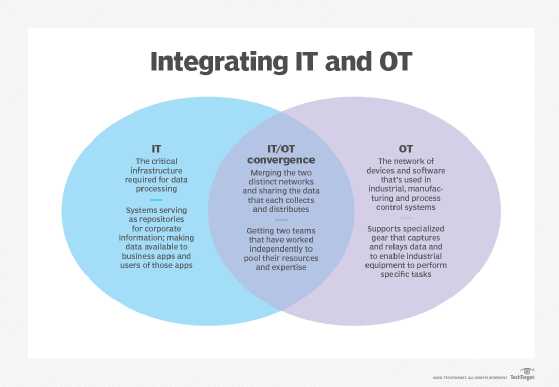
IT is certainly the more recognizable of these two technologies and represents the critical infrastructure required for data processing. It's also arguably the more mature and advanced of the twin techs.
IT systems are data-oriented, serving as repositories for corporate information and making that data available to business applications and the people who use them. IT's role is broad and extremely diverse, spanning systems that control and track accounting activities, sales and marketing, customer support, payroll processing and HR management.
Physically, IT comprises the familiar components of computing systems, including servers, storage systems, network equipment and end-user devices. Most IT implementations are based on Ethernet network topologies with TCP/IP used for external data transmissions, principally using the internet or leased lines.
Over the past couple of decades, the definition of IT has expanded to include cloud-based services and mobile computing devices, giving IT both a local and a remote presence. Internet connectivity is the primary enabler of IT's remote and cloud operations and a primary security concern.
What is OT?
OT has been around for a long time, too, but it only achieved its own identity as automation was introduced into manufacturing and industrial systems, along with the need to network automated devices to gain appropriate control over factory-floor operations.
Today, OT refers to the network of devices and software that's used in industrial, manufacturing and process control systems. The types of devices that hang off IoT networks run the gamut from sensors, relays and other single-purpose circuitry on shop floors to end-users' laptops and smartphones. However, OT supports specialized gear in industrial environments that capture and relay data, enabling industrial equipment to perform specific tasks. Typically, these IoT installations are referred to as industrial control systems.
Management for an ICS is often provided by supervisory control and data acquisition software, which handles some data gathering and processing, as well as equipment monitoring.
Other OT systems include:
- Programmable Logic Controllers. PLCs are ruggedized computers intended for industrial environments.
- Distributed Control Systems. A DCS is a distributed, multi-node hardware and software system designed to control processes in an industrial setting.
- Manufacturing Execution Systems. An MES is a software product that monitors manufacturing systems in real time.
Unlike IT, which tends to turn over gear and update firmware frequently, OT devices can be deployed and left to operate for many years. If they are doing their jobs properly, they might not be updated regularly. That scenario often leads to situations where OT must manage several versions of a sensor OS or application software, further complicating the already tough task of managing hundreds or thousands of endpoints.
One of the key challenges of OT is managing the sheer number of remote devices, making it essential to decentralize certain processes to avoid data center bottlenecks.
The data gathered by OT systems -- particularly in IoT environments -- might serve dual functions. Its primary role is to ensure that the equipment being monitored by sensors continues to operate safely and efficiently. But OT networks might also need to transmit operational data back to a central site -- a data center or a cloud computing service -- for additional analysis alongside other data already collected by IT systems.
IT vs. OT: Examples and use cases
As noted, IT is focused on gathering, storing and processing data so that it can be put into forms that are meaningful to human beings and provide some business or other value. IT systems are familiar to everyone, as they encompass computing resources for a broad spectrum of environments:
- Businesses. From small mom-and-pop companies to international enterprises, business runs on data processed by computing systems, whether those systems are on a desktop or housed in a large data center.
- Institutions. Government entities of all sizes rely on IT to maintain civil operations and to serve their constituents.
- Entertainment and education. IT reaches a vast number of homes using the internet to deliver news and related information, retail and other services, and streamed entertainment content.
Some of the IT applications provided in the above scenarios include the following:
- Business systems. Accounting, ERP, HR and employee development programs, CXM/CRM, end-user productivity apps, etc.
- Institutional applications. Social Security Administration functions, local government websites/apps, Department of Motor Vehicles applications, IRS websites and services, etc.
- Entertainment and education. Netflix and many other entertainment streaming services, video gaming, remote instruction, etc.
OT, on the other hand, is much more focused on physical devices and their safe, continuous operation, with much of OT encompassing systems internal to particular machines or processes. OT is often an exercise in managing diverse, proprietary equipment.
OT generally includes the following:
- Operation monitoring. Applications and special hardware -- including proprietary networks -- are used to monitor shop-floor machinery and to correct anomalous operations in real time.
- Equipment maintenance. Based on real-time data collection and analysis, many OT-based systems are used to determine when and where maintenance is required
- Remote management. OT systems are also instrumental in ensuring that remote devices, such as computing endpoints and sensors, operate properly and send valid data back to a central management facility.
What is IT/OT convergence?
Convergence isn't only about merging distinct IT and OT networks and normalizing disparate data; it's also about sharing the data and strengthening security across all data sources, networks and computing resources. Much of the machine- and process-related data that OT systems collect can be useful to the external-facing side of the business for forecasting, planning, supply chain control and other decision-making processes. Conversely, the OT environment can use IT-hosted business data to adjust production systems for greater efficiency.
A converged system incorporates multiple data paths, including corporate server-based networks and edge devices to collection points that can be central or satellite data centers or cloud services. Understanding the nature of the data being transmitted and its purpose is also critical to securing a converged network environment. Although IT might focus on securing data and detecting attempts to infiltrate the network, the OT security staff might be more concerned with anomaly detection to determine whether endpoint devices have been compromised by spurious data that could cause them to function improperly or unsafely.
Many companies embark on convergence to enhance their security processes. That effort often involves finding ways to adopt traditional IT security measures to the device-oriented IoT environment that OT supports. There might also be security measures in place specifically designed to protect OT endpoint devices, so those methods and processes must be integrated with IT security. IoT security can be particularly tricky given the number and types of devices that are connected to the network -- increasing the potential attack surface.
Convergence can be introduced on different levels. It might be principally based on the following:
- Physical (hardware and environment) convergence of systems.
- Software convergence.
- Data convergence.
In all cases, there will likely be a need for some degree of translation/integration, and in most cases, IT/OT convergence will require some degree of integration at all three levels.
Benefits of IT/OT convergence
The chief benefit of convergence is cost. Maintaining two separate networks is an expensive proposition. By merging networks, it's possible to reduce the amount of required networking gear, as some parts of the converged network will end up doing double duty, serving both the industrial and front-office sides of a business.
A converged physical network also makes data sharing much easier, which, as noted, can benefit the processes running on both sides of the business. But it can also mean that data can be acted on more immediately, and data storage resources can be combined for an additional economic benefit. IT and the business units it supports will be smarter when OT's real-time data is incorporated into their data sets for enhanced analysis, enabling practices such as just-in-time manufacturing and smarter supply chain management.
The OT staff can combine sales and marketing data from IT with the voluminous data it collects to control manufacturing processes more efficiently. That way, production of best-selling products can be ramped up, while production of less popular products can be cut back.
Although there are opportunities for cross-training to build a converged staff, organizations might still want some staff to specialize in OT or IT issues and devices, largely because so many of the devices that populate the OT world are unfamiliar to computer experts. The operational and health information these devices provide might be unique or industry-specific.
With AI and machine learning becoming more prominent in applications across both IT and OT environments, it makes sense to integrate their capabilities to interpret and act on data more effectively. For example, TinyML is bringing machine learning capabilities to more IoT endpoint devices; integrating these capabilities with other AI-powered applications promises benefits for both IT and OT environments.
AI applications also require that data achieves some level of homogeneity, so that the data -- regardless of where and how it was captured -- can potentially play a critical role in an AI system. That means industrial data that was traditionally rarely used outside of machinery control and monitoring environments might now have greater value, especially when combined with data from other sources, such as traditional IT systems (e.g., CRM, ERP, transactional apps). Centralizing data management is an imperative, as it is key to effective data governance and compliance.
Connections to outside organizations have become important to both environments as well, so combining their networks and network connections can benefit them equally. For some IoT environments, such as energy distribution from power plants, outside connectivity is necessary. And traditional IT networks have long relied on remote connectivity -- often using cloud-based services -- to stay in touch with suppliers and customers.
From an IT perspective, convergence means drastically extending the reach of installed systems and computing resources, which could create management issues, but might also present new opportunities for business expansion.
Challenges of IT/OT convergence
The challenges of implementing a converged IT/OT environment might be significant, as it will likely require changes to procedures in both technical disciplines. Some of the obstacles that organizations must address include the following:
- Scale of connectivity. OT typically connects far more devices than an IT network. The sheer number of devices involved in a convergence effort must be considered before networks converge.
- Device inventory. Everything that's connected to IT and OT networks must be accounted for to ensure that devices aren't left unsecured or orphaned. Communication among diverse devices must be tested and confirmed. This also suggests that IT and OT personnel develop a basic understanding of each other's equipment to enhance troubleshooting and remediation efforts.
- Firmware and other updates. As part of its security efforts, IT tends to emphasize firmware and system software updates to help ensure that no vulnerabilities are exposed. OT, on the other hand, might host devices that have been used for many years and might have out-of-date software -- or might no longer be supported. Those issues must be resolved to ensure that endpoint devices don't present additional vulnerabilities.
- Encryption. The converged systems should encrypt all communication between devices and other processing resources, whether they are internal to the organization or provided by external services.
- Adjust networking systems for different types of data and transmission rates. Systems are often tuned to the types of data they collect and transmit. For example, OT data is typically very small and voluminous, while IT data can range from small files to huge media files. Some tuning of network devices might be required, as data is bound to travel more and mix more frequently across a converged OT/IT environment.
- Hybrid storage systems. In most cases, the data collected in IT and OT environments will be merged at some point. Combining edge storage with more traditional centralized storage can pose problems due to the differing data types that each environment supports. Differences in network bandwidth, data types, capacities, access frequency and data ingestion rates must all be resolved. IT groups with limited experience with cloud storage will face a steep learning curve, as IoT endpoint storage often relies on proximity to a cloud storage service.
- Merging data. Gathering data from multiple sources is just the start of the data sharing process. The data is likely to be in different formats and adhere to different protocols, so some form of data management middleware will likely be needed to handle the disparities in the collected data.
- Ask for a software bill of materials. An SBOM is a list of all the software components and dependencies that go into a device deployed in an IoT environment. Providing SBOMs is a newer practice by product vendors, but it's a key step in addressing issues related to the variety and age of IoT devices.
Security might be at the top of the IT/OT convergence list of challenges, but ironically, it can also loom as a significant potential benefit because consolidated network management is likely to make securing network resources easier and more effective.
For IT, security activities typically focus on the network infrastructure that transports data and the storage and memory systems where applications and data reside, either permanently or transiently. OT must also secure a similar set of components, but the task is compounded by the sheer number of endpoint devices that can connect to operational networks. Those endpoints can be a mix of legacy and new devices with varying needs for patches and updates. So, job one might be using management software to establish an accurate inventory of devices and to methodically update it as needed.
In a converged world, security should be bolstered by modern firewall technologies, such as web application firewalls and VPNs, which encrypt data in motion across remote network connections and add a layer of protection against a variety of cyberattacks.
Backing up data is a crucial part of security and of maintaining business processes to avoid disruptions for both IT and OT, but the location and nature of the data to be protected differ. Backup and disaster recovery applications and processes must work effectively in both environments and efficiently access and back up a range of endpoint storage devices.
There are, of course, also human elements that must be considered for a convergence effort to succeed. The effects of organizational convergence can be just as important as systems convergence:
- Traditionally disparate teams will be involved, but despite the differences, there will be significant overlapping responsibilities that must be sorted out for convergence.
- All parties, from the C-suite to the data center floor, will have to come to an understanding of common goals that might be beyond the scope of what they had experienced when IT and OT were separate entities.
- The inevitable redistribution of responsibilities will likely change reporting structures as well as personal goals and expectations.
Rich Castagna has been a high-tech journalist for more than 30 years. Rich worked at TechTarget for 15 years, overseeing technical coverage and content creation as vice president of editorial. Previous roles include executive editor of ZDNet Tech Update and CNET Enterprise, and editor-in-chief of Windows Systems magazine.