At FinOps X 2026, AWS announced updates across FinOps tools, including an AI agent for cost analysis and new Bedrock attribution features for tracking AI spending.
Key AWS news from FinOps X 2026 includes the following:
FinOps Agent. A new public preview tool that lets users analyze cloud spend using natural language, investigate anomalies and surface optimization recommendations within engineering workflows.
Bedrock attribution. Expanded cost visibility for Amazon Bedrock with granular attribution linking AI usage and spend to models, applications, agents and users.
Cost management updates. Enhancements to Savings Plans target planning, automated cost and forecast explanations, and expanded idle-resource recommendations.
Credit controls. New credit-level sharing and transparency features that improve visibility into cloud credit usage across workloads and accounts.
SAN DIEGO -- AI has become both a challenge and an opportunity for FinOps teams, and AWS used this year's FinOps X conference to showcase a series of product updates that align closely with that reality.
AWS introduced the AWS FinOps Agent in public preview, an AI-powered tool designed to automate cloud cost analysis, anomaly investigation and reporting, while surfacing optimization recommendations. AWS also expanded cost visibility for Amazon Bedrock with granular attribution capabilities that help organizations track AI spending at the application, agent and user level.
Additional updates included new cost management capabilities for optimization, forecasting and financial controls. The announcements show how AWS is applying AI to traditional FinOps processes and building tools to track AI spending.
FinOps Agent moves into public preview
AWS introduced the AWS FinOps Agent in public preview as an AI-powered system that analyzes cloud spend, investigates anomalies and surfaces optimization recommendations within engineering workflows.
The agent lets AWS users ask about cloud costs using natural language, said Bradford Lyman, director of product management at AWS, in his portion of the keynote. It can detect anomalies, generate custom reports and identify optimization opportunities.
The agent integrates with tools such as Jira to route findings and recommendations directly to the teams responsible for resolving cost issues. Users can run the agent on a schedule, trigger it when specific events occur or use it on demand through natural language queries.
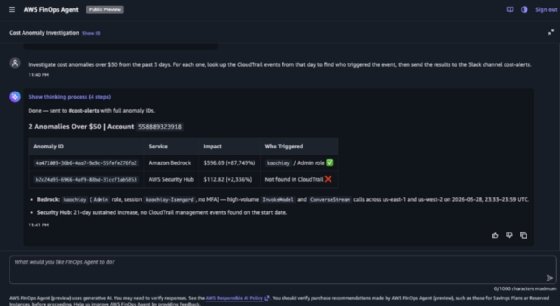
AWS FinOps Agent traces cost anomalies to their root causes.
The tool was presented as part of AWS's vision to make FinOps more agent-first.
"We think FinOps should be effortless, intelligent and autonomous," Lyman said in the keynote.
However, the system does not currently execute infrastructure changes or apply optimizations automatically.
The agent instead surfaces recommendations and investigation summaries, which are routed into tools for engineering follow-up. Customers decide what the agent looks for, what organizational context it uses and where it sends its findings.
The system draws on AWS Cost Explorer, Cost Anomaly Detection, Cost Optimization Hub and Compute Optimizer then uses CloudTrail activity to trace cost changes back to the AWS users or roles that triggered them.
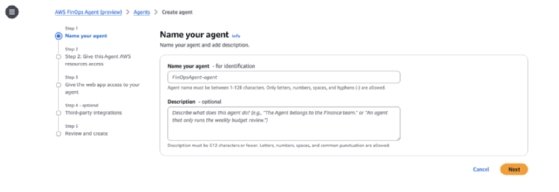
The FinOps Agent setup process includes permissions configuration, workflow integrations and organization-specific context settings.
Bedrock gets granular cost attribution for AI usage tracking
AWS also announced new granular attribution capabilities within Amazon Bedrock to help organizations track AI spending. The update shows which model was called and the cost associated with each session, and can attribute usage to specific applications, agents or users.
This is the foundation of tokenomics.
Bradford LymanDirector of product management, AWS
"This is the foundation of tokenomics," Lyman said in the keynote.
The cost attribution feature maps usage to identity and access management (IAM) roles or users, which then appear in AWS Cost Explorer and the AWS Cost and Usage Report.
If organizations assign separate IAM roles to individual applications, agents or teams, Bedrock costs can be tracked at that level through existing cost management tools. The Cost and Usage Report also includes input and output token usage at the line-item level, enabling more detailed analysis of AI consumption within existing billing data.
AWS updates cost management capabilities
AWS also introduced updates across existing tools for optimization, forecasting and financial controls.
Everywhere within our consoles, you're able to push a button and see any kind of unexpected cost, [and] an immediate root cause investigation and analysis.
Bradford LymanDirector of product management, AWS
It added target planning for Savings Plans, which lets organizations set coverage goals directly in the AWS console and receive recommendations aligned with those targets. It also introduced automatic cost and forecast explanations that provide root cause analysis for unexpected spending and forecast changes.
"Everywhere within our consoles, you're able to push a button and see any kind of unexpected cost, [and] an immediate root cause investigation and analysis," Lyman said in the keynote.
AWS also doubled the number of idle-resource recommendations available through its optimization tools to help customers identify unused or underutilized resources.
In addition, the company introduced credit-level sharing controls that let organizations determine which workloads and accounts receive the benefits of cloud credits. It also expanded credit transparency with a new console view that shows earned credits, remaining balances and the workloads to which credits were applied.
Tim Murphy is a site editor and writer for the IT Strategy team at TechTarget.