
KOHb - Getty Images
AI's role in different software architecture contexts
Generative AI is reshaping architecture by augmenting human judgment, accelerating understanding and expanding options across design, migration and maintenance -- when applied thoughtfully.

Emergence of newer capabilities in AI -- generative AI specifically -- is reshaping how traditional software and architecture problems are approached and solved.
AI's general-purpose abilities are reducing the time and cognitive effort required for tasks that once depended heavily on experience and manual analysis. These capabilities include intelligent recall, concept generation, chain of thought or reasoning over design alternatives, and natural-language interaction with technical artifacts.
Capabilities of generative AI for software architecture
Fundamentally, the following generative AI capabilities can help improve both the quality of outcomes and the speed of execution.
Information synthesis and intelligent recall
Large context windows and the ability to consume information from a variety of sources and in varied formats enable generative AI to stitch together a distributed context and synthesize information into a coherent contextual view. This new capability significantly reduces the time required to comprehend complex systems and reconstruct architectural intent.
Deeper capabilities: Natural-language understanding and generation, code and artifact reasoning, context synthesis and summarization, multi-document and multi-source correlation.
Analysis and insight acceleration
AI makes it is easier to correlate patterns and signals across data sources, such as repositories, incidents, schemas and runtime behavior, to surface risks and dependencies. This shifts analysis from manual inspection to AI-assisted, insight-driven reasoning.
Deeper capabilities: Pattern recognition at scale, interactive reasoning and critique, data-assisted impact assessment.
Concept generation and exploration
AI excels at being a virtual partner, helping the user ideate. It brings a tremendous pool of general knowledge to combine with human insight. Alongside AI, users can generate new concepts and create context-aware design alternatives, migration strategies and software variations on demand. This enables ideation and accelerates the early discovery and evaluation of possibilities.
Deeper capabilities: Design and solution exploration, cognitive augmentation.
Guided execution and skill augmentation
Generative AI agents can execute structured tasks with oversight, reducing grunt work and toil, enabling scaffolding, refactoring, documentation and incremental transformations.
Deeper capabilities: Task automation and co-creation, learning from feedback loops.
Adaptation and learning
A layer of structured prompting can guide modern tools to adapt their output to an organization's language, conventions and evolving context. This means that even though each response is uniquely generated, it can remain grounded in configured conventions and constraints.
Deeper capabilities: Contextual personalization across teams, domains, and constraints, cognitive augmentation to reduce search, recall and cognitive load.
Architectural context types
Technology systems can have different objectives and demand unique mindsets to manage trade-offs. In different contexts, systems have different objectives.
Prototypes prioritize speed and learning, while greenfield systems aim for strong long-term foundations. Brownfield, migration and maintenance contexts emphasize safety, compatibility and incremental evolution over purity. The architect's role is to continuously balance competing forces, such as ideal design vs. pragmatic progress, innovation vs. risk and short-term delivery vs. long-term resilience. The architect needs to find this balance while staying grounded in business goals and system realities.
Good architecture is not about enforcing a single standard approach -- it's about choosing the right architectural posture for the context. The following table summarizes a set of architectural contexts for different project types. This will help us later articulate the role generative AI can play in improving the efficacy of the process in those contexts.
Generative AI's effect on architectural contexts
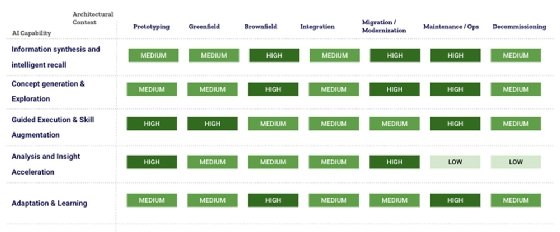
Examine how the various capabilities of generative AI enhance the architect's process of balancing architectural trade-offs in diverse architectural contexts.
Information synthesis and intelligent recall
This capability helps quickly understand complex systems by unifying code, existing documentation, project management tools, logs and design artifacts into a coherent picture. Across architectural contexts, especially brownfield, migration, maintenance and integration, it reduces the time needed to reconstruct intent, trace dependencies and build shared understanding. It is particularly valuable when onboarding individuals to legacy systems or when planning changes in environments with fragmented knowledge.
Analysis and insight acceleration
This capability enhances architectural decision-making by analyzing code, existing documentation, coupling patterns and dependencies earlier in the lifecycle. Brownfield evolution, integration-heavy environments, migration planning and maintenance benefit from it, where structural and operational risks must be surfaced before changes are introduced. The shift is from manual inspection toward assisted, evidence-backed analysis.
Concept generation and exploration
This capability expands the available design options by generating alternative architectures, modernization paths and refactoring strategies. It is valuable in prototyping and greenfield contexts, as well as in modernization and migration programs where multiple pathways must be evaluated. Instead of starting from a clean slate, it can offer structured context-aware architectural alternatives.
Guided execution and skill augmentation
This capability combines human insight and acumen with the execution capabilities of AI. It can meaningfully scaffold, execute focused tasks, transformations and validations, while observing conventions and constraints provided as part of the context. The capabilities are sometimes hit or miss on a brownfield codebase and are more effective in a greenfield context. However, the capabilities are constantly improving. It is useful in prototyping, migration, integration and maintenance contexts by reducing toil and shortening feedback loops.
Adaptation and learning
We can use layered and structured prompts across teams to achieve consistent outcomes. It embeds the team's terminology, architecture patterns and constraints so that output from the models align in intent and approach. It is particularly useful in sustained maintenance, recurring modernization efforts and long-running brownfield programs. Tools improve decision consistency, pattern reuse and institutional continuity.
Challenges of generative AI in software architecture
While generative AI brings speed to the technology architecture domain, it also introduces new challenges that must be considered.
- Validation fatigue. The constant flow and possibilities of suggestions, alternatives and insights can increase cognitive load rather than reduce it. Especially when AI-generated outputs require interpretation and validation.
- Outsourced decision making. The ease of using offered suggestions can also incentivize outsourcing critical thinking, reducing the quality of decisions and value of human insight.
- Constant context switching. Frequently switching contexts across tools, conversations and artifacts can lead to fragmented thinking and decision fatigue. The rapid churn in AI and tools creates a continuous learning curve, and models often require ongoing refinement and oversight to remain reliable and relevant.
Effectively using AI in architecture requires not only technical adoption but also intentional governance, discipline and architectural judgment.
Generative AI is reshaping how architectural work is understood, explored and executed across various delivery contexts, from prototyping and greenfield design to migration, maintenance and brownfield evolution. Its greatest value lies in augmenting human insight and judgment, accelerating understanding and widening the range of feasible options, rather than replacing architectural thinking. The opportunity is to harness these capabilities thoughtfully and apply them where they create real change while managing the risks, constraints and organizational realities that still define good architecture. The toolchains to achieve the same are constantly evolving and must be reviewed for newer capabilities.
Priyank Gupta is a polyglot technologist who is well versed with the craft of building distributed systems that operate at scale. He is an active open source contributor and speaker who loves to solve a difficult business challenge using technology at scale.