AWS AI IDE, AgentCore throw down gauntlets for Microsoft
Kiro emerges as a significant alternative to GitHub Copilot agents, while AWS AgentCore updates square off against Agent 365 in the battle for enterprise AI development.
Updates to an AI IDE and AgentCore platform bolster AWS's stance in its fierce competition for enterprise AI development against Microsoft and other AI coding competitors, according to industry observers.
Amazon Bedrock AgentCore updates this week touched on the same AI agent governance and security concerns cited by Microsoft at its Ignite conference last month when it launched Agent 365.
A new policy feature in AgentCore also sprang from AWS customers' struggles to get enterprise AI agents into production, according to comments by AWS CEO Matt Garman during the keynote presentation at the annual AWS re:Invent conference on Tuesday.
"Most customers feel that they're blocked from being able to deploy agents to their most valuable, critical use cases, and today, that's why we're announcing policy in AgentCore," Garman said. "Policy provides you with real-time, deterministic controls for how your agents interact with your enterprise tools and your data. Now you can set up these policies that can define which tools and data your agents can access, but also how they access them, … what actions they can perform and under what conditions."
Other updates to AgentCore this week included AgentCore Evaluations, which enables developers to continuously monitor AI Agent behavior, and AgentCore Memory, which helps agents learn from past experiences to improve their decision-making.
A new autonomous frontier agent and a feature called Kiro powers, unveiled in preview this week, both added to the context used by AI-assisted code generation tools to ensure quality outputs. The Kiro autonomous agent maintains consistency independent of individual code repositories and coding sessions, while Kiro powers can automatically pre-load sets of Model Context Protocol (MCP) tools and agent framework expertise as developer prompts come in. Other frontier agents previewed by AWS this week include a security agent that proactively secures applications throughout the development lifecycle and a DevOps agent that automatically resolves and can proactively prevent incidents.
In some ways, comparing AWS Kiro and frontier agents to their GitHub counterparts -- namely, GitHub Copilot Agent mode and coding agent, along with Copilot Autofix -- is like comparing apples and oranges, said Jason Andersen, an analyst at Moor Insights & Strategy, in an interview with Informa TechTarget this week.
For the past year, I have not seen anything that has approached what GitHub has been doing with autonomous coding agents, until now.
Jason AndersenAnalyst, Moor Insights & Strategy
Kiro's specialty is spec-driven development, while GitHub's focus within individual repositories can make developer-specific workflows more efficient, according to Andersen. AWS application developer tools also have a long way to go to match the 180 million-developer installed base boasted by GitHub, and Copilot still has a strong first-mover advantage.
But with this week's updates, Kiro has emerged as a unique challenger for Copilot, Andersen said.
"For the past year, I have not seen anything that has approached what GitHub has been doing with autonomous coding agents, until now," Andersen wrote in a LinkedIn post this week. "The combination of frontier agents, Kiro and spec-based development is finally a complete, alternative solution that should prompt serious consideration."
AWS AgentCore vs. Microsoft Agent 365
With frontier agents, Kiro and AgentCore updates this week, a fresh battleground in enterprise AI is beginning to take shape between AWS and Microsoft in the AI-driven development realm, Andersen said.
"Functionally, we're not talking about some sort of huge individual differentiator," he said. "It's really more of the collection of the different pieces of the story. If you're doing something with the Kiro agent, it may have the ability to work with AgentCore Memory, and be able to run for longer, so you might be able to do more complex jobs with it."
Overall, AWS and Microsoft take different approaches to some of the same challenges, appealing to different parts of the enterprise AI development process and different ways of working, Andersen said. For example, Microsoft Agent 365, Copilot Fabric and Foundry IQ tools offer a comprehensive and crisply delineated product package but are a little more limited than Amazon Bedrock in terms of model and framework choices, he said.
"The AgentCore architecture is also quite interesting -- the new policy [feature] isn't its own separate service -- it's actually a feature of the gateway service," he said. "That's where you want to implement policy, because if you put it in the agent, or you put it into the model, it becomes non-deterministic… There are some novel ways AWS has approached some of these engineering problems that really show sophistication."
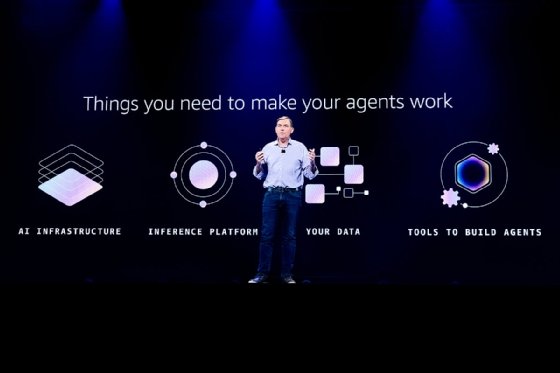
AWS CEO Matt Garman presents the latest AWS AI agent development updates during a keynote presentation at re:Invent 2025.
AWS Kiro AI IDE vs. GitHub Copilot
With both the autonomous agent and powers, the Kiro project looks to reduce fragmentation and unnecessary toil in configuring coding agents, according to blog posts by AWS engineers.
"Most AI coding assistants require you to actively manage context," read a post introducing the Kiro autonomous agent. "You constantly re-explain your preferences and patterns or build systems to store context in repos… Once you close a session, they forget everything."
By contrast, the Kiro autonomous agent "maintains context across your work," according to the post. "When you give feedback on one [pull request] about error handling, it remembers and applies that pattern to subsequent change... It already knows how you work and gets better with each interaction."
Kiro powers bring a bundled approach to packaging context for AI agents, which makes loading that context more efficient in complex environments, AWS engineers wrote in a separate post.
"AI development tools are evolving rapidly," according to the post, which cited Anthropic's dynamic tool loading and Claude Skills, Cursor rules and MCP tools. "Each requires separate configuration and management. You're stitching together multiple primitives to get the full picture: tools, knowledge [and] dynamic loading. And when you switch between … tools, you're reconfiguring everything again.
"The challenge isn't missing capabilities -- it's fragmentation," the post continued. "Developers want a unified package."
Kiro powers include an agent onboarding manual called a steering file, MCP server configuration details and additional steering instructions or hooks into resources. Once these bundles are installed, specific words in prompts, such as payment or checkout for Stripe, activate the Stripe power, which then automatically deactivates when the developer moves to a different task.
Kiro powers must be proven in practice but have the potential to address many of the issues that have made vibe coding practices largely fail in enterprises, said Torsten Volk, an analyst at Omdia, a division of Informa TechTarget, in an interview this week.
"With Kiro, what I can see is that it has the agent's action space really defined, and it lets you really define best practices," Volk said. "However that actually works in practice is something to consider, but it is the next frontier -- I've worked with a couple of startups that do exactly that … they are all trying to approach that problem of having to throw away vibe code after you prototype stuff and then start over for enterprise development projects."
Kiro's holistic focus beyond individual repos could make its AI agents uniquely suited to addressing issues with AI agent-driven applications in production, Andersen said.
"The way AWS is approaching this, it may be helpful for maintenance and sub-releases, whereas if you look at the GitHub side, it's much more related to pull requests, merging and actions," he said. "Kiro powers seem a little bit more runtime-focused, where it might be able to take on things in the runtime world too, eventually."
Beth Pariseau, a senior news writer for Informa TechTarget, is an award-winning veteran of IT journalism covering DevOps. Have a tip? Email her or reach out @PariseauTT.