Workers have long feared AI will one day displace them. But emerging evidence suggests otherwise: AI might preserve jobs, even as it reshapes roles and skill requirements.
For much of the AI boom, it was assumed smarter machines would enable businesses to reduce labor costs and operate with fewer employees. But as AI adoption accelerates, that narrative is shifting away from job elimination to job transformation.
The economics of deploying AI systems in production environments is proving to be more complicated than anticipated. Businesses are investing in the development of models and infrastructure, but they also need to invest in governance, integration, workforce training and ongoing oversight. Yet, so far, labor market data hasn't shown the expected AI hiring disruption.
Instead of laying off workers, businesses are wrestling with a couple different questions: Where does AI create value, and where do people remain indispensable? That shift in thinking is influencing enterprise strategy.
"The misconception isn't just that AI replaces jobs, it's [whether] jobs are the right unit of analysis at all," said Tori Paulman, VP analyst on Gartner's talent research team. "Increasingly, the more important question is not 'Which jobs disappear?' but 'Which capabilities spread, and how fast?'" Gartner analyzed 1.4 million layoffs in 2025 and found that less than 1% were due to AI productivity, Paulman noted.
New research released in April 2026 by the University of Maryland's Robert H. Smith School of Business showed little evidence that AI adoption has reduced overall labor demand. The researchers found that demand for people with AI expertise increased significantly following the launch of ChatGPT in 2022. AI-related positions accounted for 0.28% of all job postings in late 2022 and climbed to 1.13% by the end of 2025; during that period, the share of job postings targeting new graduates increased from 11.7% to 12.6%.
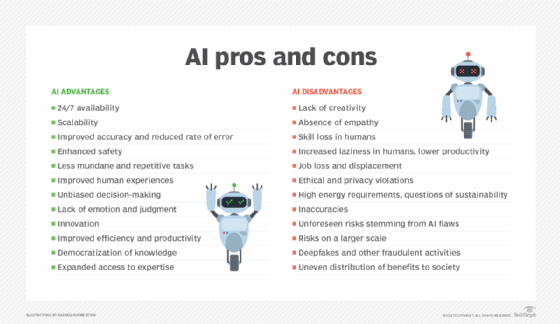
AI in the workplace presents a dichotomy of improved productivity and job deskilling.
AI isn't a simple labor-saving tool
Hiring data captures only one side of the equation. Businesses are discovering AI isn't the straightforward labor-saving tool it was expected to be. While AI creates efficiencies, implementation and operating costs often go far beyond infrastructure and models, and include governance, workflow redesign, change management and workforce training, Paulman said, adding that non-IT training and change management are often overlooked when estimating AI costs.
To achieve human-level quality in many tasks [using AI], it is … occasionally more expensive than just using a human.
Randall HuntCTO, Caylent
"Surprisingly, costs are not always lower," said Randall Hunt, CTO at cloud native services provider Caylent. "To achieve human-level quality in many tasks [using AI], it is possible but occasionally more expensive than just using a human." Businesses have largely moved beyond asking whether they should adopt AI, Hunt said, and are now focused on determining where the technology delivers meaningful advantages and returns on investment.
But determining ROI can be problematic. Many businesses overestimate the AI's savings in labor because they underestimate the amount of organizational redesign required before the technology can generate durable returns, Paulman explained. In agentic workflows, value often depends on redefining decision rights, supervisor roles and approval processes, rather than simply removing people from the loop.
"Creating a human approval factory is an expensive bottleneck where humans spend time reviewing, escalating and correcting agents instead of doing higher-value work," Paulman said. "To unlock real value, enterprises must decompose workflows, set decision rights, define supervisor roles, and make agents visible and auditable in systems of record. Not only is this not a labor-elimination shortcut, it's a work redesign cost burden that many organizations have not planned for."
Yet many businesses have become more realistic about AI's limitations over the past year, Hunt said. While businesses continue to pursue automation opportunities, he explained, many are discovering that the highest returns come from applying AI to specific business problems rather than expecting the technology to broadly reduce labor costs. "A year ago, everyone was focused on AI adoption," he said. "Today, people are focused on leverage."
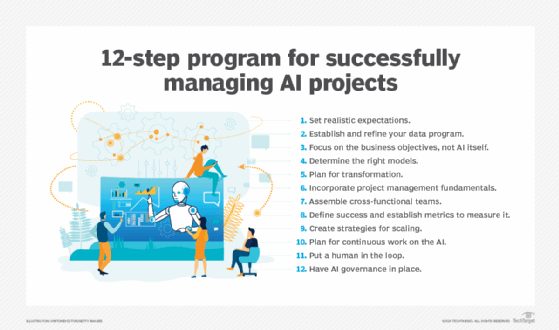
AI deployments have a better chance of succeeding when cross-functional teams focus on solving specific business problems.
From workforce reduction to workforce redesign
The biggest misconception is that AI's role in the workforce centers on replacing jobs. "In most cases, AI is changing the work inside roles far more often than it's eliminating the roles themselves," said Maruf Ahmed, CEO of talent and technology consultancy Dexian. "The question I encourage workforce planners to ask is not, 'Which jobs go away?' but rather, 'Which roles now require different judgment, context and accountability?'"
Project managers, for example, might be expected to evaluate AI-generated timelines, challenge risk models and recognize when automation creates a false sense of confidence, Ahmed explained. Operations leaders increasingly need to interpret AI-driven analytics and translate them into business decisions rather than simply overseeing established processes. And healthcare organizations increasingly need employees who understand both AI models and clinical operations, as well as compliance requirements and workflow realities.
Along those lines, businesses are increasingly looking for workers who combine domain expertise with AI fluency. "The broader movement is away from pure execution and toward interpretation," Ahmed said. Roles tied to governance, analytics and operational decision-making are becoming more valuable, he added, while workers across functions are expected to develop sufficient AI fluency to validate outputs, ask better questions and connect technology back to business outcomes.
AI training and skills are front and center in workforce planning. Businesses are placing greater emphasis on understanding existing workforce capabilities, identifying skills gaps and developing employees for evolving roles, said Greg Fuller, vice president of Skillsoft's Codecademy Enterprise. "In reality, AI is more likely to transform jobs than eliminate them outright."
Therefore, businesses are increasingly emphasizing transferable skills such as critical thinking, communication, learning agility and adaptability, said Mike Hudy, chief science officer at AI-powered hiring tool provider Hirevue. "The most successful companies," he surmised, "will likely be those that focus on hiring people who can learn quickly and then continuously upskilling them as technology evolves."
The debate around AI is moving beyond the question of whether it will replace workers. Business leaders are discovering that the more important challenge is determining where AI creates value, where human judgment remains essential and how work should be redesigned to take advantage of both.
Liz Hughes is an award-winning editor and writer covering AI and emerging technology and the former editor of AI Business and IoT World Today.