Free DownloadA guide to artificial intelligence in the enterprise
This wide-ranging guide to artificial intelligence in the enterprise provides the building blocks for becoming successful business consumers of AI technologies. It starts with introductory explanations of AI's history, how AI works and the main types of AI. The importance and impact of AI is covered next, followed by information on AI's key benefits and risks, current and potential AI use cases, building a successful AI strategy, steps for implementing AI tools in the enterprise and technological breakthroughs that are driving the field forward. Throughout the guide, we include hyperlinks to TechTarget articles that provide more detail and insights on the topics discussed.
As the project management field increasingly embraces AI-powered software, the benefits can help organizations thrive -- but only if the risks are properly considered too.
Incorporating AI into project management can involve anything from automating simple administrative actions to performing complex tasks such as risk management.
Given AI's diverse use cases and benefits, organizations are increasingly exploring how to implement AI in their project management workflows. According to the 2025 Project Management Software Trends Survey from technology review firm Capterra, 55% of buyers reported that "AI was the top trigger for their most recent purchase."
"This isn't about chasing shiny features," Capterra associate principal analyst Olivia Montgomery wrote in the report. "It's about tackling rising project complexity, resource constraints and the demand for speed."
AI is embedded in most project management software to various degrees. AI largely works behind the scenes to assist project managers and their teams with numerous fundamental tasks, aiming to save time and money while enhancing project outcomes.
Expert sources said they expect increasing ROI from AI moving forward. They predicted that both traditional and generative AI will handle increasing amounts of project management work in the near future, a development that could bring significant gains in project delivery.
"AI is going to transform projects in the near term by improving administration, and it's going to improve project management in the long term by lowering risk," said Barry Cousins, distinguished analyst and research fellow who specializes in project portfolio management, project management and organizational change management at Info-Tech Research Group.
AI is going to transform projects in the near term by improving administration, and it's going to improve project management in the long term by lowering risk.
Barry CousinsDistinguished Analyst and Research Fellow, Info-Tech Research Group
However, Cousins said the use of AI in project management faces limitations -- at least for now. While AI excels in administrative tasks, such as note-taking, it often lacks the necessary data from organizations to effectively and accurately perform core project management tasks, including resource allocation.
"If you're going to use AI to figure out whether I'm the best person to assign and when I'm free, then you need that data, and you need that data for everyone," Cousins said. "I can't say when organizations are going to have that data ready."
How AI is used in project management
AI has made significant inroads into the project management discipline, said David Jani, senior content analyst at Capterra. Research shows that task automation, forecasting and risk management are among the most common uses of AI in the space, he added.
Capterra has identified various areas of project management where different types of AI are in use. For example, generative AI is used for drafting documents, summarizing meetings and answering questions. Machine learning algorithms help with optimizing schedules. Predictive analytics aid in identifying risks and resource planning.
The most prominent and successful uses of AI in project management today are on the front and tail ends of projects, said Te Wu, CEO and chief project officer at project management consulting firm PMO Advisory, and associate professor of management at Montclair State University.
At the front end, AI aids in project planning, brainstorming, risk analysis, drafting rudimentary schedules and identifying stakeholders, Wu said. AI also encompasses tail-end tasks, such as generating reports and producing summaries.
"With a simple prompt, you get a lot of great ideas," he added. "That means you don't have to start with a blank sheet."
To date, AI is most commonly used in these areas of project management:
1. Administrative tasks
One central area where AI is used in project management is for administrative tasks, such as the following:
Meetings. Using generative AI to create notes and summaries for meetings frees up team members' time for higher-value work, Wu said. Generative AI can also propose action items and set agendas for follow-up meetings. These capabilities not only improve efficiency for project teams but also help them stay on track, Cousins said.
Initial project design. Generative AI tools can help build initial project designs, with particularly good results for routine projects. "If I want to build a house, I can put in a description of the house I want to build, and almost any of the generative AI tools will come back with something reasonable for scheduling," Wu said.
Routine task automation. AI tools can automate routine tasks such as generating status reports. "Anytime you can assign rote tasks to AI, that frees up [workers'] time for more complex work," Montgomery said in an interview.
2. Planning tasks
AI is also well-equipped to assist planning needs, such as the following:
Prioritization and scheduling. AI tools can craft and optimize schedules at the project's start, based on available resources and other relevant data. They can also adjust schedules based on changes in priorities, resources and other factors, Wu said.
Cost estimation. AI technology can analyze past projects and current prices to estimate a project's total costs more quickly -- and sometimes more accurately -- than human project managers, Wu said.
Resource allocation. AI capabilities are increasingly used to allocate resources, Montgomery said, noting that such capabilities are standard in many modern project management tools. AI models can assist project managers in assigning the right people to the right tasks by analyzing historical data along with information on the current project's requirements and available resources.
3. Scenario analysis
Project management often involves scenario analysis. AI can help in the following areas:
Modeling. Project managers can use AI to explore the outcomes of different scenarios -- for example, forecasting the result of adding five more resources to a project while cutting five weeks off the timeline. "Project managers could certainly do that without AI, but AI just makes it much faster and more comprehensive," Montgomery said.
Adjusting projects to different delivery methodologies. Some AI tools can help users experiment with various project management methodologies. For example, a user could create Kanban charts or try out switching between Waterfall and Agile software development models, Montgomery said.
Predictive analytics. AI tools can use available data to identify factors that could affect project success, such as possible scheduling or resource allocation issues, Montgomery said. These insights provide project managers with sufficient advance notice to take steps to mitigate issues and keep projects on track.
Risk management. AI algorithms identify potential threats to project success by analyzing a multitude of data sets, a capability that Wu called "one of the more impactful uses of AI in project management." Moreover, a growing number of project management tools come with AI advanced enough to not only identify risks but also offer risk mitigation strategies.
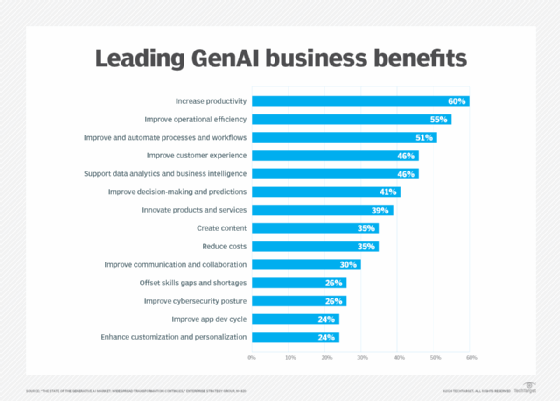
Like many other industries, the project management field is increasingly using generative AI for various business benefits.
Will AI replace project managers?
Capterra's 2024 Most Impactful PM Tools Survey found that project managers were already using AI for critical tasks in early 2024. Indeed, 54% reported using AI for project risk management, 53% for task automation, 52% for predictive analysis and forecasting, 52% for schedule optimization and 47% for resource planning and allocation.
But experts said they don't see the technology making project managers obsolete anytime soon -- if ever.
"I'm sure someone will try it somewhere. There will be someone who will experiment with that," Jani said. "Whether it will work is the big question, and whether it will be the norm? I don't get the vibe that it would."
However, Wu said he expects AI will affect the number of project managers needed in an organization. Some organizations will not need to hire as many project managers because their staff will be able to use AI to do more within their existing work hours, he said.
Yet Wu said organizations will still need human project managers to perform tasks that only humans can do -- such as working with teams across business functions.
Cousins had a similar take, saying that AI might someday "stand in for pieces of project management, such as prompting a worker to provide an update," but some work -- such as leading high-risk, costly and lengthy projects -- will remain in human hands.
Top benefits of AI in project management
Experts cited three top benefits of AI in project management:
AI helps scale project management. Project management professionals must perform core tasks such as developing schedules, assessing risk, modeling various scenarios and estimating costs. AI enables them to do that work at a velocity and volume that would be impossible to achieve manually.
AI improves accuracy. Although AI-powered project management software can't guarantee 100% accuracy, AI can avoid some human errors and deliver a high degree of accuracy for many tasks. "AI will get you to 85, 90 and 95% accuracy for cost estimates, risk and schedules right out of the box," Wu said. "If you want to get beyond that threshold, that's where human intervention comes in."
AI drives efficiency. "[AI] tools are starting to take over the rote, mundane, predictable tasks that are part of project management life," Montgomery said. This frees users to spend more time on higher-value, more complex work, such as decision analysis and meeting with stakeholders.
[AI] tools are starting to take over the rote, mundane, predictable tasks that are part of project management life.
Olivia MontgomeryAssociate Principal Analyst, Capterra
Challenges and risks of AI in project management
Such benefits, however, aren't automatic. AI, like nearly all enterprise technologies, is not plug-and-play. Instead, project teams must lay the groundwork if they want to use AI and reap the potential benefits.
A top challenge is preparing the enterprise data that AI tools require, Montgomery said, citing data quality, availability and volume as limitations on the helpfulness of AI tools.
Another challenge is rooting out unintended biases in the algorithms -- an issue in all uses of AI, as those biases can skew results and produce inaccurate insights, Montgomery said.
Experts also cited the lack of proficient data skills and AI experience among project management professionals as additional challenges to optimizing the use of AI tools in the field. "Humans are a limiting factor," Wu said. For example, AI can inundate workers with information, meaning project leaders must know how to apply their expertise to interpret AI output.
Another significant issue is the fact that AI can introduce risks into the project management environment. "The irony is that the use of AI for project management is a risk itself," Wu said. Consequently, project management teams need to develop guardrails and governance to reduce the risks that AI can introduce into their work.
This poses an additional challenge, Wu said, as many project management professionals don't yet have the skills needed to understand, identify and mitigate AI-related risks. Wu also cited the risk of AI's potential to fabricate results, a phenomenon known as hallucination.
Given these challenges and risks, Montgomery said, enterprise and project management leaders will have to decide where and how much to trust AI-generated information, as well as the extent to which human intervention is needed.
"AI tools can make decisions for you right now, so the company has to decide whether to verify those decisions or whether to execute on them," she said. "We want to be cautious with AI tools. They're not decision-making tools -- they're decision-informing tools. They distill, they predict, but they shouldn't be the decider."
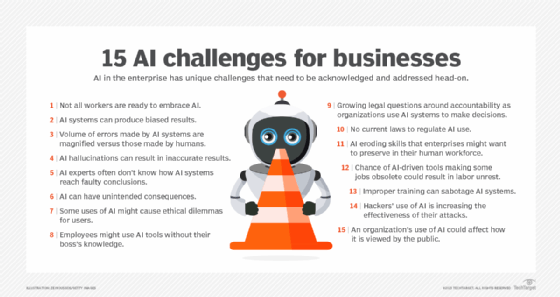
AI presents multiple challenges that businesses must consider and address.
Best practices for implementing AI in project management
To help overcome challenges and maximize benefits, experts offered the following best practices:
1. Strategize where and how to use AI in project management. "It's about understanding the task that's going to be automated and understanding why you're doing it," Jani said. "It's about identifying the goals you want to achieve."
2. Focus on integrating AI with other systems. AI works most effectively when it's not a standalone tool but rather a technology to improve or ideally transform workflows and processes, Jani said.
3. Select the right AI for your use case. "Know your AI; make sure you apply the right AI to the right task," Jani advised.
4. Establish AI governance and policies for AI use. "Adopt policies on when AI should and shouldn't be used," Wu said. "Remember, you own the work at the end of the day. It doesn't matter if you say, 'AI made the mistake,' because by the time you present the mistake, you own the work. You are accountable."
5. Implement training. As with other technologies, organizations that have the most success with AI adoption are those that have effective change management and user training, Wu said.
6. Retain your human agency. "Don't greenlight everything AI says," Cousins said. "You can't outsource discernment to AI."
The future of AI in project management
The level of AI capabilities delivered by project management software varies from one vendor to the next. However, vendors are rapidly adding AI to their products as a standard part of their offerings.
Wu anticipates that AI will improve enough to accurately distinguish voices in project meetings, enabling tools to deliver increasingly accurate summaries of who said what. He also expects vendors to use AI to make such records searchable at increasingly granular levels.
Montgomery expects large language models (LLMs) to make it easier for project team members to use project management software to perform complex tasks. Using LLMs, teams can engage with the software using everyday language rather than writing code.
Cousins anticipates advances in AI's ability to perform capacity planning, a capability that is still in its infancy. Technological advancements could also increasingly support other areas where AI is only just beginning to make inroads, such as demand management, resource assignment and prioritization.
In the future, Cousins said, project teams will be able to increasingly use AI to generate synthetic data to further aid predictive and prescriptive analyses. This, in turn, will help project management professionals increase their overall management accuracy, including their ability to audit their entire project portfolios.
Cousins also expects AI will help teams determine when to cancel struggling projects by bringing data-driven insights to a task that today tends to be more subjective than objective. Furthermore, he said, AI could advance enough to handle many tasks associated with project portfolio manager and change manager positions.
"There will still be a human who has responsibility for [those jobs], but they'll be massively assisted by AI," he said.
That, though, is likely far in the future. Many project managers haven't yet adopted AI, and those that have are facing challenges. Capterra's 2025 Project Management Software Trends Survey found that 41% of responding project managers said AI adoption is a challenge, 39% reported a lack of AI skills on staff and 36% said integrating new tools into existing workflows is a significant hurdle.
"These numbers reflect a deeper issue: Rapid innovation is outpacing teams' ability to learn and adapt," Montgomery wrote in the report.
Cousins had similar thoughts mixed with optimism. "AI is going to spin without getting a lot of traction for at least a couple more years until people figure out how to give it actionable data," he said. "When that happens, it's going to become an assistance device for good project managers."
Mary K. Pratt is an award-winning freelance journalist with a focus on covering enterprise IT and cybersecurity management.