Explaining the hidden costs of ERP implementations
It's easy to know what the software costs, but what about variables like customization, productivity and training? Experts reveal the pitfalls so you can avoid expensive surprises.

ERP software remains a bedrock of nearly every organization's IT stack, and demand for the technology remains high.
Fortune Business Insights, a market research and consulting firm, valued the global ERP software market at $92.6 billion in 2025 and predicted it will hit $281.6 billion by 2034 -- a 13% compound annual growth rate.
According to numerous research reports over the years, most organizations that successfully implemented ERP recouped their initial investment well within two years and saw significant ROI during the lifetime of their ERP system.
However, executives currently are under tremendous pressure to achieve positive returns faster. "Today's economic environment makes risk, cash discipline and speed-to-value the priority," noted Panorama Consulting Group in its "2026 ERP Report." Consequently, CIOs have little room for error when estimating the cost of a new ERP system.
Successfully deploying an ERP system is notoriously challenging, and the risk of budget overruns is high.
In fact, Gartner claimed that more than 70% of recently implemented ERP initiatives will fail to fully meet their original use-case goals, and up to 25% of those initiatives will fail catastrophically. Thirty percent of survey respondents in the Panorama report said their ERP projects were over budget. Scope expansion, technical issues, organizational issues, underestimating staffing needs and having to buy additional technology were the top five reasons for overruns.
Experts said many CIOs anticipate those kinds of costs yet still encounter unexpected ones as they shepherd their ERP projects from design to deployment and beyond.
"The biggest surprises typically come from selecting an ERP that isn't the right fit," said Walter Merkas, a partner at Withum, a consulting firm. Common reasons are not fully understanding current-state processes, underestimating integrations and data work, and making customization decisions that bring upfront and long-term ownership and maintenance costs, Merkas said.
Why ERP implementations are so expensive
Implementation costs vary widely. One ERP vendor targeting SMBs, Acumatica, estimated them between $150,000 and $750,000, but systems for large enterprises can reach into the millions.
The hefty cost matches the software's complexity.
ERP is one of the most complex pieces of software in the enterprise tech stack because it supports processes in nearly every part of the business. ERP platforms have several components, called modules, for functions such as accounting, finance, HR, customer relations, procurement and supply chain. Bringing all these business units and their processes into one system takes significant work, such as connecting the ERP software to other systems and ensuring data moves seamlessly between them.
In fact, much of the expense of bringing a new ERP system online comes not from the technology's price tag, but from the work required to first determine the organization's needs, then map connecting systems, deal with data issues and train workers on new business processes.
Organizations that fail to put in adequate planning upfront are the ones most likely to encounter hidden costs and budget overruns, Merkas said.
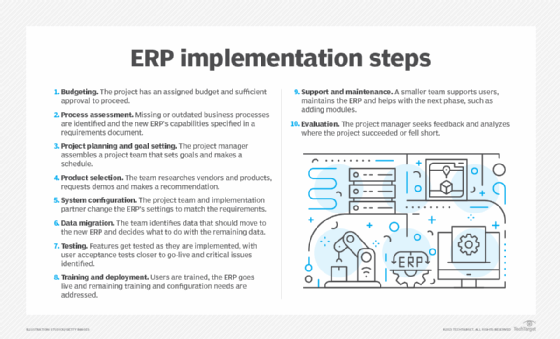
Hidden costs of ERP implementations
Despite such advice, many organizations still get hit with unexpected bills from their ERP implementations. IT leaders cited the following 10 items as the most common hidden costs.
1. The final price of the software itself
One of the first surprises to hit organizations is the licensing costs. Many organizations learn as they start the implementation work that their plans weren't as accurate or detailed as they should have been, said John Harrison, managing director at the Protiviti consultancy.
"If you're not granular enough, then a certain amount won't be included in that first bid. So, as you go through your design phase, you realize you need more modules, and that can be a quick escalator on the software cost side," Harrison said.
2. The cost of a bad fit
Similarly, organizations that don't fully understand their processes might select an ERP system that does not match their needs and requirements. "A lot of people pick the wrong application," Merkas said. That might not tank the entire project, but it usually leads to unanticipated costs for the extra work required to better align business needs with the new software.
3. Underestimating or missing needed connections
Organizations underestimate how many systems need to connect to the new ERP platform, which adds labor, technology and other costs for implementing and maintaining the integrations, Merkas said.
"Modern ERP systems sit at the center of a much larger application ecosystem, and companies routinely underestimate how many integrations they'll need," he said. "The initial build is only part of the cost. There are ongoing expenses for middleware subscriptions, API limits, monitoring, security and keeping integrations working as systems change. What looks like a one‑time technical task often becomes a permanent operating cost."
Harrison said he, too, has seen these costs sneak up on organizations, citing, as an example, how companies might see an increase in middleware subscription costs as a result of pumping data into their new ERP software.
4. The high cost of customization
Organizations that tweak their ERP systems to their own unique workflows also face unplanned costs, Merkas said. Modern ERP products, especially multi-tenant SaaS ERP platforms, support processes that meet industry best practices and have optimized and automated those processes to help organizations become more efficient. However, when ERP buyers don't already use or want to adopt industry-leading processes and instead prefer to customize their new ERP system to align with their existing workflows, they can be shocked by the price they pay for taking that path.
5. The ongoing costs of custom code
"A lot of the delivery consulting firms will say yes to the customization requested by [organizations], and when they're saying yes to the customization, they're just going to bill the client for the code," Merkas said.
Then come the ongoing costs. The ERP buyer -- not the vendor -- owns the custom code and must handle all the updating and maintenance. "That customization will cost a lot of money in the long run," he said.
6. The true price of talent
While organizations typically experience unexpected labor costs when they misstep in planning their ERP implementations, many face other surprises from miscalculating the available talent, said Sam Gupta, principal consultant at ElevatIQ, a provider of technology, management and digital transformation services.
For example, enterprise leaders often underestimate the skills required for the ERP work and overestimate the expertise of their own employees. That leaves a big shortfall in the talent needed to move the ERP project across the finish line.
Enterprise leaders also tend to overestimate their workers' availability and expect them to work on the ERP project while still performing their regular duties. When that doesn't pan out, organizations end up paying for extra help to work directly on the implementation or backfill positions so staff can shift from their regular jobs.
7. Dealing with data
One of the most significant hidden costs on almost all ERP implementations comes from the data work that's required, said Greg Taffet, managing partner and CIO at Taffet Associates, a technology consultancy.
Organizations often don't have a good handle on their data when they head into an ERP implementation, in part because their legacy ERP software hindered data management in the first place. And, unless they were meticulous in building up their data program in advance of the implementation, they encounter surprise bills for cleaning, managing and migrating their data to the new ERP system, Taffet said.
8. Missed work and missed business opportunities
Besides the unexpected costs associated with backfilling positions as employees shift to working on the ERP implementation, organizations face other hidden talent costs. Specifically, they often find that the workers covering for the diverted staff aren't as experienced, so work takes longer to complete or might go unfinished, Harrison said. That, in turn, impacts productivity levels and perhaps the ability to act on business opportunities -- both opaque costs of an ERP project.
9. Resistance to change
New ERP systems aren't enhancements as much as they are transformations, and they require employees to work in new ways, especially if they were used to an old ERP system, Taffet said.
That may be more so today than ever before.
"While many systems include AI routines, these routines normally add more features to the package and require people to learn how to use them to get the most out of the software. These additional changes to their normal work routines often make people more resistant to the new system, but it can be overcome with additional training and coaching," Taffet said. "We actually have to work on changing people's mindsets."
It helps that many workers are incentivized to learn how to use AI. "People now fear that if they don't learn to use the new technology quickly enough, AI will replace them," he said.
However, organizations often don't anticipate how much effort such a transformation requires, so they underbudget training and underestimate the time needed for changes in the workplace.
They pay a price for miscalculating, he said. Productivity drops as workers muddle through, and training costs rise as they try to catch up with managing the change. Or employees develop workarounds and resist adopting the new processes enabled by the ERP platform, which reduces its value.
10. Post–go‑live costs
Cost overruns don't end at deployment, these experts warned.
"There's a common assumption that costs taper off after go‑live, but that's rarely the case. Organizations spend heavily on hypercare to stabilize the system, retrain users, resolve defects and tune performance," Merkas said. "Over time, ERP becomes less of a project and more of a product, requiring continuous investment in optimization, automation and process improvement."
Merkas said organizations can also be hit with SaaS ERP pricing realities and subscription creep.
"With SaaS ERP, the surprise isn't infrastructure anymore -- it's subscription creep," he explained. "Organizations often start with a core license and later realize they need additional users, premium modules, sandbox environments or advanced analytics that weren't part of the original estimate. Usage‑based pricing for transactions, APIs or data volumes can also materially change costs once the system is live. If those scenarios aren't modeled upfront, total cost of ownership can escalate quickly."
Additionally, Gupta noted that many organizations underestimate the consumption-based bills they'll see post-ERP deployment. He explained that while consumption-based pricing isn't new, it is more novel for AI and is something that executives still struggle to predict.
Hidden costs expected but not inevitable
Studies have shown and experts have attested to the frequency of cost overruns in ERP implementations.
But hidden costs aren't inevitable, Gupta said.
He acknowledged that the costs of some ERP implementation work is hard to pin down, especially those associated with readying and migrating data. And many organizations struggle to build accurate cost estimates because they don't do ERP implementations often.
Those factors can be mitigated with more comprehensive upfront planning, Gupta said.
"The only way to remove invisibility from any model is to really break down your plan," he said. "You have to break down your implementation plan to know what you're going to see, and you need detailed planning assessments at the process, data and technology levels."
But even here organizations often face a pay-now-or-pay-later choice, Gupta said.
It is clear, he explained, that executives who put in more legwork when planning an ERP implementation can identify more of the needed work upfront and, thus, more accurately calculate project costs.
"The more you do in advance, the more confidence you'll have with your cost estimates," he said.
But that advance work also adds costs to the project, Gupta said. Moreover, it doesn't necessarily lower the overall cost. It just helps cut down on surprises.
Editor's note: This 2023 article was updated in September 2026.
Mary K. Pratt is an award-winning freelance journalist with a focus on covering enterprise IT and cybersecurity management.
Dig Deeper on ERP & Supply Chain
-
![]()
SAP rolls out customer experience AI agents, assistants
By: Don Fluckinger
-
![]()
AI transformation is inevitable but requires change management
By: Jim O'Donnell
-
![]()
Accounting experts call for public inquiry into Birmingham bankruptcy
By: Cliff Saran
-
![]()
12 notable ERP implementation failures and why they failed
By: George Lawton