Getting ERP contracts reviewed and approved is a critical last step in the ERP purchasing cycle. Once signed by the customer and vendor, the contracts lay the foundation for ERP software fees, acceptable use policies, service levels, implementation responsibilities, data protection obligations, renewal terms and exit rights.
What is an ERP contract and why is it important?
An ERP contract defines the parameters of the relationship between the customer and vendor. Finalizing the contract among legal teams can take months depending on the complexity of the project, the contract's wording and length, and the number of issues raised by the customer.
There may be multiple contracts for an ERP project due to its scope and requirements. Separate contracts may be necessary, for example, when the project's requirements dictate third-party software, when hardware is needed, or for software licensing and implementation services.
Cloud ERP and SaaS deployments can add more documents to the contract package, such as order forms, service-level agreements, data processing agreements and statements of work for implementation or integration services. Buyers should understand which document controls each obligation and whether terms differ across the ERP vendor, reseller, systems integrator and third-party software providers.
ERP contracts should define not only software fees and usage rights, but also implementation responsibilities, renewal terms, data protection obligations and exit conditions.
ERP contracts should define not only software fees and usage rights, but also implementation responsibilities, renewal terms, data protection obligations and exit conditions.
From the customer's perspective, the contract should include the following important items:
Fees, subscription terms, renewal rules and price increases.
What functionality, modules and usage rights are included.
Service-level commitments, support hours and expected resolution times.
Implementation scope, deliverables, responsibilities and change-order rules.
How the software may and may not be used.
The number and type of licensed users or usage metrics.
Data ownership, data protection, data portability and return or deletion obligations.
How AI features may use customer data, if applicable.
How the contract can be renewed, renegotiated or ended.
Vendors ensure the contract provides them with protections, specifies the software and services provided, and contains fee-related details.
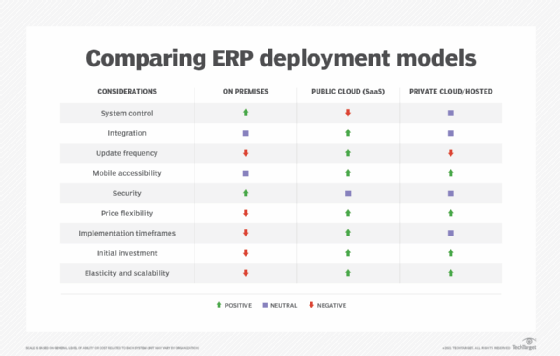
Chart comparing enterprise resource planning deployment models and their contract considerations.
Types of ERP contracts
ERP vendors write their contracts partly based on their sales model. Circumstances that may influence the sales model and associated contracts include the size of the vendor, global locations where it operates and market segments. Some vendors, for example, may want to sell their ERP software directly to customers, while others may rely on resellers. An ERP vendor also may choose to sell its software in key geographies and use a reseller in other parts of the world.
Vendors typically use three types of contracts. But they can be creative with the way they use third parties to sell their software. They may also allow third parties to enhance and expand the software's functionality or, in some cases, white label unbranded software.
ERP vendor contract
The ERP vendor is the primary contact and provides the contract for the ERP software. The contract may include implementation services, even if deployment is done by a certified systems integrator. In that case, software implementation may also require a separate contract provided by the systems integrator.
Reseller engagement with ERP vendor contract
Large ERP vendors may have agreements with resellers that can sell the software on the vendor's behalf. The software vendor maintains responsibility for the software, including fixing and enhancing the software, while the reseller may offer additional services such as technical support and consulting.
Reseller contract
A reseller provides the contract to the client that includes the ERP software, and the reseller takes contractual responsibility. The reseller maintains a relationship with the software vendor, but customers go through the reseller for software fixes and enhancements. The reseller may be able to customize or augment the software to meet vertical market and customer needs.
ERP deployment models can directly influence contract terms, including licensing, service levels, implementation responsibilities, customization, data protection and support.
Cloud ERP contracts add new review points
Cloud ERP contracts often involve more than a traditional software license. A contract package might include subscription terms, service-level agreements, data processing terms, implementation statements of work and separate agreements with systems integrators, resellers or third-party software providers.
That makes it important to understand which document controls each obligation. For example, one document might define pricing and renewal terms, while another governs uptime commitments, support response times, data protection, breach notification or transition assistance at the end of the contract.
Buyers should also review how the contract addresses AI features, if applicable. The agreement should make clear whether customer data can be used to train, tune or improve vendor models, and whether protections for privacy, security, intellectual property and liability are sufficient for the organization's risk tolerance.
Key considerations when reviewing an ERP contract
The customer may invite several people to review and validate an ERP contract, including legal, external counsel, technical members of the team, project management, finance and the contract management team. Consider the following questions when reviewing an ERP contract:
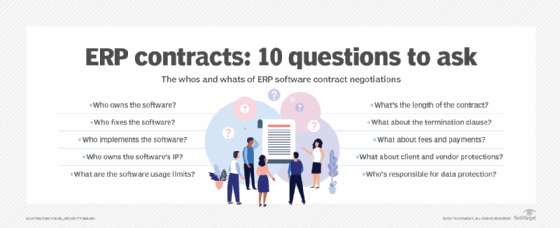
Who owns the software being licensed? Depending on the software required to meet the requirements, there may be multiple software vendors involved in the process. Additionally, resellers may be involved that sell the OEM's software but don't own the software contractually.
Who's responsible for fixing software issues? Responsibility can depend on the functionality being considered since ERP projects may involve multiple vendors. Any custom code that's necessary to complete the software also needs to be considered.
Who's responsible for the software's implementation? This responsibility may rest with the ERP vendor, a reseller or a certified implementation partner.
When working with resellers, do they own any intellectual property (IP) rights to the software? A reseller that owns the IP may have added custom code to augment the software.
What are the software's usage restrictions? The contract often outlines what can and can't be done with the software. For example, there may be restrictions on the number of users, the countries where the software can be used or customers reselling the software.
What's the length of the contract? The contract indicates how many years the software can be used before it has to be renegotiated.
What's included in the termination clause? Contracts always have a clause that indicates how the vendor or customer can exercise early termination of the contract. A clause may include a notification period or a penalty fee for early termination.
What are the fees and payment schedule? Contracts include everything related to the amount the customer must pay to license, use and implement the software. The deployment costs may be quoted separately, especially when the implementation services are provided by a third party.
Does the indemnification clause protect the vendor and customer? The contract outlines who's responsible for compensating the other party for losses in case of certain events, like a data breach.
What's listed in the data protection clause? Data protection is highly important since data breaches can significantly impact the vendor and customer. The contract's wording often indicates that both parties are responsible for protecting data.
Negotiating your ERP contract with your vendor
During contract negotiations with an ERP vendor, consider the following items to ensure the process runs smoothly and important steps and items are included:
Create a process beforehand to manage the contract review.
Designate one person to be responsible for the contract review process.
Involve legal counsel early in the process.
Use
to manage the process, including tracking emails, revisions and signed contracts.
Review and validate each piece of software identified in the contract with subject matter experts, especially when there's a fee attached to the software.
Understand the allotted budget versus actual costs for the project.
Negotiate elements of the contract that don't meet the company's needs or standard practices.
Negotiate the price for all listed components of the project, including licensing, maintenance and support, implementation and consulting services.
Identify who must sign the final contract before the signatures are required.
Editor's note: This article was updated to improve clarity and include current ERP contract considerations around cloud services, data protection and AI features.
Eric St-Jean is an independent consultant with a particular focus on HR technology, project management, and Microsoft Excel training and automation. He writes about numerous business and technology areas.