
Getty Images
Prepare a complete ERP readiness assessment for your company
Before starting an implementation, you need to determine whether the organization has the culture, resources and structure to support an ERP system. Here are the essential steps.

Before deciding to acquire and implement an ERP system, companies can perform an ERP readiness assessment. The assessment will inform leaders about the organization's ability to take on this type of project before investing time, money and effort.
Key questions the assessment will answer include the financial viability of the project, the business need and the availability of resources required. The assessment also covers other topics, such as quantifying the cost of staying with the status quo, the cultural readiness and adaptability of employees, and how prepared the company is with documented processes, procedures and policies that can be implemented in the ERP.
With the assessment complete, the organization's leaders can determine if it is ready for an ERP project -- or when it could be ready -- and all the steps that must be taken before the project begins. For example, the assessment might highlight significant technical gaps that must be addressed before kicking off the project.
Key components of ERP readiness
Before launching the assessment, the project leader should gather information from key stakeholders about what's most important to them. They should also use templates and their own experience to develop a detailed plan of what will be assessed.
Here are 10 things to consider when developing the readiness assessment template:
- Budget. The CFO should confirm there is budget to acquire, implement and support the ERP system post go-live.
- Business need. Through interviews and surveys, the project leader should gather input, document the need for the new ERP and determine how it aligns with other business priorities.
- Aligned goals. The assessment should help flush out any conflicting or misaligned goals for the project that need to be addressed.
- Documented policies, processes and procedures. Confirm there are up-to-date documents that can easily be translated into ERP requirements, or, alternatively, identify the documentation that is out of date or nonexistent.
- Cultural assessment. Through employee surveys and focus groups, assess whether employees will embrace a new ERP. The response to this assessment might not derail an ERP project, but it will help when developing a communication and change management plan.
- Resource availability and experience. The company's leaders need to know whether it has employees with the right experience and sufficient time to dedicate to the project. This includes identifying other major projects being undertaken by the company and their impact.
- Data cleanliness. It's important to understand how clean and valid the data is in its current state. Major issues might require cleanup before migration to an ERP.
- System map. There should be a clear understanding of the systems currently in use and how they will be affected by a new ERP. For example, some might be replaced and others might need to be integrated into the ERP.
- IT infrastructure. IT plays an important role in a new ERP project. Given this dependency, leaders should feel comfortable that IT has a solid base to build on and the capacity to take on a new project.
- Ownership and leadership stability. Assess whether the organization is in a position to commit to this type of project. For example, has it recently acquired a company? Is it the target of an acquisition? Has the leadership team changed significantly?
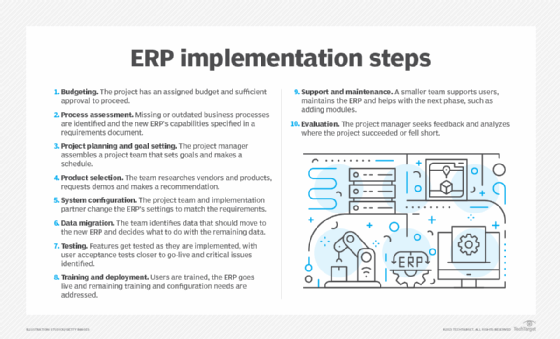
Steps in developing and using an ERP readiness assessment
Take these steps to develop an effective readiness assessment and put it to good use:
- Assign a project leader. For the assessment to be effective, a dedicated project leader should be assigned to it with sufficient authority and support to carry out the project. The project leader can be an employee or an external consultant who has experience developing this type of assessment.
- Establish a timeline. There needs to be a clear timeline for the assessment, so it doesn't go too long but also isn't so short that critical data is missed.
- Develop the assessment. With input from the project sponsor and key stakeholders, develop the assessment, including the questions and surveys, and identify who will participate in each phase of the assessment.
- Develop a communication plan. The communication plan outlines who will be told about the project and what they should expect. For example, every employee asked to complete a cultural readiness survey should be told in advance about the survey, its goals and how the feedback will be used.
- Launch the assessment. Gather input from groups and individuals whose feedback is considered essential. The project leader might need additional support to build and manage surveys, schedule meetings and interview participants.
- Analyze data. As portions of the assessment are completed, the data must be analyzed and summarized.
- Prepare a report. Once the assessment is complete, the project leader should summarize the data and put it in a format that can be presented to the project sponsor. It's important to give the project sponsor time to review and provide feedback on the report before sharing it more broadly.
- Share the findings of the assessment. Once the assessment is final, share the findings with company leaders and other stakeholders.
- Make a go/no-go decision. With the assessment complete, the organization's leaders must determine whether they are prepared to go forward with the project. Rather than granting approval to acquire an ERP, this decision determines whether to pursue the next steps: developing requirements, investigating ERP products and validating assumptions about cost, implementation timelines and other critical factors.
Eric St-Jean is an independent consultant with a particular focus on HR technology, project management and Microsoft Excel training and automation. He writes about numerous business and technology areas.