Webinars
Stay current with the latest webinars on information strategy. Explore more related webinars on TechTarget's BrightTALK platform.
-
Leading Through Critical Incidents: Communication, Trust and Recovery
The real measure of incident leadership is not just how quickly we recover today, but how deliberately we reduce the probability and impact of tomorrow’s incidents. In this session, Jyotirmayee Pradeep Kumar, Vice President - Cloud DevOps at a well-known global bank, will explore the full incident lifecycle through the lens of leadership, communication, and resilience. From identifying what failed, who was affected, and where the business risk sits, to establishing incident command, coordinating responders, communicating with executives, making recovery decisions, and managing stakeholder updates under pressure, she will show how effective leaders bring clarity, structure, and confidence to high-stakes moments. Attendees will leave with practical insights into leading through disruption, restoring service effectively, and turning incident response into stronger long-term operational resilience. Key takeaways - Build incident command quickly and communicate with clarity. - Adapt messaging for different stakeholders during high-pressure moments. - Make sound recovery decisions while minimizing business disruption. - Preserve trust through transparency, accountability, and steady leadership. - Convert crisis lessons into lasting operational resilience.
 Jyotirmayee Pradeep Kumar, Vice President - CoreDev DevOps | International Banking
-
ON-DEMAND 44 mins
Command the Peak: The 2026 Holiday Readiness Masterclass
Contact Us Command the Peak: The 2026 Holiday Readiness Masterclass On-demand •45 minutes Register to watch now Share With 1.5 billion global shoppers now starting their journeys earlier and demanding more value, traditional retail strategies are no longer enough. Join us in this webinar as we cover key trends coming off the back of the 2025 holiday season, hear best practices from Commerce Trailblazer Elaine Bagshaw, Salesforce Platform Owner at Curry's and walk through your Month-by-Month Peak Readiness Checklist—a proven framework used by global leaders to stress-test systems, forecast demand, and dominate the peak shopping season to turn traffic into permanent loyalty and revenue. Sign up now if you want to: Scale Through Digital Labour: During 2025 Cyber Week, 68 billion AI-product recommendations were delivered by the Salesforce platform. Learn how to deploy AI Agents that provide 24/7 personalized service and product discovery, scaling your capacity to capture more revenue without increasing overhead. Deliver Seamless Customer Experiences That Boost Conversion: Organizations that leverage unified customer profiles see up to a 2x increase in repeat purchase rates, as they can deliver hyper-relevant promotions, product recommendations, customer service and real-time inventory visibility that builds long-term revenue. Bulletproof Your Infrastructure for Zero-Downtime: A one-second of downtime can cost millions during a peak surge. Learn to identify and eliminate hidden technical bottlenecks before they impact your bottom line. We'll cover the essentials of minimizing API latency, securing third-party integrations, and optimizing your checkout flow to ensure stability of your platform's performance during peak season. Don’t just survive the holiday rush—command it by leveraging a unified commerce strategy to transform these best practices and insights into your most profitable season yet.
Viktoria Austin - Product Marketing Lead; Rosemary Okolie - Industry Solutions & Strategy Director; Dan Seymour - Consumption Lead; Elaine Bagshaw - Salesforce Consultant
-

ON-DEMAND 47 mins
The Headless Law Firm: The Full Power of Salesforce Within Outlook and Teams
Despite digital transformation being a top priority, elite firms often struggle with partner adoption due to the administrative burden of legacy CRMs. Join this live webinar to explore how to overcome these barriers by implementing an "Invisible CRM". Discover how Salesforce and Agentforce seamlessly integrate into the tools partners already use daily — such as Microsoft Outlook and Teams. See how conversational AI agents can handle client research, matter intake, and business development directly from the inbox. Learn how this "headless" approach eliminates administrative tax, empowers data-driven decision-making, and accelerates profitable growth, all while elevating partner expertise and preserving their valuable time.
Ed Thompson - SVP Global Influencer Strategy; Nicola Driscoll - Regional Vice President, Sales; James Merrick - Client Director
-
ON-DEMAND 40 mins
There's No Cybersecurity Mindset: Why Diverse Thinking Strengthens Security
Adversaries are accelerating their use of automation and AI, outpacing what legacy SOC architectures can handle. Relying solely on new technology addresses only part of the challenge. Effective cybersecurity demands equal focus on people and policy. Staying ahead requires building adaptive, analyst-driven teams that integrate human and machine strengths. Individuals facing the same threat interpret risks and priorities differently. Harnessing these varied perspectives improves communication, reduces risk and boosts readiness. Charles Kolodgy discusses why there is no single ideal cybersecurity mindset. Instead, a spectrum of perspectives shapes how teams assess threats, make decisions, and respond to incidents. Tune in to discover why an environment that harnesses these differences to challenge assumptions and drive better outcomes is crucial for resilient security operations. Key Takeaways: - Pinpoint the elements of diverse cybersecurity mindsets and show how different perspectives influence priorities, risk assessments, incident response, and business decisions. - Apply practical methods to manage mindset diversity, using techniques for constructive challenge, clear communication, conflict resolution, and team cohesion. - Adopt strategies to align varied mindsets across SOC teams, IT operations, leadership, and users. - Recognize how cognitive diversity and complementary mindsets strengthen defenses against complex, evolving threats. - Evaluate how AI is reshaping cybersecurity thinking and how human-machine collaboration changes perception, decision-making, and response.
Charles Kolodgy, Principal | Security Mindsets LLC
-
ON-DEMAND 47 mins
How to Limit Risk and Exposure from Agentic AI
As agentic AI transitions from experimental technology to embedded workplace reality, organizations face an unprecedented expansion of their attack surface. This conversation examines the critical inflection point we've reached—where coding assistants, browser-integrated agents, and autonomous systems with persistent execution loops are becoming standard tools, accessible even to non-developers. Join Pascal Geenens, VP of Cyber Threat Intelligence at Radware, and Simon Ratcliffe, Independent Management & Technology Consultant, for a compelling 30-minute fireside chat exploring the emerging security challenges posed by autonomous AI agents in 2026. Pascal and Simon will navigate essential dimensions of this evolving landscape. They'll contextualize the fundamental shift occurring in 2026, including the "Bring Your Own Agent" phenomenon where autonomous agents are now integrated directly into operating systems and corporate workflows. They'll dissect the real-world threat vectors that security teams must address—from indirect prompt injection attacks and software supply chain compromises to the architectural trade-offs between cloud-based frontier models and self-hosted alternatives. Pascal will provide actionable guidance on risk mitigation strategies, exploring visibility frameworks, artifact proxies, LLM firewalls, and why intent-based protection models are essential when traditional content filters fall short. Whether you're a security professional, technology leader, or risk manager, this session offers critical insights into protecting your organization as AI agents become autonomous actors within your infrastructure.
Pascal Geenens, VP of Cyber Threat Intelligence, Radware | Simon Ratcliffe, Independent Management & Technology Consultant
-
ON-DEMAND 46 mins
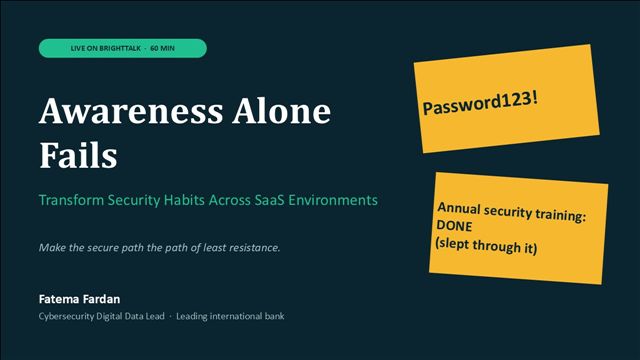
Awareness Alone Fails: Transform Security Habits Across SaaS Environments
Attackers exploit established routines and workflows, making traditional training ineffective. Human error is magnified in hybrid environments. The SaaS footprint keeps expanding, access paths keep shifting, and oversight becomes uneven. This drives up fraud losses, data exposure, operational downtime, and regulatory risk. Ultimately, customer trust, employee confidence and your security team's credibility are on the line. Leaders need to make the secure path the path of least resistance by embedding clear guidance and guardrails into daily workflows and tools. This session examines how organizations can move past compliance-focused training and implement a human-centered security strategy by identifying risky behaviors, reducing security friction, and building controls that employees naturally embrace. Fatema Fardan, Cybersecurity Digital Data Lead at a leading international bank, draws on lessons from banking, fraud prevention, and cybersecurity operations to show practical ways to measure behavior change, design effective security nudges and balance user experience with risk in today’s hybrid workplace. Topics for discussion include: - Pinpoint why awareness programs fall short and map risky behaviors across your environment. - Design controls employees actually use, from adaptive MFA to real-time guidance at critical decision points. - Counter phishing and fraud by integrating training, simulations, and behavioral nudges linked to identity signals. - Track what drives impact: reporting rates, time-to-report, reduction in repeat clicks, control adoption, and measurable ROI. - Establish a cross-functional operating model using pilots, A/B testing and leadership dashboards.
Fatema Fardan, Cybersecurity Digital Data Lead | Leading International Bank
-
ON-DEMAND 40 mins
Weakest Link: How Security Gaps and Bad AI Hygiene Can Kill a Business
AI is already in your business, whether you rolled it out or not. Someone on your team pasted a contract into a chatbot this week, connected an AI assistant to their inbox, or signed up for a new tool with a work email, and every one of those moves opened a new door into your environment. In this session, John Hansman, CEO of Truit, a managed IT, cybersecurity and AI consulting firm, walks leaders through the security gaps and bad AI habits he sees most often in real organizations: free tools that keep or train on what employees type, shared and orphaned logins, sensitive data pasted into public AI, and AI agents wired into business systems with no owner and no oversight. He'll show how these small gaps chain together into a business-ending incident, and why adopting AI without a plan means adopting risk without a plan. Attendees will leave with: - A vendor-neutral, three-step framework (see it, secure it, strategize it) for finding the AI already in use. - Setting guardrails such as a short-written AI policy, an approved-tools list and clear data-handling rules. - Building a prioritized roadmap with an owner for every use case, so AI becomes an advantage instead of the weakest link. Meet the Speaker John Hansman is CEO of Truit, a family-owned managed IT, cybersecurity, and AI consulting company with offices in Tumwater and Spokane, Washington. He spent the first 20 years of his career in the electronic security industry, rising from entry-level technician to Central Station Manager and later IT Project Manager for a major corporation. He now helps organizations strengthen their cybersecurity, protect their data, and put AI to work safely. A frequent speaker for chambers of commerce and industry groups, including the Thurston County Chamber and the Washington Trucking Association, John turns complex cybersecurity and AI topics into practical steps business leaders can act on immediately.
John Hansman, CEO | Truit
-
ON-DEMAND 59 mins
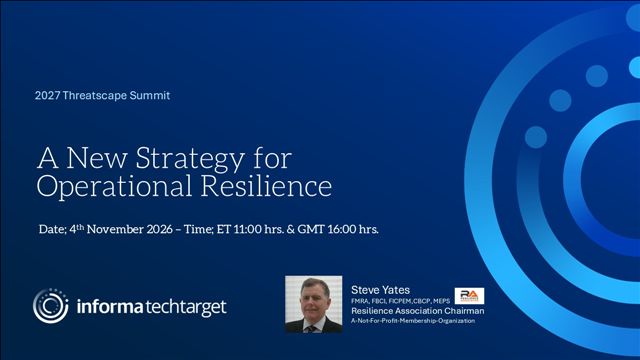
Preparing for the 2027 Threatscape: A New Strategy for Operational Resilience
The speed of geopolitical risk continues to increase, not least in the differing approaches to the development of Artificial Intelligence (AI). Governments are now warning that it is "likely, if not inevitable" that national cyber defenses will at some point be breached. Among this growing spread of challenges, any new strategy must take account of the current level of operational risk. So ask yourself this question: do you do nothing, or do you move your organizational strategy towards planning for the worst? Join Steve Yates, Chairman of the Resilience Association and Liveryman of the Worshipful Company of Information Technologists, to explore lessons learned from past events and how you should position your organization to be sufficiently prepared for "business-as-unusual". Key Takeaways: - Identify 2027 threat landscape challenges. - Review the changing direction of operational risk. - Update operational readiness and response strategy. - Change leadership thinking about operational resilience. - Establish a joined-up way of thinking with internal and external partners.
Steve Yates, Chairman | Resilience Association
-
ON-DEMAND 58 mins
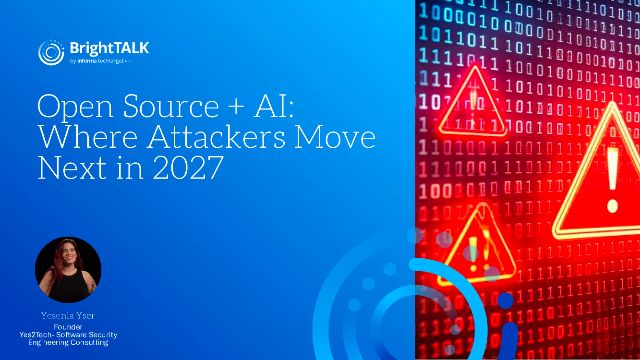
Open Source + AI: Where Attackers Move Next in 2027
Supply chain and AI security failures share a common thread. Adversaries identify structural gaps, assess potential impact, and act before defenders can respond. In 2026, this approach drove major incidents across open source, AI tooling, build pipelines, and interconnected vendor environments. However, attackers do not rely on static tactics. Their methods adapt faster than most organizations can adjust their defenses. Industy thought leader Yesenia Yser moves the conversation from retrospective analysis to forward-looking action. Using threat patterns, attacker behaviors, and governance breakdowns from 2026, she argues for anticipatory defense. The goal? To understand adversary strategy deeply enough to close architectural gaps before attackers exploit them, not after the damage is done. For 2027, Yesenia will identify the threat vectors set to define risk across open-source software, AI systems, and supply chains. The session will turn the hard lessons of 2026 into actionable foresight. Expect clear guidance on where advanced attackers are likely to strike next, which structural weaknesses enable those moves, and what defensive architectures can close the most critical gaps.
Yesenia Yser, Founder | Yes2Tech- Software Security Engineering Consulting
-
ON-DEMAND 29 mins
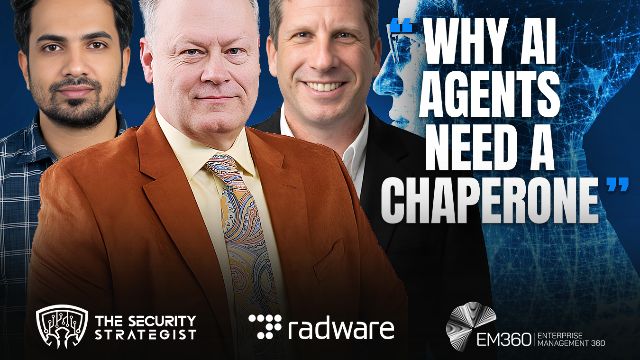
Can Runtime Security Keep Autonomous AI Under Control?
“Autonomous AI agents could take an entire task & run it from start to stop without intervention, without any directives, making agentic AI attacks far more vicious than what the industry is accustomed to in traditional applications.” The one key thing that could aid enterprise success in the agentic AI cybersecurity space today is its ability to understand agents' intent. It’s easy to state but hard to convert into an actionable security strategy. This is why in the recent episode of The Security Strategist podcast, host John Tolbert, Director of Research and Principal Analyst at KuppingerCole Analysis, is joined by Dror Zelber, VP Product Marketing at Radware and Dhanesh Ramachandran, Product Marketing Manager at Radware. They got together to discuss the emerging challenges of agentic AI security and how to tackle it realistically.
John Tolbert, Director of Research and Principal Analyst, KuppingerCole Analysis | Dror Zelber, VP Product Marketing, Radware | Dhanesh Ramachandran, Product Marketing Manager, Radware