Quantum-inspired algorithms mimic quantum computing principles on classical hardware. Experts share how businesses can benefit from this innovative technology.
Quantum is quickly advancing toward commercial utility, bringing revolutionary benefits to numerous industries and solving intractable problems.
Quantum computing's potential stems from its very nature: It uses the principles and qualities of quantum mechanics to produce its calculations. Instead of using the traditional binary bit, which represents 0 or 1, quantum computing uses the quantum bit, or qubit, as its fundamental unit of information. Qubits can represent 0, 1 or both simultaneously via superposition, enabling quantum computers to evaluate multiple possibilities at once. This is what enables quantum computing's advanced, high-speed computational capabilities.
According to McKinsey & Company's report "McKinsey Quantum Technology Monitor 2026: A commercial tipping point," quantum computing could create $2.7 trillion of economic value worldwide by 2035. Companies building quantum computers and services include Amazon, D-Wave Quantum, Google, IBM, Microsoft and Quantinuum; however, they are still a ways off from offering commercialized quantum computing services at scale.
"The expectation is that … in the next five to 10 years we will be able to use hundreds of thousands of qubits to solve problems," said Velu Sinha, partner at global management consulting firm Bain & Company.
Some companies are already using the limited quantum computing services available to experiment with solving their most complex problems. Meanwhile, others are using the next best thing: quantum-inspired algorithms. These algorithms provide businesses with some of the benefits of quantum computing while also preparing them for the day when quantum computing is readily available for broader commercial use.
What are quantum-inspired algorithms?
Quantum‑inspired algorithms borrow ideas from quantum computing, yet they do not require quantum computers to run.
"A quantum-inspired algorithm is not using true quantum hardware. It uses the quantum concept on the hardware we have right now," explained Amr Magdy, associate professor of computer science and engineering at the University of California, Riverside.
These algorithms mimic specific quantum computing principles and use mathematical quantum concepts, such as superposition, entanglement and tunneling, but run on classical hardware using CPUs, GPUs and TPUs. Magdy said these algorithms benefit organizations by enabling them to tackle highly complex problems with greater accuracy and speed than conventional algorithms would, though not to the degree of true quantum computing.
Quantum-inspired algorithms also provide a bridge to quantum computing itself. Their use prompts executives, technologists and developers to consider quantum use cases and build the skills they will need to use quantum computing when it's commercially available.
"Quantum-inspired algorithms allow us to prepare," Sinha said.
Applications of quantum-inspired algorithms
Organizations are using quantum-inspired algorithms across a range of use cases and seeing ROI for their efforts.
Quantum-inspired algorithms provide the benefits of quantum computing on classical computers.
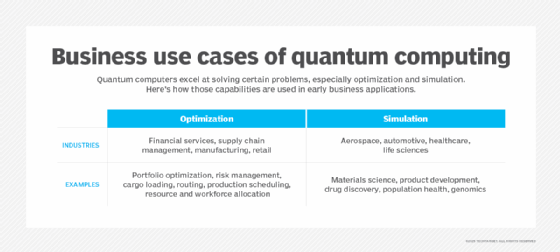
According to Sinha, logistics, pharmaceuticals, manufacturing and financial services are using these algorithms and seeing outputs in minutes or hours, rather than hours or days as they'd normally expect. Financial services firms are using quantum-inspired algorithms for portfolio optimization. Healthcare providers are using them for radiotherapy planning optimization. Life sciences companies are using them to accelerate drug discovery. Manufacturers are using them for production scheduling and yield optimization.
Consider the following case studies:
Toshiba's High-Frequency Trading system. Toshiba launched SQBM+, "quantum-inspired optimization technology," according to the World Economic Forum. This tech demonstrated improved performance and arbitrage-trading speed compared to classical computing and algorithms.
Fujitsu's Digital Annealer. Fujitsu developed its Digital Annealer, inspired by quantum technology, to solve complex combinatorial optimization problems. The annealer enabled the company to optimize robotic movements in BMW paint shop operations, bundle vehicle loans for Commerzbank and stabilize molecular structures in pharmaceutical R&D at Toray Industries.
Deloitte's fraud detection. Deloitte is using quantum-inspired models to detect fraud and predict scams. In one such case, the company identified individuals at risk of romance scams and intervened, following up with those affected.
Amazon, BQP, Classiq, D-Wave, Google Quantum AI, IBM, IonQ, Microsoft, Quantinuum and Rigetti Computing are among the leaders in quantum and quantum-inspired offerings.
"[Users] are seeing real gains, and they're seeing real business benefits today," Sinha said, adding that these benefits "portend what they will be able to do with real quantum computing."
He said that while pharmaceuticals and manufacturing are leading in quantum-inspired algorithm adoption, any organization using large data sets to solve complex problems could benefit from them. Magdy agreed, noting that optimization problems are the types of problems that quantum computing and inspired algorithms are primed to solve.
"Optimization problems are everywhere," he said.
Strategic considerations
Quantum-inspired algorithms deliver powerful problem-solving capabilities to organizations. But, like all technologies, they're not panaceas.
We think that the use of quantum-inspired algorithms is a good bridge action.
Velu SinhaPartner at Bain & Company
Holger Mueller, vice president and principal analyst at Constellation Research, said not every problem requires quantum computing, noting, "Some problems should stay with classical computing."
Mueller said that organizations must consider the size of the problems they're looking to solve and whether the vendors' machines have enough qubits to handle their complexity.
Magdy echoed Mueller's advice, saying that executives should carefully identify use cases where quantum-inspired technology would meaningfully outperform advanced classical computing techniques and deliver value.
Magdy also said that while quantum-inspired algorithms might not offer the same speed and accuracy as true quantum computing, they are much more accessible today and are a good option for organizations to start building their quantum-related acumen and skills.
Sinha agreed, explaining that companies can work with these algorithms to learn how to set up problems, interpret their results and determine whether to build quantum skills in-house or through partners.
"Not every company has to be on the leading edge of [quantum computing use], which is why we think that the use of quantum-inspired algorithms is a good bridge action," Sinha said. "Quantum-inspired algorithms let you start whetting your appetite around what can happen."
Mary K. Pratt is an award-winning freelance journalist with a focus on covering enterprise IT and cybersecurity management.