How governance maturity affects M&A integration outcomes
M&As are often based on valuation and strategic fit, but post-deal integration -- where governance maturity becomes critical -- determines whether they succeed or fail.
It's commonplace for M&A deals to be evaluated based on projections around valuation, synergy and strategic fit. Before a deal goes through, M&A experts carefully analyze a target company's current value. They also attempt to draw a picture of its future financial health, explore opportunities for generating synergies, and examine critical aspects like cultural compatibility, legal liabilities and deal alignment with long-term business goals.
These careful pre-deal assessments are crucial for M&A success.
However, it is the post-deal integration phase that ultimately determines whether the deal's projected value materializes. And during this phase, governance maturity is vital. This concept refers to the presence of clear decision rights and escalation paths, well-established platform ownership and cross-functional accountability structures, along with effective data governance policies, architecture standards and risk management and compliance controls.
This article explores how governance structures can influence the success of M&A integration,particularly in enterprises that rely on complex digital platforms and systems.
Post-merger integration as a governance 'stress test'
During post-merger integration, on-paper M&A strategy meets real-world execution. In this crucial phase, the stakes are high and the pressure to succeed is intense. Clarity, control and coordination are needed to withstand the pressure, successfully execute the initiative and achieve an M&A's strategic objectives. Here's where astrong governance framework plays a critical role. In fact, experts like Jake Henry, senior partner and co-leader of Mergers and Acquisitions at global management consultancy McKinsey & Company, directly link organizations' governance maturity and their leaders' governance proficiency with the ability of an M&A deal to create value during integration.
Organizations with mature governance structures tend to have the following:
Systematic framework and controls for proactive risk management and compliance.
Codified institutional knowledge through systematized, documented, repeatable processes.
Cross-functional, data-driven decision-making.
Transparent, timely, accurate flows of information and communications.
These firms can effectively and smoothly integrate systems, teams, processes, data models and decision authority across two companies. Leaders take more informed decisions and effectively manage common risksduring high-stakes post-merger integration, transformation and scaling. They can also reduce uncertainty and measure the outcomes of the deal across real teams, systems and decisions.
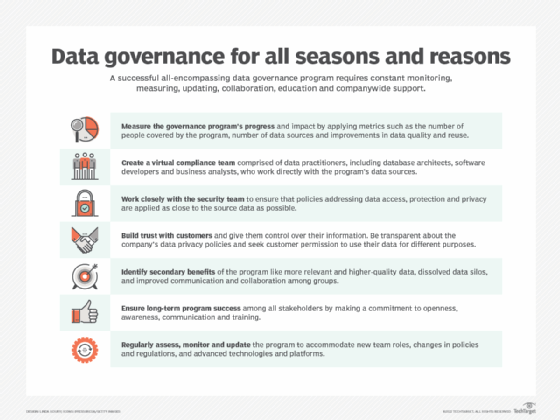
Collaboration, continuous monitoring and training are all necessary components of successful governance frameworks.
Without a strong governance framework, gaps quickly emerge in decision-making, accountability, cross-functional coordination, compliance, risk oversight and business integration. These gaps could lead to unexpected integration delays or duplicated technology investments.
They also create shadow IT that affects the firm's cybersecurity posture, along with data siloes that affect cross-functional collaboration and communication. Most importantly, weak governance hinders organizations from realizing critical synergies and achieving their strategic objectives.
Why governance maturity becomes critical after the deal closes
Whether an organization has a strong and mature governance structure becomes clear during post-merger integration. This period often exposes governance weaknesses that were previously manageable within a single organization but that now hinder M&A integration and create a host of problems, including system incompatibility, operational disruptions, cross-functional data siloes, new cybersecurity vulnerabilities and higher technical debt.
To avoid these issues, leadership teams must address numerous high-priority issues, including the following:
Which systems should survive.
Who has authority to standardize platforms.
Who owns integration decisions.
How data should be reconciled across platforms.
Which data model becomes canonical.
How to resolve data ownership disputes.
Who is responsible for risk and compliance management.
How responsibilities should be divided across the combined organization.
How cultural conflicts in tool usage will be addressed.
How risk and compliance will be tracked.
How technology investments will be tracked, and how their ROI will be assessed.
Organizations with mature governance frameworks usually resolve these issues faster. They face few, if any, problems integrating platforms, processes and teams; aligning data models; and rationalizing technology portfoliosacross the combined organization. In contrast, organizations with fragmented governance experience slower integration and increased operational complexity -- both undesirable consequences of ambitious M&A deals.
These issues explain why many M&A experts and practitioners emphasize the importance of mature, strong governance in successful M&A integration. One of them is Jonathan Milde, managing director and partner at Boston Consulting Group. Milde also recommends that organizations establish "steering mechanisms" and dedicated teams to coordinate all tech-related dependencies and, more importantly, to ensure that the "available technology supports the combined entity's business vision."
Enterprise platforms as the integration battleground
Technology is a key enabler of business operations, efficiency and productivity in modern organizations. Companies in every industry make use of advanced technologies through a variety of enterprise platforms, including ERP, CRM, workflow automation, supply chain and procurement, HR, workforce management, collaboration, data management and business intelligence systems.
These systems help to streamline operations, support data-driven decision-making, facilitate connectivity and collaboration, and drive business scalability and innovation. They deliver these benefits by encoding business processes and operational logic, which is why they often become the focal point of integration decisions after mergers or acquisitions.
Following M&A deals, it can be challenging to integrate incompatible IT systems and consolidate disparate data, while also maintaining operational continuity and mitigating security risks. A mature, time-tested, multi-layered governance framework can help ease these challenges, influencing and simplifying multiple integration efforts, including the following:
Platform consolidation, scaling, upgrades, modernization or decommissioning decisions.
Strong governance provides visibility into the tech stack, enabling organizations to select, manage and seamlessly harmonize technologies and systems, while lowering the risk of operational disruptions, lost productivity, communication breakdowns and innovation slowdowns. Ultimately, it ensures smooth post-merger integration and acceleratessynergy realization for all involved organizations.
In 2025, global M&A value rose to a staggering $4.8 trillion, making it the second-highest M&A value year on record.Deal sizes also increased,with a record-breaking 60 M&A deals valued at $10 billion or more completed last year. This cresting wave of M&A activity is expected to continue in the near future, and experts predict that the same factors that drove M&A activity in 2025 -- the availability of capital and financing options, a growing IPO market and a shifting regulatory environment -- will also fuel M&A deals in 2026. These recent increases in dealmaking momentum are driven by organizations' recognition that M&As are a critical business growth engine in today's hyper-competitive global economy.
But growing optimism for M&Asnotwithstanding, the risk of M&A integration failure also remains very high. Over the past four decades, the M&A failure rate has hovered around 70%-75%, meaning around three-quarters of M&A deals failed to deliver the expected financial, operational or strategic value post-integration. One of the key reasons so many deals fall apart, as outlined by finance and accounting researchers Baruch Lev and Feng Gu, is that many CEOs are incentivized to focus more on M&A completion than M&A success, causing them to prioritize speed over due diligence during the integration phase.
M&A integration -- and, by extension, the success of the M&A deal -- depends less on deal strategy pre-execution and more on governance discipline during execution.
M&A integration -- and, by extension, the success of the M&A deal -- depends less on deal strategy pre-execution and more on governance discipline during execution. Therefore, leaders hoping to maximize the potential of any merger or acquisition must prioritize governance maturity. A well-planned, resilient governance structure with clear, well-defined decision rights, system ownership, data management and accountability structures provides visibility into and control over how technology is implemented, managed and evolved in each organization.
Mature governance frameworks enable leaders to determine optimal ways to align systems, data and operational processes across the two firms. In doing so, they can effectively optimize the merged firm's technology portfolio and realize expected deal value and powerful synergies -- without appreciably increasing disruptions or risk.
Rahul Awati is a PMP-certified project manager with IT infrastructure experience spanning storage, compute and enterprise networking.