Dell touts the strength of its supply chain as analysts anticipate a memory shortage will put a premium on efficiency for enterprise IT organizations this year.
With a global memory chip shortage looming, Dell is flexing its supply chain muscle by boosting efficiency for its PowerStore all-flash arrays.
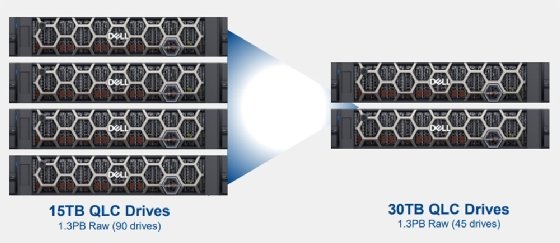
Users of Dell PowerStore Q arrays, which support high-capacity quad-level cell (QLC) NAND flash drives, can now install 30 TB QLC drives in any 2U Q series chassis, replacing or mixing them with the previous generation of QLC drives with 15 TB raw capacity. With a full deployment of 30 TB drives, Dell PowerStore can now support up to 2 petabytes of effective data capacity in half the rack space. Updates to the PowerStoreOS shipped with version 4.3 this week also include new Fibre Channel replication options and other digital resiliency features, expanded AIOps support and a new monitoring feature called "Top Talkers."
The news comes in the wake of supply chain upheavals in computer memory worldwide, spurred by the rapid expansion of AI infrastructure over the last year, which might be further exacerbated by the latest Nvidia hardware refresh announced this month during CES.
"Dell has the long-term contracts with the NVMe flash manufacturers to be able to commit to replacement parts or upgrades into the foreseeable future," said Brent Ellis, an analyst at Forrester Research, who was briefed by Dell on its supply chain status and the PowerStore update.
"[Software-defined storage competitors] are addressing the dry year for flash storage by touting their compression, deduplication and storage management capabilities, but [buyers] have to make sourcing decisions for the hardware that supports it separately," Ellis added. "It's not quite the same as buying from Dell, NetApp and HPE, who have locked down the actual supply of the drives."
In every conversation, a highlight is going to be, how efficiently do you use that capacity? It's going to be the dominant issue impacting the [storage] industry this year.
Simon Robinson,Analyst, Omdia
Dell officials acknowledged in a November earnings call that price hikes will also be coming for customers over the next year. But this week's update offers enterprises a potential means of stocking up on capacity before those market ripple effects come into play, said Simon Robinson, an analyst at Omdia, a division of Informa TechTarget.
"There is some potential that customers are going to be saying, 'If it's a case of paying a little bit more now, or paying even more in the future, I might just make that jump now," Robinson said. "Other customers may say, 'I'm going to sweat my existing assets for longer.' But in every conversation, a highlight is going to be, how efficiently do you use that capacity? It's going to be the dominant issue impacting the [storage] industry this year."
PowerStore lures in net-new users
PowerStore has led Dell's storage product growth over the last year. During its fiscal second quarter earnings call in August 2025, Dell said that while overall storage revenue was down 3% for the quarter, it had seen six consecutive quarters of growth in PowerStore, five of them by double-digit percentages. For the fiscal second quarter, 46% of PowerStore customers were new to using the product line and 23% were new to using Dell storage entirely.
While much of that growth is likely due to customers switching from the older VxRail product to PowerStore, which was first introduced five years ago, the storage market is highly commoditized, so it also likely represents capturing market share from competitors, Robinson said.
Most enterprise storage products in this mature market have comparable features, according to Robinson. He attributed PowerStore growth primarily to Dell increasing its focus on support, with initiatives such as the Lifecycle Extension program, which Robinson compared to Pure Storage Evergreen subscriptions.
"Dell has certainly heard from customers that they like what Pure has been doing there, and responded," Robinson said.
Dell's 5:1 data reduction guarantee could be a further selling point for potential buyers in a capacity-constrained year, Robinson said. The program ships free disk drives to customers in the event they see a lower data reduction ratio on PowerStore arrays.
"Every Dell salesperson is going to be really hammering that, and there are going to be more customers who are going to be more receptive to hearing that, because they know that these are supply chain issues," he said.
With 30 TB QLC drives, Dell PowerStore can now support up to 2 petabytes of effective data capacity in half the rack space.
Dell PowerStore QLC vs competitors
Dell does not disclose manufacturers' suggested retail pricing for PowerStore arrays, most of which are sold through partners. List prices from partners for PowerStore 3200Q arrays vary widely by hardware configuration, ranging from $18,418 to $110,000.
Comparable all-flash QLC arrays from Dell competitors include the IBM FlashSystem C200, Hitachi Vantara Virtual Storage Platform One Block 20, HPE Alletra Storage MP B10000, NetApp AFF C-Series and Pure Storage DirectFlash Shelf.
On the features front, there were some incremental but potentially significant updates with PowerStoreOS 4.3 this week, analysts said. These include support for both synchronous and asynchronous local and metro Fibre Channel replication for block and file data. The PowerStore update further expands digital resilience features with multiparty authorization for critical storage functions and labeled NFS 4.2 support, which mandates access control security labels for file shares.
Fibre Channel replication, along with Dell's AIOps tool, which now supports non-disruptive upgrades on multiple PowerStore arrays at once, could centralize management among separate islands of storage for some customers, Ellis said.
"There are also some advantages to Fibre Channel, like being able to determine alternate nodes for failover, whereas that stuff has to be supported in the storage OS, if you're doing it over Ethernet," he said.
Beth Pariseau, a senior news writer for Informa TechTarget, is an award-winning veteran of IT journalism covering DevOps. Have a tip? Email her or reach out @PariseauTT.