
Getty Images/iStockphoto
Guide to understanding the various types of data centers
IT leaders must assess the types of data centers and align infrastructure with their business priorities, factoring in scalability, costs, security and sustainability objectives.

Data strategy is increasingly constrained and accelerated by infrastructure choices. The type of data center an organization relies on shapes the cost structure, scalability options, risk exposure, sustainability outcomes and deployment speed for new capabilities.
For IT leaders, this is more than a facilities decision; it's an opportunity to shape business architecture. Each data center model prioritizes different factors, including control, flexibility, performance and efficiency.
This article helps leaders understand these trade-offs, enabling them to align infrastructure investments with growth strategy, financial obligations, regulatory requirements and long-term operational resilience.
How to evaluate data center models
Evaluating data center models begins with aligning infrastructure capabilities with business priorities rather than technical or historical preferences. Leaders should first assess capacity needs and growth trajectory to define requirements and direction. Determine whether workloads are stable, seasonal or rapidly expanding. These factors directly influence scalability and investment needs.
Next, consider the financial model by examining the consequences of capital-intensive ownership versus operational, consumption-based spending. This decision affects balance sheet strategy, cost predictability and total lifecycle expense.
Security and compliance remain foundational. Evaluate data sovereignty, regulatory exposure, and risk tolerance across shared and dedicated environments. Assess third-party vendor compliance and certifications.
Consider application latency sensitivity and the geographic distribution of users from a performance perspective, not just a data sovereignty view.
Finally, energy efficiency and sustainability goals are increasingly decisive, particularly for organizations with environmental, social and governance (ESG) commitments or rising power costs. Similarly, automation maturity and operational complexity determine staffing needs, resilience and error risk.
Executive stakeholders will weigh these factors differently, making cross-functional alignment essential before selecting a data center strategy.
Use the above criteria to evaluate each of the following data center types.
Enterprise data centers
Enterprise data centers are the traditional model of infrastructure ownership, in which organizations design, build and operate facilities dedicated exclusively to their own workloads.
This model prioritizes control, governance and predictable performance, making it a good strategic choice for organizations with strict regulatory obligations or deeply integrated legacy systems. Dedicated facilities can support complex, high-stakes operations where data sensitivity, operational continuity and customization outweigh the need for rapid scalability.
Definition
Privately owned and operated data center facilities dedicated to a single organization.
Examples
Large corporate facilities owned by individual companies.
Typical use cases
Specific organizations select this infrastructure option based on the following criteria:
- Highly regulated industries.
- Mission-critical legacy systems.
- Full control over the infrastructure stack.
Benefits
- Maximum control over security and governance.
- Custom architecture and performance tuning.
- Predictable compliance management.
Challenges
- High capital investment and lifecycle costs.
- Slower scalability.
- Staffing and operational complexity.
- The energy-efficiency burden rests with the owner.
Best fit decision factors
- Strict compliance with data sovereignty requirements.
- Long-term stable workloads.
- Organizations prioritizing control over agility.
While enterprise data centers require substantial capital investment and operational expertise, they offer unmatched control over infrastructure design, security posture and compliance management. They provide long-term stability and clarity in governance. However, they also come with slower scalability, rising energy demands and evolving expectations for agility.
Enterprise data centers remain a powerful but specialized option best suited for environments where control and assurance are strategic imperatives rather than operational preferences.
Multi-tenant/colocation data centers
Multi-tenant or colocation data centers provide shared, professionally managed facilities where organizations lease space, power and connectivity while retaining control over their own hardware and configurations.
This model is a middle ground between full ownership and outsourced cloud infrastructure, enabling enterprises to reduce Capex while accessing strong physical security, redundant power and network capabilities.
Definition
Third-party facilities where multiple organizations lease space, power and connectivity.
Examples
Providers such as Equinix and Digital Realty.
Typical use cases
Organizations choose this option based on the following criteria or requirements:
- Hybrid IT systems.
- Disaster recovery sites.
- Rapid geographic expansion.
Benefits
- Reduced Capex.
- Shared infrastructure efficiencies.
- Access to dense network ecosystems.
- Faster deployment timelines.
Challenges
- Shared physical environment risk considerations.
- Less customization.
- Ongoing operational costs.
- Dependency on provider reliability.
Best fit decision factors
- Need for flexibility without owning facilities.
- Interconnection and ecosystem access priorities.
- Cost predictability over asset ownership.
Colocation data centers deliver flexibility, faster deployment and cost efficiency by shifting facility management to specialized providers while retaining infrastructure control. The advantages benefit organizations with hybrid IT strategies, geographic expansion plans and a need for predictable operating costs. IT leaders must balance these advantages against shared-environment considerations, provider dependency and limited customization.
Hyperscale data centers
Hyperscale data centers are purpose-built facilities engineered for massive scale, high automation and extreme operational efficiency. These environments prioritize rapid scalability, standardized architecture and software-defined infrastructure to support cloud-native applications and globally distributed services.
Leading cloud service providers operate hyperscale facilities to deliver advanced compute, storage and services on demand, enabling organizations to transition from infrastructure ownership to consumption-based models.
Definition
Massive, highly automated facilities engineered for extreme scale and efficiency.
Examples
Cloud platforms such as AWS, Microsoft Azure and Google Cloud.
Typical use cases
- Cloud-native applications.
- Large data and AI workloads.
- Global digital platforms.
Benefits
- Virtually unlimited scalability.
- Advanced automation and orchestration.
- High energy efficiency at scale.
- Consumption-based pricing models.
Challenges
- Vendor lock-in risk.
- Reduced infrastructure control.
- Data residency concerns.
- Cost complexity at a large scale.
Best fit decision factors
- Rapid growth or unpredictable demand.
- Platform and innovation speed priority.
- Organizations that are shifting from ownership to service consumption models.
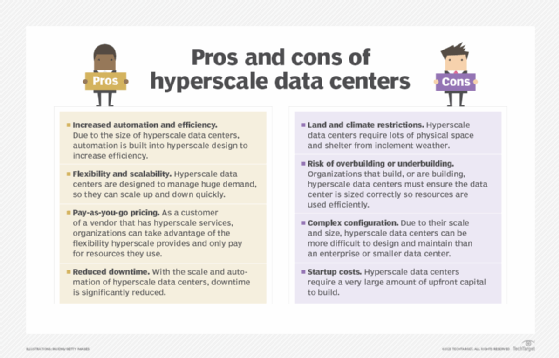
Hyperscale data centers provide unmatched scalability, automation and global reach, making them a cornerstone of modern digital transformation strategies. They enable rapid innovation, support data-intensive workloads and convert infrastructure from a fixed asset to a flexible service. However, organizations must carefully evaluate trade-offs related to vendor dependency, data governance and long-term cost management.
Edge and micro data centers
Edge and micro data centers are compact, distributed facilities deployed close to end users, devices or data sources to minimize latency and enable real-time processing.
This model brings compute capacity to the network's edge, supporting applications such as industrial IoT, autonomous systems and immersive digital experiences.
Telecommunications providers use edge deployments to support low-latency services across 5G networks, illustrating how proximity can be a competitive differentiator in performance-sensitive environments.
Definition
Small, distributed facilities located near users or devices to reduce latency.
Examples
- Telecom network edge deployments.
- Industrial IoT processing nodes.
- Smart city infrastructure.
Typical use cases
- Real-time analytics.
- Autonomous systems.
- Content delivery optimization.
Benefits
- Ultra-low latency.
- Reduced bandwidth costs.
- Improved UX.
- Localized resilience.
Challenges
- Distributed security management
- Limited capacity.
- Operational complexity at scale.
- Physical site risk exposure.
Best fit decision factors
- Latency-sensitive applications.
- Geographic data generation.
- Hybrid architectures combining core and edge.
Edge and micro data centers play a critical role in modern distributed architectures by enabling faster response times, localized processing and improved UX. They are particularly valuable where latency, bandwidth efficiency and real-time analytics directly affect business outcomes. However, they also introduce operational and security complexities that require strong management frameworks.
Containerized/modular data centers
Containerized or modular data centers are pre-engineered, self-contained units that integrate compute, storage, power and cooling into standardized modules that organizations can deploy rapidly when and where capacity is needed.
Modular data centers are built off-site and delivered ready for operation, enabling organizations to scale infrastructure in a building-block fashion without lengthy or costly construction cycles. They allow for rapid expansion, remote deployments and temporary scenarios.
Definition
Pre-engineered, portable data center units that can be rapidly deployed.
Examples
- Prefabricated modules for temporary capacity expansion.
- Remote or harsh environment deployments.
Typical use cases
- Rapid capacity scaling.
- Disaster recovery.
- Remote industrial operations.
Benefits
- Faster deployment.
- Scalable building-block architecture.
- Lower construction complexity.
- Predictable performance design.
Challenges
- Limited customization.
- Capacity constraints.
- Integration with legacy or proprietary systems.
Best fit decision factors
- Speed of deployment over permanence.
- Temporary or flexible infrastructure needs.
Modular data centers offer speed, flexibility and predictable deployment outcomes, making them well-suited to organizations facing fluctuating demand, geographic expansion or infrastructure constraints. However, IT leaders must consider customization limitations and total capacity constraints.
Emerging and specialized data center attributes
Data center implementations don't always fit into a single category. Hybrid and custom options exist, and new designs continue to emerge to meet business needs.
Some IT leaders will want to explore emerging, specialized data center designs and characteristics that meet specific requirements. Emerging designs reflect broader priorities such as sustainability, resilience, advanced research needs and next-generation computing.
Green/sustainable data centers
Green data centers emphasize energy efficiency, support ESG goals and reduce environmental impact by using renewable energy and advanced cooling and power management.
Specific characteristics include:
- Renewable energy integration.
- Waste heat reuse.
- ESG alignment.
- Incorporate AI-driven energy optimization.
Underground data centers
Underground data centers focus on physical protection and thermal stability to reduce energy consumption. They are commonly used where resilience, security and environmental stability are top priorities.
Specific characteristics include:
- Physical protection and thermal stability.
- Disaster resilience.
Quantum-ready facilities
These facilities support the unique conditions required for next-generation quantum computing, which often requires advanced cooling, shielding and environmental control.
Specific characteristics include:
- Specialized cooling and environmental control.
- Research and advanced computing readiness.
Choosing the right mix: Hybrid strategies
Most enterprises today adopt a hybrid approach, combining multiple data center models to balance control, security, cost, performance and agility.
For example, core workloads may reside in enterprise facilities for security and compliance, while hyperscale or cloud platforms handle elastic, high-demand applications. Edge or micro data centers enhance this mix by supporting latency-sensitive or geographically distributed operations. Modular deployments complement these designs, providing increased scalability and flexibility.
Data center strategy is a critical competitive lever, shaping innovation speed, operational resilience and risk management. Leaders should map workloads to the strengths of each model and evaluate trade-offs across cost, scalability and risk.
By evaluating control, cost, scalability and agility, organizations can design a balanced portfolio that supports growth, regulatory compliance and digital transformation -- turning infrastructure decisions into a strategic advantage rather than just a technical necessity.
Damon Garn owns Cogspinner Coaction and provides freelance IT writing and editing services. He has written multiple CompTIA study guides, including the Linux+, Cloud Essentials+ and Server+ guides, and contributes extensively to TechTarget Editorial, The New Stack and CompTIA Blogs.