IBM infrastructure revenue down; open source, quantum on rise
IBM is looking to close what its CEO is calling "delayed sales" and eyeing a quantum future. While infrastructure and mainframe revenue is down, other units are up.
Despite last week's warning by IBM CEO Arvind Krishna of a 7% dip in second quarter revenue for the company's infrastructure business, coupled with a disappointing financial performance of its Z series of mainframes, the executive came back just days later with a decidedly more optimistic outlook for the rest of the year.
Initially, Krishna attributed the poor performance to a significant shift in spending among its largest corporate accounts from software to hardware, including servers, storage and memory products, because of the anticipated rise in costs of those products later this year. Another factor was IBM's failure to close "tens of deals" for the quarter ending June 30. On this news, IBM's stock dropped a record-setting 25% in one day.
But speaking at the company's quarterly financial analyst meeting Wednesday, Krishna said about 30% of those deals that failed to close have now been signed just over the past three weeks and he is confident the company will close as many as 75% of them by the end of the year.
"The sales that slipped away towards the end of the second quarter aren't so much lost sales as they are delayed sales," Krishna told financial analysts.
While IBM took a hard hit with the pre-announcement of revenues, some analysts lauded his moral courage to do so.
"Most financial analysts thought (the pre-announcement) was a good move," said Frank Dzubeck, president of Communications Network Architects in Washington, D.C. "It showed he had the moral fortitude to step forward, which is in the best interest of both investors and larger corporate customers. He's a hero, at least for now, among those guys."
At the same time, there could be a downside to the pre-announcement. While IBM quickly regained a third of the delayed sales, with more to come over the short term, if they don't roll over, users and analysts will come back with less mercy.
"If these additional sales fail to come through, he'll go from hero to goat by the end of the third quarter," Dzubeck said.
If these additional sales fail to come through, [Krishna will] go from hero to goat by the end of the third quarter.
Frank DzubeckPresident, Communications Network Architects
The fine print on IBM's financials
With the unexpected steep drop in infrastructure software sales, IBM has lowered its expectations for overall revenue growth. Originally, IBM anticipated revenue growth for the full year to be 5% or slightly higher, but now the vendor believes it will be between 4% and 5%. On the upside, the company expects to increase free cash flow by $1 billion for the full year.
Software accounts for nearly 45% of IBM's total revenue, Krishna told financial analysts. That business has been steadily repositioned to go after what he sees as higher growth markets, including hybrid cloud, data across hybrid cloud, data, automation, and mission-critical transaction processing software running on mainframes.
"We have held the view that the unprecedented investment in AI infrastructure and models we have made will increase pressure on enterprises to generate meaningful returns from that spend," Krishna said. "The value will increasingly shift towards the orchestration and data layers, so that clients can optimize outcomes, cost and governance across multiple models and agents."
Revenue of its open source offerings continues to grow, according to Krishna. Red Hat sales grew slightly from 10% to 11% of sales in the second quarter, driven by improvements made to its subscription business as well as continued stable growth in consumption-based services. OpenShift annual recurring revenue is now $2.2 billion, reflecting the demand of the company's containerization and virtualization products, where IBM now has about $680 million of contracts signed since early 2024, Krishna said.
"As AI adoption moves from experimentation to enterprise-scale deployment, we are more aggressively investing in more specialized technical and client-facing talent, including forward-deployed engineers," Krishna said. "Our conviction in the strength of our business and ability to capture the future growth opportunities remains unchanged."
IBM's consulting business reported revenue of $5.3 billion for the quarter, which was flat compared with the corresponding quarter last year. Infrastructure revenues were $3.8 billion, down 7% from the previous quarter; hybrid infrastructure revenue fell 10%; IBM Z mainframe revenue plummeted some 42%; but the distributed infrastructure group's revenue jumped 37%.
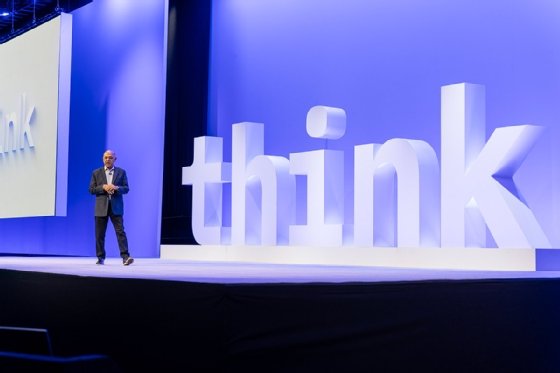
IBM CEO Arvind Krishna speaks at the Think conference in May.
IBM continues to seek quantum leap
Updating the roadmap for quantum computing, Krishna doubled down on IBM's commitment to continue aggressively investing in its technology development. He said the company will spend $10 billion over the next five years, including funding targeted for research and development, merger and acquisition activities, and ecosystem expansion. He added that IBM is still on track to deliver its first fault-tolerant quantum computer by 2029.
The company is not wasting time on using that money for acquisitions. The day after the financial analyst meeting, IBM announced it acquired HRL Laboratories to help with a variety of quantum projects. The privately held company, co-owned by Boeing and General Motors (GM), specializes in producing silicon-spin qubits that IBM will use to complement and extend its goal of scaling the next generation of quantum computers, including the fault-tolerant system. As part of the deal, Boeing and GM will continue to partner with IBM on creating quantum applications and other advanced technologies.
"Quantum computing is no longer decades away, it is upon us and we are investing aggressively," Krishna said. "Along with the U.S. Department of Commerce, we announced a letter of intent to build Anderon, the world's first pure-play quantum foundry in Albany, New York. It will be supported by $1 billion in chips incentives provided by the Commerce Department and a billion-dollar cash contribution by IBM."
Ed Scannell is a freelance writer and journalist based in Needham, Mass. He reports on a wide range of technologies and issues related to corporate IT. He can be reached at [email protected].