Quantum moves from promise to practice at IBM Think 2026
Quantum computing is becoming a reality at major companies, from Boeing to Allstate. Quantum -- especially when paired with AI -- promises better business outcomes.
BOSTON -- Quantum computing is finally producing results that matter to science and industry, according to presentations at IBM Think 2026.
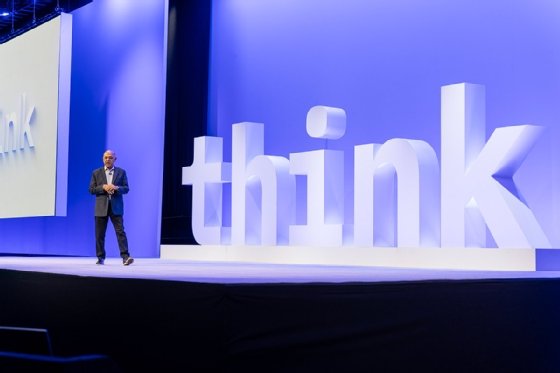
Quantum computing aims to use the unique behaviors of quantum physics to solve problems that are too complex for classical computing. It held a prominent spot alongside AI and hybrid cloud in the opening keynote of IBM Think, taking place in Boston this week. Presentations during the conference also included news that the Cleveland Clinic, RIKEN and IBM performed the largest-known simulation of biologically meaningful molecules with quantum hardware. Boeing and Allstate also presented on real-world quantum usage.
While quantum computing has been in development for years, quantum advantage, the point at which quantum computers can perform computations more accurately and efficiently, has yet to arrive. IBM CEO Arvind Krishna predicted that quantum advantage will be reached within the year.
"That's not 20 years away. That's not 10 years away. That's within this year," Krishna said during his keynote presentation on Tuesday. "The gap is closing faster than most people realize or appreciate."
Quantum at work
Cleveland Clinic, RIKEN and IBM used IBM quantum computers and two supercomputers -- Fugaku and Miyabi-G -- to simulate protein complexes spanning up to 12,635 atoms. The project's success was partly due to quantum-centric supercomputing, a hybrid approach that combines quantum computers with classical supercomputers to solve complex problems that neither could handle effectively on their own.
This project simulated a system large enough to represent what exists in nature and achieved appropriate accuracy. In drug design, if scientists can reliably predict how molecules will behave early in their research, they could significantly reduce the time it takes to develop new drugs -- a process that usually takes more than 10 years. For the biopharmaceutical sector, this could accelerate time-to-market and enhance competitive advantage, according to Gartner's "First Take: Quantum Breakthrough" report.
We're now past the point of abstract experimentation and on the practical explorations where quantum may deliver value over classical approaches for problems that matter to industry and society.
Scott CrowderVice president of adoption, IBM Quantum
"We're now past the point of abstract experimentation and on the practical explorations where quantum may deliver value over classical approaches for problems that matter to industry and society," Scott Crowder, vice president of adoption at IBM Quantum, said during his "Put quantum to work" panel session.
The panelists, who implement quantum computing, shared their experiences, potential use cases and problems they are looking to solve. For example, Boeing, an aerospace company, is developing new corrosion-resistant materials and coatings. Marna Kagele, a technical fellow and program manager at Boeing, mentioned this area would have the biggest impact, noting that an estimated $20 billion is spent on corrosion mitigation or prevention each year.
"Today, we're really focused on scale ... we know that quantum computing can help us, but we have to understand how we move to that industrially relevant scale," Kagele said.
Allstate Insurance Company is also using quantum computing to address problems where classical computing struggles, particularly dealing with collections of highly correlated decisions. Homes across the country are exposed to variable risks such as hail, hurricanes and fires, for example, which affect insurance decisions.
Allstate is taking a quantum approach to stochastic optimization in insurance underwriting. Where "classical methods struggle" with highly correlated and large-scale decisions, quantum computing "allows us to address that joint decision space much more directly," said Eric Huls, chief analytics and data officer at Allstate. For an insurance provider underwriting more than 7 million homes, even modest improvements in mathematical accuracy translate into better business outcomes.
"Allstate is still kind of early in this journey, and so we're still breaking the problems into pieces to fit on the hardware. But now, instead of things like simulation, we're able to solve them directly with these optimizations. And now we have a path toward being able to solve them more holistically and more consistent with how they exist in the real world," Huls said.
The panel session also included these other use cases:
Portfolio optimization for fixed-income assets at Vanguard.
Decentralized energy system optimization at E.ON.
Predicting mRNA secondary structures with quantum optimization techniques at Moderna.
Enhancing trade execution strategies for corporate bonds at HSBC.
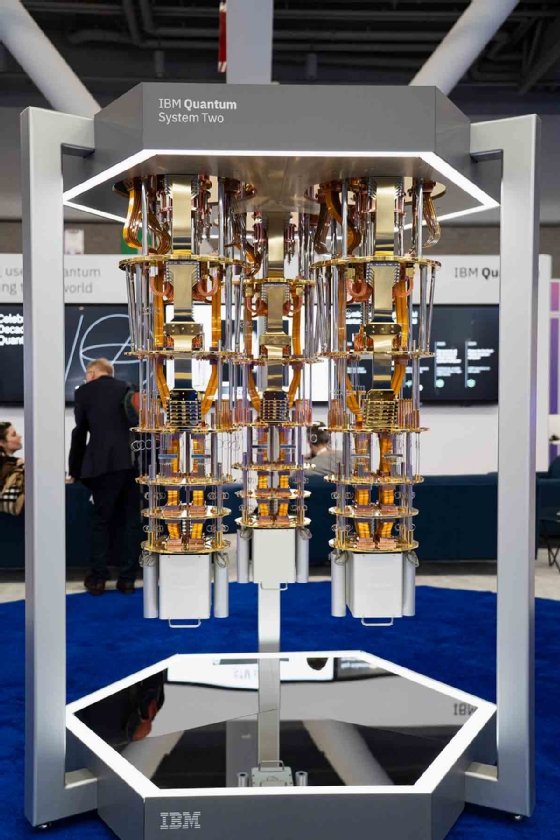
IBM Quantum System Two at IBM Think 2026
Moving quantum into practice
IBM has over 80 operational quantum computers. It also has over 300 partners globally across academia, government and industry.
"For years, quantum computing has been a promise. Now, quantum computers are producing results that matter to science. The systems we simulated here are the kind of molecules that biologists and chemists work with in the real world," Jay Gambetta, director of IBM Research and IBM fellow, said in a recent press release concerning the project with Cleveland Clinic and RIKEN.
While the breakthrough in protein complex simulation is a big achievement, Gartner said caution is warranted and that better integration between classical and quantum systems, along with specialized algorithms, is needed to make these processes effective for other, similar problems.
Quantum computing is still a few years from delivering practical business advantages. It hasn't yet produced the kind of everyday applications and productivity gains that AI has, but the protein simulation breakthrough could change how enterprises view quantum computing.
You can't wait for this technology to mature and then think about it -- you will already be late, as writing algorithms and solving problems in quantum is very different from classical,
Dr. Gaurav GuptaVice president analyst at Gartner.
"Results from experiments like these are a strong indication of progress being made in quantum computing and should influence enterprises to now invest resources into it more seriously, starting now. You can't wait for this technology to mature and then think about it -- you will already be late, as writing algorithms and solving problems in quantum is very different from classical," said Dr. Gaurav Gupta, a vice president analyst in the emerging trends and technologies team at Gartner.
IBM put the first quantum computer on the cloud on May 4, 2016, which means it is celebrating its 10th year of cloud-accessible quantum computing -- this evolved into the IBM Quantum Platform. Cloud-based quantum computing changed who and how people could access quantum computing.
"As long as there's a way to take advantage of the internet and cloud, [quantum] will get to everyone," Gambetta said.
AI and quantum relationship grows
The relationship between AI and quantum computing is multifaceted rather than competitive.
"Quantum and AI, by the way, do not compete; they converge and they complement each other. Quantum can help uncover what AI cannot yet compute, then AI learns from the quantum, and you can make faster and faster progress on algorithms and on computations," Krishna said.
Quantum could accelerate AI training with faster optimization, improved simulations and better sampling, according to "Quantum is coming" by the IBM Institute for Business Value (IBM IBV), thought leadership think tank. In turn, AI could optimize quantum workflows, guide algorithm design and allocate resources across quantum-classical architectures. In a survey conducted by IBM IBV, 73% of respondents agreed that quantum can accelerate AI and high-performance computing capabilities. For quantum-ready organizations, this percentage rose to 98%.
Gambetta sees AI as a tool that enables them to use compute much more effectively and as a way to interact. He would "love to see AI powered by quantum," but that would be years away.
"If quantum overtook AI, I think there is something wrong with us as a society," Gambetta said. "It should always be AI, it should always be architecture … and then quantum enables the architecture."
Kathleen Casey is the site editor for SearchCloudComputing. She plans and oversees the site, and covers various cloud subjects including infrastructure management, development and security