
Getty Images/iStockphoto
AI FinOps requires a different approach than cloud
While AI's utility will continue to generate revenue for businesses, its cost grows with it. FinOps is a key strategy and governance tool that ensures AI delivers measurable ROI.

The economics of cloud-based services are complex, and generative AI introduces more unpredictable, consumption-based costs.
AI spending spans infrastructure, APIs, training, inference, storage and observability. Traditional cloud governance and financial models are insufficient for today's strenuous AI workloads. At the same time, executives are under pressure to accelerate AI adoption while maintaining financial discipline. Organizations need governance-first FinOps practices that foster innovation rather than restrict it.
Businesses must reckon with certain limitations to traditional cloud financial models, while AI cost governance needs to shift from reactive cost control to proactive, value-driven management. Organizations that combine governance, visibility and architectural discipline will scale AI more sustainably. Those that take an ad hoc approach will reap fewer benefits -- and often at a higher cost.
Traditional cloud FinOps models don't fit AI workloads
Cloud-based FinOps models manage much more predictable infrastructure costs, such as storage and compute. However, AI is a game-changer. While it's easy to point to a few fundamental services or functions it enhances, IT leaders must understand what's going on "under the hood" to deliver these capabilities. AI workloads differ from traditional applications in ways that directly affect infrastructure and costs, including the following:
- Variable inference demand.
- GPU-intensive compute requirements.
- Rapid experimentation cycles.
- Multimodel and multi-cloud architectures.
These factors complicate budgeting for businesses. Token-based pricing and API consumption can change costs. The use of shadow AI reduces visibility and accountability, potentially threatening privacy, data and compliance obligations, costing businesses more to resolve. Finally, engineering teams often optimize for performance first and cost second, often at the behest of leaders unaware of the full financial implications.
AI's real-time financial volatility requires continuous, proactive governance. Understanding this provides a clear foundation for building a governance-first AI FinOps operating model.
A governance-first approach to AI FinOps
Governance is an enabler, not a blocker. It provides forward-looking capabilities while establishing guardrails that keep initiatives on track, secure, compliant and cost-effective. Practical AI governance includes the ability to experiment within established boundaries.
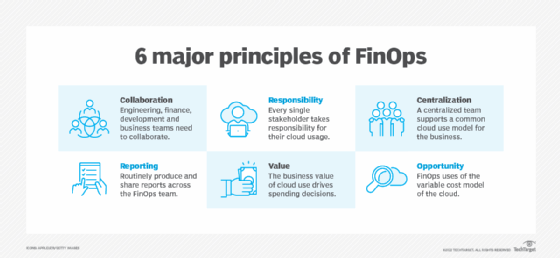
Establishing AI financial governance requires businesses to follow a series of crucial steps:
- Establish a cross-functional cost council. This should consist of IT, finance, engineering, security, procurement and business stakeholders.
- Define ownership. Businesses need defined ownership for model selection, consumption thresholds, budget accountability and vendor management.
- Create policies. There should be clear guidelines for approved AI services and use tiers.
- Empower procurement and finance teams. These teams negotiate committed-use discounts and evaluate model-provider dependencies to reduce long-term cost exposure and vendor lock-in.
Add the following elements to the framework to strengthen AI and financial governance policies:
- Shared KPIs between engineering and finance teams for enhanced visibility.
- Chargeback or showback models for accountability across teams.
- AI-spend escalation thresholds to establish better control.
- Governance cadence and executive reporting that fits the fast, dynamic and unpredictable nature of AI.
Cross-functional governance and visibility align engineering autonomy with financial accountability.
Establishing real-time visibility
Visibility is foundational to AI cost control. Effective metrics, tagging, chargebacks and KPIs all establish the value of AI services and their alignment with business objectives.
Organizations need granular visibility at specific levels of AI use, including the following:
- Team.
- Product.
- Use case.
- Model.
- Environment.
Real-time telemetry is as crucial as long-term logging. Real-time information enables rapid intervention before overruns occur. Some telemetry best practices include implementing automated alerting and shutdown policies and establishing lifecycle controls for idle GPU-intensive environments.
Many organizations are still learning how AI benefits workflows. Distinguish experimentation and production budgets to prevent uncontrolled pilot spending and identify whether costs are temporary (experimentation) or persistent (production).
Visibility tools
Ensure the existence of readily available visibility tools, including the following:
- Use-based budgeting models.
- Tagging and cost allocation strategies.
- Dashboards for token, inference and GPU consumption.
- FinOps observability tools and anomaly detection.
Organizations cannot govern what they cannot measure. AI cost visibility must be immediate and operational, not retrospective.
Architectural levers that reduce AI spending
Technical architecture decisions materially influence AI economics, affecting costs, performance and capability. Therefore, cost optimization should occur during design, not after deployment. Proactive AI governance enables this.
Efficient AI architectures also improve infrastructure utilization and support sustainability objectives through reduced energy consumption.
Focus on the following three essential aspects of AI integration:
1. Model selection
- Right-size models for specific workloads.
- Use smaller or open source models where appropriate.
- Balance performance, latency and cost, especially for experimental projects.
2. Inference optimization
- Optimize prompts for effective queries.
- Enable caching and batching.
- Implement quantization and fine-tuning strategies.
- Reduce unnecessary token consumption.
3. Workload placement
- Determine whether public or private infrastructure is appropriate.
- Optimize for multi-cloud deployments.
- Determine and use regional workload placement.
- Implement efficient GPU utilization strategies.
Integrate user training that explains the importance of performance and financial optimization. This enables engineers to understand the relationship between AI models and FinOps, making it easier to ensure compliance with guidelines.
Measuring ROI across AI environments
Successful technical and financial AI governance focuses on realizing business goals, not just cost reduction. As a technology enabler and revenue driver, AI ROI extends beyond infrastructure efficiency.
Use the following metrics to measure ROI and value:
- Cost per inference or use case.
- Revenue or productivity impact.
- Time to value.
- Model use rates.
- Customer experience improvements.
By involving operations and financial teams, organizations have a better opportunity to discover, explain and direct AI utilization. Specific opportunities to identify include the following:
- Comparing vendor economics across clouds.
- Avoiding vendor lock-in while maintaining governance consistency.
- Building executive-level AI value dashboards.
- Generating reports for stakeholders frequently.
Damon Garn owns Cogspinner Coaction and provides freelance IT writing and editing services. He has written multiple CompTIA study guides, including the Linux+, Cloud Essentials+ and Server+ guides, and contributes extensively to TechTarget Editorial, The New Stack and CompTIA Blogs.