
Getty Images/iStockphoto
The quantum technologies that will transform enterprise IT
As quantum capabilities progress toward commercial viability, business leaders need to understand the quantum technologies that will be at their disposal.

Quantum computing is moving from experimental promise to practical reality as advances in hardware stability and quantum networking bring it closer to solving real-world business problems. Organizations across government and industry sectors are exploring using it for a range of challenges that classical computers can't solve.
McKinsey's "Quantum technology monitor 2026: A commercial tipping point" report states that 52% of companies analyzed are spending $5 million or more a year on quantum efforts.
With more investment, the quantum use cases continue to expand. These include: sensors to measure time, gravity and magnetic fields; simulations for materials science and pharmaceutical R&D; machine learning (ML) to accelerate AI capabilities; and quantum key distribution (QKD), which can coexist with current security protocols. The quantum internet also promises to establish a distributed quantum computing grid to connect these systems.
For each of these developments, caveats exist. For example, quantum systems cost tens of millions of dollars annually to operate, compared with the costs of operationalizing enterprise AI. But each quantum breakthrough could potentially revolutionize business environments and introduce new opportunities.
Quantum sensors
Scientists and engineers are using the quantum properties of entanglement, superposition and interference to solve problems faster than classical computing. Harnessing these quantum properties portends a fundamental shift in how we process information.
Quantum sensors measure physical properties related to time, gravity and magnetic fields. They use extreme quantum sensitivity to register the slightest deviation in a functional tool. For example, in autonomous vehicles, drones and aircraft, quantum sensitivity can detect and respond to microscopic operational changes. Quantum networks offer the potential for distant quantum sensors to communicate and triangulate measurements, functioning as one enormous, distributed sensor.
In healthcare imaging, magnetoencephalography uses quantum sensors to measure neuron-generated magnetic fields in real time. Physicians can use the tool to pinpoint the exact regions of the brain where epileptic seizures originate and remove or treat the tissue. In the energy industry, gravimeters use quantum to detect microvariations in gravity for mineral exploration or to map underground cavities for hydrocarbon prospecting and carbon-capture monitoring. The military uses quantum radar for stealth detection and surveillance.
Quantum security
Quantum key distribution offers extremely high tamper sensitivity for detecting incursions, making it unparalleled as a security protocol. This hardware-based technology uses the laws of quantum physics to randomly generate a string of bits for encryption. Two parties share this unbreakable encryption key to protect processes and communications.
If attackers attempt to compromise a connection, the quantum states are disturbed, exposing an intrusion. A QKD system incorporates a single-photon source along with detectors and temperature-controlled optical emitters, which require precise monitoring and control.
QKD is expensive to scale because it relies on specific hardware. For this reason, it will primarily reinforce other modes of security, blending physical, classical and operational safeguards into one defensive approach. Deployments are currently limited to government, defense and telecom networks.
Specific use cases include telecom infrastructure, where QKD protects data moving between data centers and cloud services. Some government networks are combining QKD with classical encryption and post-quantum algorithms. For example, relay nodes within satellite links can distribute quantum keys between ground stations to protect communications.
Quantum machine learning
The deployment of quantum ML for enhanced AI capabilities has passed the proof-of-concept phase. According to the U.S. Data Science Institute's "From Qubits to Insights: The Rise of Quantum AI in 2026" report, the quantum AI market is projected to reach $638 million in 2026, a 35% increase over 2025.
The goal of quantum ML is to accelerate AI training and solve complex, multidimensional problems. The advantages of running algorithms on a quantum system include exponential acceleration of core linear algebraic operations and quadratic speedups for unstructured searches.
In general, IT engineers and researchers can use quantum ML to bypass compute bottlenecks in processing data and explore new ways to optimize training. In the process, they can also discover limitations, such as models with too many quantum components that run slowly, while those without sufficient components show little advantage over classical approaches. Another industry use case is supply chain modeling, in which quantum-driven processes identify the best routes, schedules and resource plans to achieve lower costs and greater efficiency in freight, transport and logistics.
An important use case in finance is quantitative analysis and modeling, where analysts study correlation patterns in assets and often struggle to correlate inconsistent data. Quantum ML can model complex market behaviors, speed up data processing and improve predictive accuracy.
Pharmaceutical scientists in drug discovery also consistently work with complex variables as they search for new drug compounds. Quantum ML can map molecular behavior to quantum states and invent promising combinations for disease treatments.
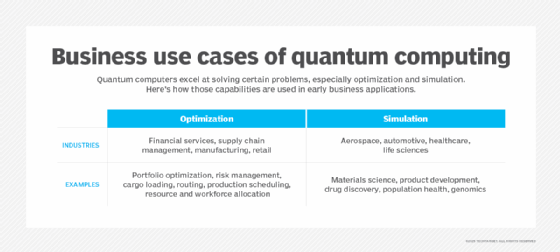
Quantum simulations
In materials science and pharmaceutical R&D, quantum-controlled simulations can mimic molecular and physical properties at the atomic level. For example, quantum systems can create a correspondence between simulation hardware and a target environment's actual physics. They then match atom behavior in a quantum simulator to electron behavior in the real material world.
These quantum emulations are useful in the automotive, electronics and aerospace industries to design complex polymers. A quantum computer can sift through an exponential number of possible configurations to quickly identify polymer compositions with traits crucial for certain products, such as 5G components and semiconductors in the electronics industry or durable, heat-resistant materials for space flight.
Quantum simulations also resolve issues in materials science and chemistry related to battery and energy storage use cases. These emulations bring together mathematical models and computational algorithms to combine electrodes, electrolytes and catalysts in novel ways, enabling faster charging, higher-capacity storage and longer lifetimes.
The quantum internet
The quantum internet comprises isolated quantum computers that use photons with their neutral charge and zero mass to create unified, distributed networks. Photons can travel through standard telecommunications fiber while largely retaining their quantum state, linking together individual quantum machines to operate as a supercomputer, exchanging encoded quantum-based information. And because quantum signals only span short distances, quantum repeaters function to extend the range of qubit entanglement without the need to copy data.
In one recent deployment, New York University and Qunnect, a global quantum hardware provider, demonstrated quantum signals running through existing metropolitan fiber-optic infrastructure. The goal was to show that scalable, secure quantum networks could operate reliably within existing telecom network media, moving one step closer to demonstrating a functional quantum network.
In another use case, connecting enterprise and academic hubs, the EPB Quantum Network in Chattanooga, Tenn., became commercially available in 2022. This open-access infrastructure lets researchers and innovators build and test quantum applications and explore real-world initiatives in business and science.
Kerry Doyle writes about technology for a variety of publications and platforms. His current focus is on issues relevant to IT and enterprise leaders across a range of topics, from nanotech and cloud to distributed services and AI.