IBM execs: AI storage and common implementation oversights
IBM storage leaders Sam Werner and Christopher Vollmar share insights on AI implementation oversights, including data governance, vector database vulnerabilities and zero trust.
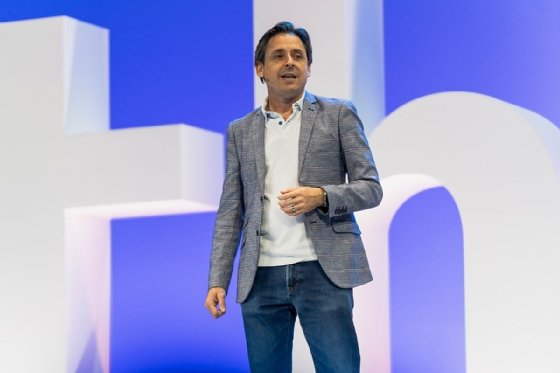
AI is actively reshaping how organizations confront storage. Onstage at IBM Think in May, two IBM storage executives prominently focused on the topic of AI.
Sam Werner is the general manager of IBM Storage and is responsible for IBM's end-to-end portfolio, directly managing the product management development teams. Christopher Vollmar, meanwhile, is the global product architect of operational resiliency and enterprise storage and IBM Master Inventor and is responsible for identifying opportunities to drive storage innovation based on market or client challenges and for solving them.
The Stage at IBM Think 2026
In this combined Q&A, TechTarget spoke with these two IBM storage experts to gauge their thoughts on how AI workloads affect storage security. Be sure to read part one of this interview, focused on storage security and resiliency.
Editor's note:The following was edited for length and clarity. Werner and Vollmar were interviewed separately.
Is there anything in storage that IT organizations fail to consider when implementing AI?
Sam Werner:
Yes, I think a lot of people tell a really good story about storage for AI, but there are things missing. A lot of the stories people tell about storage require you to re-platform all of your data, which is totally unrealistic.
I think a lot of people tell a really good story about storage for AI, but there are things missing.
Sam Wernergeneral manager of IBM Storage
Imagine if you copy a bunch of files over, so you can vectorize that data to use for RAG. That data that's been copied over is completely disconnected from the source. If the source data changes, that doesn't ripple through. And there's no way to keep track of that. But even worse, if the source data permissions change -- maybe somebody identifies PII, or you're no longer allowed to have access to it or somebody tries to delete it for data governance reasons -- it hits a data retention policy where data gets deleted from the source, but there's still a vector database that's completely searchable and completely discoverable through RAG.
People oversimplify. … Either way, you run into challenges that don't really work, so I think it takes a more comprehensive approach.
Sam Werner
Christopher Vollmar:
When implementing AI, IT organizations need to consider a couple of things. First, the need for data to be ready for AI that has implications for storage. There are four dimensions, but people often overlook some or all of them:
1) Distributed data that needs to be abstracted into AI systems.
2) Diverse data that needs to be accessed using multi-protocol -- file, object -- or format -- vector, API.
3) Dynamic data that needs to be vertically accelerated from source to AI system memories.
4) Dark data that needs to be classified, governed and cataloged for awareness by AI systems.
The four dimensions are now an emerging standard for an AI data plane.
To go a step further, I would also suggest that storage has a role when implementing valuable AI -- the value increases when accurate and timely corporate data is combined with the intelligence coming from inferencing AI reasoning models. Storage can help to catalog the metadata and to manage the semantics of the data (we call it content-aware storage), helping to automate vectorization of corporate information for similarity searches.
How does the increase in more complicated AI workloads change attack surfaces from a storage security standpoint?
Werner:
Let's start with where most people are. They just copy a bunch of data around to do AI. ... That is a huge issue because there's nobody protecting them. They're copying data to servers [and then] they're putting it into a vector database. And that's very risky.
When you deploy storage infrastructure, you start bringing in some of the discipline and security behind managing data and protecting it with encryption. Encryption of data in flight, and at least encryption of data at rest, to make sure that data is only accessible to those who have the proper permission … keeping that data under the foundation of data governance of an enterprise storage array, where we constantly keep track of the access rights and controls on the data.
Vollmar:
As AI workloads become increasingly more complicated, we need to be even more diligent in doing the foundational work that supports the operation of the business. This means, for one, instituting zero trust principles all the way through the compute and storage stack, down through to the backup and archive layers. Things like multi-factor authentication, two-person integrity, a re-evaluation of what roles people have in accessing and administering the supporting infrastructure, and yes, building immutable copies that can be used for rapid recovery and proactive validation all the way through the data and storage lifecycle.
Christopher Vollmar
Alexander Gillis is a Technical Writer and Editor at Informa TechTarget, with more than 8 years of experience writing about technology.