
IT infrastructure security audit for enterprises
Enterprise IT security audits assess infrastructure, access controls, cloud configurations and recovery readiness to reduce risk and support compliance.

As cyberthreats become more sophisticated and IT environments grow more complex, IT leaders need a clear understanding of their organization's infrastructure security posture. IT infrastructure security audits help identify vulnerabilities, validate security controls and uncover risks that could disrupt operations or expose sensitive data.
For business leaders, the value of an audit extends beyond compliance to inform risk management strategies, guide security investments and strengthen organizational resilience. Understanding what audits reveal and how to act on the results is essential for reducing risk and supporting long-term business objectives.
This article explores how to conduct IT infrastructure security audits, the challenges audits typically reveal and the difference between internal and external audits. Its primary focus is on an IT infrastructure security audit checklist and how to act on the results.
When and why enterprises conduct IT infrastructure security audits
Specific requirements or threats often drive infrastructure security audits. They also provide measurable value that informs strategic direction and executive decision-making.
Various internal and external pressures converge to drive the need for a security audit. These include the following:
- Regulatory and compliance requirements.
- Customer and stakeholder expectations.
- Mergers, acquisitions and major infrastructure changes.
- Past security incidents and emerging threats.
- Board-level risk oversight obligations.
Audits provide value by identifying opportunities for improvement, enabling organizations to avoid incidents that disrupt services or expose data. Identifying these gaps enables organizations to address security gaps proactively. There are several business benefits:
- Improved risk visibility for better mitigation.
- Validation of existing security controls.
- Data-driven investment decisions.
- Stronger resilience and governance.
- Greater confidence among customers and business partners.
- Demonstrated compliance with regulatory requirements.
What infrastructure security audits commonly reveal
Audits often reveal risks that increase the likelihood of operational disruption, compliance violations or data exposure, enabling organizations to address these issues before they become incidents.
These common recurring security and governance gaps often emerge:
- Unpatched or unsupported systems.
- Shadow IT infrastructure and practices.
- Misconfigured cloud and network resources.
- Orphaned virtual machines and cloud deployments.
- Incomplete asset inventories.
- Monitoring, logging and threat detection gaps.
- Weak backup, recovery and resilience practices.
The consequences of these issues can be severe, including data breaches, ransomware attacks and unauthorized access. They can also result in operational disruptions and unplanned downtime, leading to financial losses, reputational damage and compliance violation penalties.
Identifying and mitigating these gaps greatly improves the organization's security posture.
Internal vs. external audits: What IT leaders need to know
Organizations can opt to conduct internal, external or combined audits. Each approach offers specific advantages and challenges.
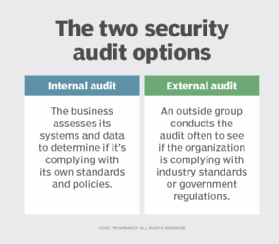
Internal audits are typically conducted by in-house teams, offering continuous visibility into systems, faster turnaround and lower cost. However, they can miss blind spots due to familiarity bias or organizational assumptions.
External audits are performed by independent specialists, providing objective validation and a broader perspective than internal teams offer. They might be required for regulatory compliance, customer assurance and board-level reporting. External audits typically cost more.
IT leaders should view internal audits as an ongoing monitoring tool, whereas external audits serve as compliance and assurance mechanisms. Combined, they offer the most complete and defensible view of infrastructure risk.
IT infrastructure security audit checklist
Automation is a key component of the infrastructure audit checklist. It provides efficient, consistent auditing practices and simplifies validation steps, including asset identification, account lifecycle management, patching, logging, backups and more. Seek to automate as many of these items as possible while implementing the checklist.
The following checklist helps IT teams conduct infrastructure security audits to identify and address potential issues.
Asset inventory and infrastructure visibility
Ensure a complete, continuously updated inventory of on-premises, cloud, network, SaaS and endpoint assets. Verify that all assets are identified, documented and monitored. Include ownership, classification and dependencies to reduce shadow IT risk and improve incident response accuracy and speed.
Vulnerability and patch management
Assess how quickly vulnerabilities are identified, prioritized and remediated. Focus on patch service-level agreements, exposure windows and risk-based prioritization for critical systems.
Identity and access management
Review authentication controls, multifactor authentication, account lifecycle controls and user permissions. Don't neglect privileged access accounts. Ensure least-privilege enforcement and timely deprovisioning of unused accounts, including those of former employees.
Network and cloud security configurations
Evaluate segmentation, firewall policies, cloud configurations and critical device vulnerabilities. Identify overly permissive configurations, public exposure risks and misaligned policies across hybrid environments that could enable lateral movement.
Monitoring, logging and incident detection
Confirm centralized logging, real-time alerting and SIEM effectiveness. Ensure the organization can quickly detect anomalous behavior and trace incidents across systems for faster containment and investigation.
Backup, recovery and business resilience
Validate backup frequency, integrity and isolation from production systems. Test recovery capabilities to ensure critical systems can be restored within defined recovery time and recovery point objectives.
How IT leaders should act on audit findings
Focus first on issues that pose the greatest operational, financial, regulatory or reputational effect. Use a risk matrix to distinguish critical vulnerabilities from lower-priority concerns and then align remediation efforts with the organization's risk tolerance.
Create the expectation of continuous improvement through ongoing internal auditing mixed with periodic external validation. Use the following practices to establish this idea:
- Assign ownership for remediation activities.
- Set timelines and measurable goals using specific KPIs as metrics.
- Report progress to executive leadership and stakeholders.
- Treat audits as part of ongoing security rather than a point-in-time exercise.
Conclusion
The real value of an IT infrastructure security audit lies in what happens next. Strengthen the organization's security posture by turning findings into action: Prioritize risks, close gaps and build continuous visibility across the IT infrastructure. Commit to acting on these results quickly and systematically to reduce exposure and protect business continuity.
Damon Garn owns Cogspinner Coaction and provides freelance IT writing and editing services. He has written multiple CompTIA study guides, including the Linux+, Cloud Essentials+ and Server+ guides, and contributes extensively to Informa TechTarget, The New Stack and CompTIA Blogs.