
Getty Images/iStockphoto
Is Citrini Research's dark AI future a given?
Agentic AI might look good now, but it could have negative repercussions on the economy. So says a controversial thought experiment from Citrini Research.

The stock market has seen its fair share of fluctuations caused by AI developments and earnings reports over the years. But Citrini Research's speculative thought experiment, "The 2028 Global Intelligence Crisis," published this week, caused quite a stir.
In the paper, Citrini and co-author Alap Shah imagined what 2028 would look like with the continued rapid advance of agentic AI and automation. In two years, AI had reduced labor costs and increased productivity by removing friction -- agents performed complex and manual tasks without tiring, unlike humans.
"Financial advice. Tax prep. Routine legal work. Any category where the service provider's value proposition was ultimately 'I will navigate complexity that you find tedious' was disrupted, as the agents found nothing tedious," the paper hypothesized.
The hypothetical stock market initially responded with expanding margins, impressive earnings reports and rallying stocks. But this seemingly positive advancement ultimately upended the economy.
Businesses laid off white-collar employees, opting for cheaper and more efficient machine intelligence over human intelligence. Displaced workers reduced their consumer spending, causing consumer demand to plummet. As businesses' profits tanked and investor pressure grew, they tried to cut costs further by deploying more AI and laying off more workers.
This caused a "negative feedback loop with no natural brake," the paper said, resulting in a hypothetical unemployment rate of 10.2%.
Doomsday speculation vs. scenario planning
As Citrini clearly stated in the paper's preface, this whole experiment wasn't a prediction; it was a big what-if scenario. Companies cited in the speculative future, such as DoorDash and Mastercard, haven't been displaced by agentic AI systems. But their stocks -- and those of many others in various sectors -- took very real dips after the Citrini paper was published on Feb. 22.
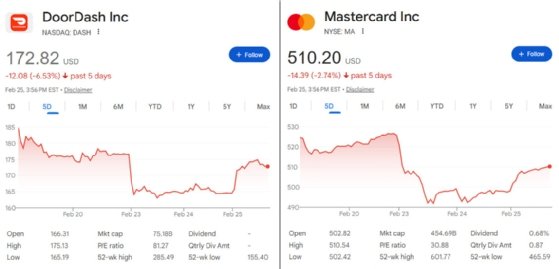
Analysts and critics have talked at length about investors' herd-like reactions to the thought experiment, longstanding fears of AI replacement and the overvaluation of AI stocks. Jim Cramer, host of CNBC's "Mad Money," deemed the experiment a "stunning, well-written, incredibly pessimistic paper," highlighting its theory that the AI market could actually be bearish rather than bullish.
While the Citrini experiment might be drastic and far-reaching, it's worth exploring the questions and concerns here. Many businesses are deep into their AI initiatives and seeking ROI. Still more are urging -- or even mandating -- that employees use AI in their workflows. And yes, layoffs have been rampant.
But, as Citrini said in its concluding remarks, we're not in the doomsday scenario yet.
"As investors, we still have time to assess how much of our portfolios are built upon assumptions that won't survive the decade," the paper said. "As a society, we still have time to be proactive. The canary is still alive."
Business leaders can take this as an opportunity to reassess the "why" behind their AI initiatives and conduct their own scenario planning, specific to their markets and products.
Are we developing and implementing AI solely for cost savings and productivity gains? Or are we using AI to differentiate our products and services? How is AI affecting our markets and sectors, and how might it in the future? Do we have the proper risk management and governance frameworks in place? Are we too dependent on automation? Are we actively augmenting and reskilling our employees?
Better to ask -- and honestly answer -- these questions now than face Citrini-like consequences in two years.
Jennifer English is editorial director for TechTarget's AI & Emerging Tech group.