Developers want to spend their days shipping new features but somehow, they are always on call for production problems that should have been handled by operations, support, QA or literally anyone else.
The daily reality is often bleak: vague tickets with no reproduction steps, half-logged errors that trail off right before the useful part, dashboards nobody has touched since the service launched, and a page created at 2:00 a.m. for something three teams upstream actually broke.
The loop itself never changes.
Latency climbs, or an error rate spikes after a deploy (or at seemingly random intervals). The developer reproduces it, reads the trace, finds the rogue query or the unbounded retry, writes the fix, adds the unit test and opens the pull request. Best case: a couple of hours. Worst case: multiple days.
Datadog goes platform
At DASH 2026 this week, Datadog went after exactly that grind.
Bits Code, Bits Testing Agent (preview) and Bits Release are the observability vendor's new AI agents. They share the joint mission of shielding developers from the daily grind of production support.
The demand was already on record. In Omdia's March 2026 observability survey (N=400), 90% of respondents rate self-healing and auto-remediation as an important requirement for their monitoring platform (45% important, 45% somewhat important).
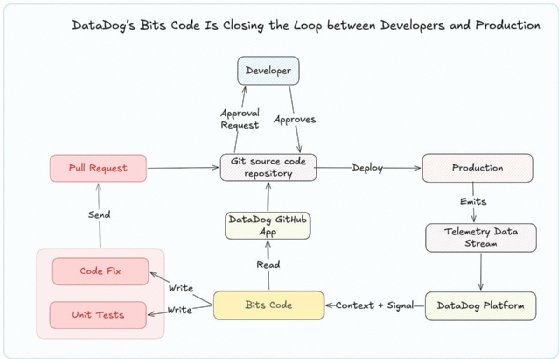
The new Bits Detection (preview) watches production and starts the loop. Code-level issues route to Bits Code. Service and infrastructure issues route to the SRE-facing remediation agents. The more complete the available context, the better the odds that Bits Code repairs the issue without a human investigation.
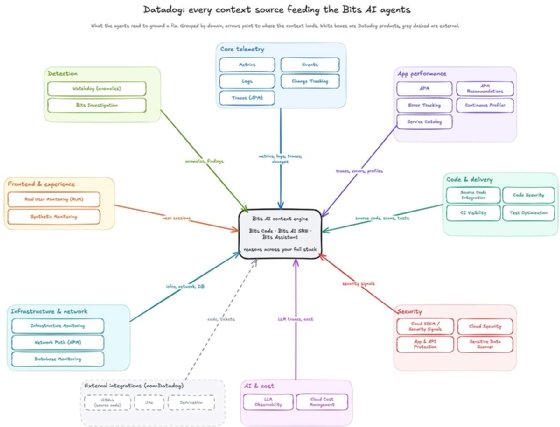
Bits Code reads the impacted code through what Datadog already holds: error tracking, APM, profiling, logs and code security findings. Bits Release validates the change through the rollout and feeds the result back into monitoring. On paper, the loop closes. The database demo showed the same pattern catching a slow query, rewriting it, benchmarking the rewrite against a copy of your schema and opening a pull request on the exact line that issued the query. No DBA, no separate ticket.
It's worth stating plainly: much of this loop is in preview. Bits Detection, Bits Testing Agent and AI Guard all carry the label. Nobody outside Datadog has data yet on fix quality or how often autonomous remediation completes without a human dragging it across the line. DASH 2026 put more than 125 announcements on stage, many of them in preview status. The honest test is if this loop closes applied to a real customer codebase six months from now -- with nobody watching.
Humans stay in the loop
Datadog also shipped AI Guard for coding agents (preview, starting with Claude Code) to block prompt injection and malicious scripts at runtime. The human review gate stays in place and the guardrail runs automatically underneath it.
In the same Omdia survey, 86% said they are comfortable letting AI autonomously make low-risk configuration changes. Writing a fix and opening a pull request sits one step beyond that line. The review gate is what makes the step acceptable.
Strip off the agent branding and the move is plain -- Datadog has gone from watching code to writing it.
The signal was on the keynote stage, where co-founder and CTO Alexis Lê-Quôc sat down with the head of OpenAI's Codex. Datadog knows it now plays on the coding-agent vendors' turf, and it competes on the asset they lack. Copilot sees your repository. Bits Code sees what your code does in production.
That edge exists only if you are already instrumented with Datadog, and Bits Memories widens it by holding the operational context your team builds up and reapplying it to every fix.
Then there is Agent Console, the quieter bet. It meters the coding agents you already run -- Claude Code, Cursor, Copilot -- and reports their cost and output. Even customers who never adopt Bits Code still run their telemetry, their agent bill, and now their operational memory through Datadog's platform.
Final take
Datadog chose to build its own coding agent and control the complete observability loop, from signal detection to issue remediation, while most competitors wire a third-party agent into their platforms. Building lets Datadog connect the agent directly to the telemetry, the investigation and the validation. Routing the fix to Copilot would demote Datadog to a context feed for someone else's agent. Bits Code keeps the high-value line item on Datadog's own ledger and Agent Console taxes the rivals' agents at the same time.
For developers in the near term, the remediation grind moves from writing the fix to reviewing it. For everyone above them, the question DASH 2026 raised is who owns the code your observability vendor now writes, and what does it cost to leave once that vendor knows your systems better than your last three hires did.
Bits Memories is the deeper tell. The operational context that makes the agent over time only compounds if Datadog controls the agent end to end. A proprietary feedback loop is impossible to build on top of a third-party agent. That is the durable moat, and it requires building. The build is also cheaper than it looks, because Bits Code is model-agnostic. Datadog leaves frontier-model training to the model labs and builds the harness around someone else's model: the grounding, the investigation, the validation, the memory.
Partnering has its own logic. New Relic, Dynatrace and Grafana are smaller or open-source-centric, and there is a defensible view that code-writing is a commodity best bought while the observability vendor's job is detection, investigation and validation. Partnering ships faster and leaves code quality and liability with the coding-agent vendor.
Datadog is betting that telemetry grounding beats raw coding skill.
That liability point is the honest risk in Datadog's choice. By owning Bits Code, Datadog owns the failure mode. When the agent ships a bad fix that breaks production, Datadog's name is on the pull request. Also, the dedicated coding agents are improving at pure code-writing faster than an observability vendor's in-house agent likely can. Datadog is betting that telemetry grounding beats raw coding skill. The competitors are betting that the coding agent is a commodity input and the value sits in the context they supply it. That fork is genuinely unresolved.
Torsten Volk is principal analyst at Omdia covering application modernization, cloud-native applications, DevOps, hybrid cloud and observability. Omdia is a division of Informa TechTarget. Its analysts have business relationships with technology vendors.