Enterprise mobility is a dynamic area that is constantly evolving. IT leaders should know what trends to look out for in 2026, from shared devices to private 5G and AI copilots.
Executive summary: Mobile devices are a key driver of productivity and business agility today. The effectiveness of mobility strategies affects operations, employee experience and data protection across the enterprise. To stay competitive in the digital landscape of 2026, IT leaders will need to define mobile priorities, adopt new technologies and modernize mobile workflows.
Enterprise mobility is now a critical aspect of modern business.
In the past few years, new mobile tools and technologies have emerged that make it easier for organizations to support a flexible workforce while maintaining productivity and security. The field will change even more in the coming years, and IT leaders must prepare for new and evolving trends around enterprise mobility in 2026 and beyond.
Here are seven enterprise mobility trends to watch in 2026.
1. Android Enterprise will become more common for frontline workers
In 2026, Google's Android Enterprise is likely to become the framework of choice for enterprise mobility management (EMM). First launched in 2014, Android Enterprise enables organizations to easily and effectively use, manage and secure Android devices and apps.
In the past, many firms avoided adopting Android, even though this mobile OS has an overall market share of nearly 72%. Reasons for such a lukewarm enterprise response to Android include security concerns, integration challenges with existing enterprise systems, and high development and optimization costs. Android Enterprise eases these challenges with enterprise-grade EMM tools, services and APIs.
These tools and features enable organizations to easily enroll, provision and manage corporate devices through third-party EMM platforms and integrate support for Android into those tools. Additionally, Android Enterprise provides centralized management for device security, data protection, app updates and compliance monitoring and management.
Android Enterprise supports many types of devices, including rugged devices and kiosks. IT can configure and manage these and other mobile devices for many different environments, such as offices, factories and industrial settings. The tools and services included in the platform support use cases for EMM, including work profiles for BYOD endpoints and kiosk mode for dedicated devices. Different settings and enrollment options enable IT to apply policies to specific management sets, groups of users or individual devices as needed. These features help keep enterprise data secure without impeding user privacy or productivity.
Because of these features, Android Enterprise is expected to continue gaining prevalence in 2026, especially for frontline and shift-based workers.
2. Knowledge workers will continue to prefer iOS, but it will see tighter identity enforcement
Among knowledge workers, particularly in developed countries, the iPhone is a popular device for work. This is because iOS offers reliable performance and enables easy access to user-friendly apps and tools. Apple also has an interconnected device ecosystem, which facilitates seamless workflows across different Apple endpoints. Users can easily create, edit, store and share work documents from multiple Apple devices.
Strong security and privacy protections are another benefit. Using features like App Tracking Transparency, hardware-level encryption, Face ID and Touch ID, workers can securely access important files, handle sensitive data and engage in confidential communications.
However, in corporate environments, the baseline security framework of any OS isn't enough to mitigate enterprise risks or ensure regulatory compliance. Because knowledge workers who handle critical data commonly use iOS, these devices require stronger, more consistent security measures, especially around identity.
More stringent identity controls will likely become the norm in 2026 to protect sensitive workflows and corporate data.
Apple has responded by tightening identity enforcement. Organizations can use these identity services to implement scalable, identity-first governance. By treating identities as the chief control point for corporate mobile use, device administrators can securely manage passwords and usernames across the workplace.
Apple has also enabled identity federation across identity providers, Google Workspace and Microsoft Entra ID to ease resource access for authorized users while maintaining strict security controls for corporate data.
Still, the popularity of iOS among knowledge workers and executives makes it a strategic target for threats. More stringent identity controls will likely become the norm in 2026 to protect sensitive workflows and corporate data. To adopt this approach, organizations must implement the following best practices:
Stricter conditional access policies. Make sure that only authorized users and compliant devices can access corporate resources.
Device posture checks. Continuously verify device health metrics, including encryption status, jailbreak status, OS version and security update compliance.
Identity-driven governance. Use multifactor authentication, single sign-on (SSO) and centralized identity management to tie access control directly to verified user identities.
Automated compliance monitoring and enforcement. Audit devices, apps and access logs in real time to maintain security standards.
Segmentation of sensitive resources. Grant access based on role, risk or device trust to reduce data exposure.
3. Mobile threat defense will become an enterprise priority
Mobile devices are highly attractive to threat actors because they present a different type of attack surface from PCs. The integrated hardware components -- coupled with wireless communication mechanisms and physical connections -- expose devices to a distinct set of threats, including smishing, rooting and session hijacking. Any of these threats can compromise one or more devices on the enterprise network.
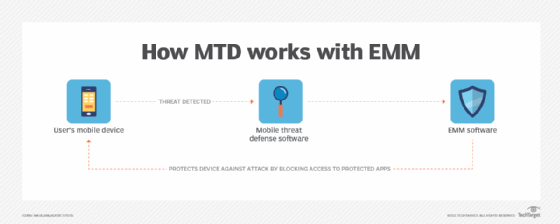
To keep data secure across devices and networks, organizations will prioritize mobile threat defense (MTD) in 2026 and beyond. MTD tools monitor mobile devices across different platforms for signs of malicious activity, detecting and flagging threats in real time. Many of these tools can be integrated with an organization's EMM or other management software for seamless tracking and protection. Some can even remediate threats automatically.
MTD can integrate with EMM to help streamline threat detection and response.
As mobile threats continue to grow, organizations that make mobile security a priority will be better prepared to protect their data and stay ahead of attacks. MTD is a key tool to aid in this process.
4. Generative AI copilots will become core mobile workplace experiences
In 2024, one in five organizations had generative AI (GenAI) tools in production, and nearly two-thirds of them were using the technology across multiple business units.
AI copilots are among the most popular applications of GenAI in the workplace. Many enterprise software products now include copilots. They're increasingly embedded in mobile workplace applications, spanning email, CRM, scheduling and support apps.
Powered by large language models (LLMs), copilots are advanced virtual assistants that can understand and generate human language. They can help automate routine tasks, create content, analyze data and manage projects. Some copilots can also perform the following tasks:
Summarize information.
Suggest changes to the tone and structure of text.
Create presentations.
Draft work reports.
Translate text from one language to another.
With all these built-in capabilities, AI copilots could have a tangible effect on employee productivity and efficiency. However, organizations must also contend with the governance, privacy and performance concerns that accompany this trend.
Organizations must ensure that AI-generated suggestions are accurate, compliant and auditable. Sensitive employee or customer data processed by mobile apps also raises privacy concerns, especially if sent to cloud servers. And when interacting with LLMs, a mobile device might experience latency issues, bandwidth constraints or limited processing power.
On-device AI might be able to mitigate some of these issues. By running models locally, mobile copilots can keep sensitive information on the device, reducing the risk of data exposure. On-device AI also enables offline functionality. Employees can generate drafts, summarize messages or receive scheduling suggestions without network connectivity.
As mobile-first AI copilots mature, they're poised to become integral to workflows across departments. The most successful deployments will balance intelligent automation with strong governance, privacy safeguards and efficient on-device processing.
5. Shared-device and shift-based environments will get standardized
Organizations need to equip their workers with the right devices, including mobile devices like smartphones and tablets. However, equipping each worker with a unique device can be a costly endeavor, particularly for firms with shift-based or large, geographically dispersed workforces. It can also be burdensome to manually manage the enrollment, configuration, inventory, remote support and security of large device fleets. In these situations, shared devices can be a more feasible enterprise mobility approach.
In 2026, organizations will aim to standardize shift-based and shared-mobile-device environments. A key part of this process is device enrollment into MDM platforms. MDM enables admins to fine-tune users' requirements while also easing device configuration, security and management. Organizations will look for MDM tools that can perform the following tasks:
Enable faster user switching and authentication on shared mobile devices.
Automatically log out users based on their shift times.
Ensure strong session security to protect corporate data.
The current market is well-positioned for this development. Google and Apple both support shared-device management for their mobile OSes.
One popular identity and access management service for shift-based and shared-device environments is Microsoft Entra ID. The platform includes a shared device mode (SDM) feature for securely configuring iOS, iPadOS and Android devices for shared use among multiple employees. Entra ID SDM also supports SSO, which eliminates the need for multiple sign-ins.
6. Use of private 5G will expand
A private 5G network is a non-public mobile network belonging to a specific owner. It can use a licensed, unlicensed or shared spectrum, and network owners can control who can access it. For users, benefits of private 5G include low-latency access and high-throughput device connectivity. These advantages make it particularly useful for industries and apps that require fast, reliable, high-performance connectivity, such as manufacturing, energy, mining, logistics, hospitality and education, as well as for critical public services like emergency medical care.
There are also security benefits. Private 5G networks aren't connected to public networks, and all communications are encrypted. Plus, any endpoint attempting to connect to the network must have an authorized SIM card. These features keep unauthorized devices off the network and help protect enterprise assets and data from compromise.
As a result, more organizations will plan for 5G readiness in 2026. This means investing in 5G spectrum and equipment and embracing technologies like containerization, microservices and private clouds. It also affects mobile device strategy, as devices become the primary endpoints in private 5G deployments.
For example, mobile device requirements might change. Devices must support SIM-based authentication and be compatible with private 5G bands. To support the full range of private 5G use cases, organizations will need to integrate both traditional mobile devices and specialized IoT endpoints into the network.
7. App modernization will accelerate for mobile workflows
According to a research report from Mordor Intelligence, the app modernization market was worth $21.91 billion in 2025. The report also predicts that this number will grow to $42.6 billion by 2030. One reason for this increase is that app modernization, particularly mobile app modernization, delivers several measurable benefits.
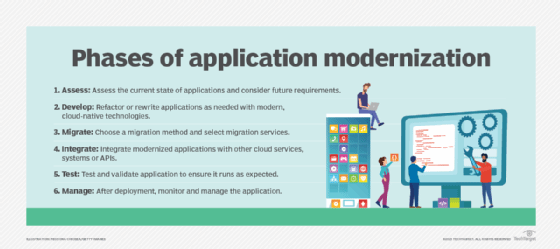
App modernization refers to the consolidation, repurposing or restructuring of old software code, and the migration of legacy on-premises software systems to a modern, cloud-native environment. It can also involve adopting no-code or low-code workflows and implementing strategies to improve UX. Improving continuous integration and continuous deployment pipelines, code refactoring and data modernization are some of the other aspects of app modernization initiatives.
Modernizing the legacy application landscape enables organizations to streamline processes, increase operational efficiency and improve customer experiences. It can also lower their technical debt and enhance their business agility and resilience.
The app modernization process can be complex, but it's an investment organizations today must make.
Modern applications offer the following advantages over legacy apps:
They're more secure, making them better able to protect corporate data and comply with regulatory standards.
They're easier to integrate with other enterprise systems and applications.
They're easier to update due to their microservices architecture.
And because modernizing legacy apps increases reliability, scalability and security, over time, it also eases app maintenance and reduces support costs.
Given the significant operational benefits of mobile app modernization, it will no longer be an optional activity in the coming years. It will emerge as a key differentiator that enables modernizing organizations to grow, leaving the laggards behind to stagnate.
Conclusion
Enterprise mobility can help organizations tap into new opportunities to streamline operations, enhance innovation and gain a competitive advantage.
That said, this area is rapidly changing due to the emergence of new technologies and trends. Enterprise leaders need to be aware of these trends and make them actionable. That means prioritizing initiatives like identity-first governance for fleets, adoption of mobile threat defense tools and standardization of shared-device environments. Organizations that understand the direction of change will be well-prepared to optimize their investments and operate successfully in a mobile-first world.
Rahul Awati is a PMP-certified project manager with IT infrastructure experience spanning storage, compute and enterprise networking.