Businesses gear up for AI agents in the enterprise
AI agents might be going mainstream and coming to a desk near you -- so say speakers at EmTech AI this week, where attendees were also treated to viewing their digital twins.
CAMBRIDGE, Mass. -- At MIT Technology Review's EmTech AI conference this week, sessions and attendee conversations alike often focused on agentic AI -- how they're using it, how they want to use it, how they wish to govern it. Many attendees swarmed the post-lunch Wednesday session to learn about building their own agent. They also interacted with an agentic digital twins simulation.
Yet even amid all the buzz, agentic development still sends ripples of concern among businesses. On Wednesday, MIT Technology Review executive editor Amy Nordrum and principal technology analyst Brian Bryson circulated a statement for attendees to either confirm or disagree with: "Over the next 12 months, AI agents will create more confusion than value." 70% of those in the room opted for the "confirm" paddle.
Whether implementing agent workflows to improve internal productivity, using agentic AI in external-facing products, or developing a personal agent for administrative tasks, business leaders hope agentic AI will solve their problems and drive revenue. But they're moving cautiously and shoring up their AI initiatives with monitoring and human-in-the-loop capabilities.
Attendees mirrored in digital twins simulation
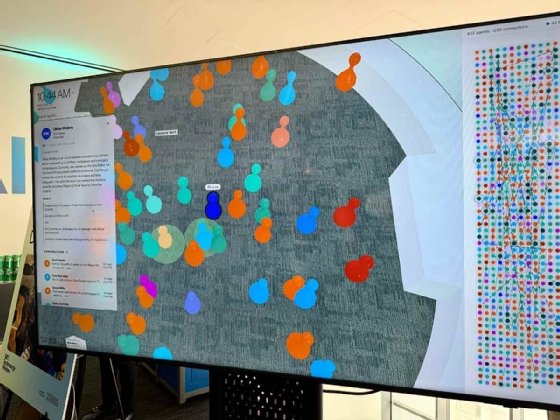
During the conference, design and innovation consultancyIDEO set up an experiment: an agentic digital twins simulation. Mirroring the conference agenda, floor plan, specific attendee list and even the weather outside, this simulation showed attendee "agents" moving around the sixth floor of the MIT Media Lab.
Throngs of intrigued or anxious conference attendees lined up to see what their digital twin was up to in this mirrored EmTech AI world. Some agents were engaged in discussions about recent and upcoming sessions. Others lamented about jet lag or the cloudy Boston weather. Some were in the elevator. All were conversing with one another with their individual data in mind.
This data was taken from EmTech AI registration information and a public web search, explained Jenna Fizel, managing director of AI and emerging tech at IDEO. "The idea is to capture enough detail to give everyone a personality and enough grounding to get some kind of value out of the conversations that we have with each other," she told me in an interview.
My agentic digital twin relied on data from stories and social media posts I had recently written, my contributor page from Informa TechTarget and even awards pages. And I must admit my agentic twin's bio was very similar to my real-life one.
IDEO presented its digital twins simulation on a TV monitor in the MIT Media Lab, where attendees could view their individual agent. Details included agent backgrounds, goals and conversations with other twins.
The simulation architecture involves different types of actors, Fizel explained. Each attendee was represented by an agent that was assigned a conversational style based on the attendee's background information. There were also director agents that shaped conversations. These directors explicitly instructed the agentic twins to express their varying opinions and welcome disagreement to lower the likelihood of sycophancy -- the proclivity of agents built on large language model (LLM) architecture to be overly agreeable with one another.
"This was an experiment built for this event," Fizel said. "It's supposed to be a provocation about what it feels like to be twinned. We all have these shadow versions of ourselves that live online and in databases, so this is an attempt to make that very tangible and explicit to see emotional reactions. How does it feel to be modeled? How does it feel uncomfortable, but also what superpowers might it give you?"
How does it feel to be modeled? How does it feel uncomfortable, but also what superpowers might it give you?
Jenna FizelManaging director of AI and emerging tech, IDEO
Some attendees noted the power of networking with each other through their digital twin. Because their agent was "out and about" talking with other "agent" attendees -- not from the same company as a rule -- it sometimes kick-started real-world conversations. In other cases, the simulation prompted attendees to ask others around them how they felt about being twinned. While some felt their twins were much like their real selves, many others felt uncomfortable, noting that their twin wasn't like them at all.
Fizel expected some attendees would be uncomfortable with their twin. IDEO gave attendees the option to remove themselves and their data from the simulation. "No one has opted out so far that I know of," Fizel said. "But I do anticipate that at least some people will. And that's totally alright -- the point of doing this is to figure out where that level of confidence is."
Testimonials tout agentic use case wins in business
We've been hearing about agentic AI since late 2024, and 2025 was quickly dubbed the year of AI agents. Today, agents are easier to implement in real-world business applications.
In her session, "How to build an agentic workforce," ServiceNow CDIO Kellie Romack explained how her company implemented agentic AI in their internal IT service desk, successfully turning over 90% of desk tasks to autonomous AI. This didn't replace workers; 85% moved to higher-value jobs with ServiceNow upskilling, and the remaining workers opted to stay in their roles, managing the agents and the other 10% of tasks.
Agentic AI use cases such as these are a productivity driver for the business, Romack said. For example, by using agentic AI to streamline communications between the finance and sales teams, a four-day process was whittled down to just about eight seconds. "We had conversations with humans. We reinvented the process, and we put agentic AI to work," she said.
Ascendion, an AI-first software engineering provider, uses agentic AI to help businesses update their software operating models. Without finding the right operating model, working with AI agents can lead to significant frustration, Karthik Krishnamurthy, CEO of Ascendion, told me in an interview. The company's platform, AAVA,orchestrates a system that enables agents and humans to work together.
The speed, cost and quality of outcomes greatly improve when using agentic AI in this way, Krishnamurthy said. For example, one enterprise bank client reduced a 26-month goal to 8 months. Another client, a healthcare company, massively accelerated its medical enrollment timeline by using the tool. "That's the power of agent tech," Krishnamurthy said.
We had conversations with humans. We reinvented the process, and we put agentic AI to work.
Kellie RomackCDIO, ServiceNow
In his session "The agent engine," Ash Edwards, head of forward-deployed research engineering, spoke about how his company, Poolside, enables software engineers to create more with AI agents. These agents primarily do background work so that engineers can explore more scenarios.
"It's never been more fun to be a [software] engineer," Edwards said. Before agents, you might have had an idea and five different directions to go in, but you had to pick one. Now, you can try all five, and you get much more real exploration, he said.
Building your own AI agent
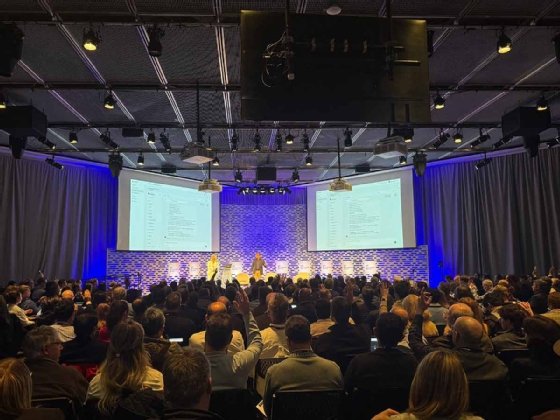
After lunch on Wednesday, the MIT Media Lab was standing-room-only to watch a live demo of building an AI agent with OpenClaw. The session, "From prompt to agent: Build an autonomous AI in 45 minutes," was led by Project NANDA researcher Maria Gorskikh and MIT Media Lab scientist Santanu Bhattacharya.
OpenClaw is an open source AI agent that can live on a user's device and connect to third-party LLMs to autonomously complete tasks for its user. During the session, Gorskikh guided attendees on how to use maritime, a platform for cloud hosting AI agents, to set up and run their own OpenClaw AI agent on their personal devices. She also demonstrated how to connect that agent to NANDA NEST, an open platform for orchestrating network-native AI agents and part of Project NANDA's long-term goal to architect an open agentic web of AI agents that securely collaborate across the internet.
Even though possible Wi-Fi issues left some attendees with pending agents, the number of attendees who successfully built a personal agent more than doubled by the end of the session.
During their session, Gorskikh and Bhattacharya guided attendees through the agent-building process. Attendees raised their hands when their agents were up and running.
Agent orchestration requires monitoring and human involvement
One of MIT Technology Review's top 10 things to watch in AI right now is agent orchestration: teams of agents that coordinate with one another to complete increasingly complex goals.Orchestration involves a slew of tasks, such as agent communication management, task assignment and conflict resolution.
"There's a lot of work going on in general," said David Cox, VP of AI foundations at IBM Research and IBM director of the MIT-IBM Watson AI Lab, in an interview with me. "If I have multiple agents running around, how do I get them to do the right thing?" That's where orchestration comes into play and becomes crucial.
As companies shift toward increasingly relying on these [agentic] systems, observability and understanding are going to be a really critical part.
Ash EdwardsHead of forward-deployed research engineering, Poolside
With the added complexity of agent orchestration, businesses must prioritize stringent agent monitoring and human-focused strategies.
"When you have multiple agents interacting, there's a bunch of interesting concerns," Cox said. He pointed to growing research on emergent behaviors in agents: new behaviors, sometimes problematic, that arise from interactions among agents and their environments.Given the possibility of emergent behaviors, the field is grappling with how to ensure there are no unintended side effects when multiple agents work toward a goal.
"We'll increasingly have agent monitoring," Cox said. Agent monitoring can include examining individual agent actions and collective behaviors, identifying issues in agent interactions and determining the appropriate levels of autonomy for different functions.
The prioritization of agent monitoring is on the minds of many businesses. "As companies shift toward increasingly relying on these [agentic] systems, observability and understanding are going to be a really critical part," Poolside's Edwards said. ServiceNow's Romack agreed, saying that monitoring agents through a comprehensive dashboard has been essential -- something she would have preferred to have done first rather than later.
As with so many conversations in AI, the agents of today and the future need humans to remain at the forefront. Human-in-the-loop protocols and accountability are priorities. "It's very much the responsibility of anyone building out these systems to do so with absolute care," Edwards said. During his session, he emphasized the role humans should play in reviewing and controlling agent actions.
Having humans in the loop is critical right now, a subject matter expert from an AI consulting services firm told me at the conference. Especially in high-risk industries, agents today only act as advisors -- humans always have the final say and use agents to augment their abilities, he said.
Prioritizing human-in-the-loop goes hand in hand with prioritizing workers, ServiceNow's Romack said. Any agentic deployment must focus on people and their roles in AI development. This means educating workers on AI, giving them access to play around with AI tools and find their own use cases, and upskilling them to new or modified roles when agents are deployed.
"Upskill your people [and] focus on your people," Romack said. "People aren't going away, people are important, and they're the safeguards of everything."
Olivia Wisbey is a site editor for Informa TechTarget's AI & Emerging Tech group. She has experience covering AI, machine learning and other emerging technologies.