What are AI agents? Types and examples
AI agents are autonomous intelligent software components that form the foundation of artificial intelligence (AI) systems. Agents are designed to perform specific tasks independently without the need for human intervention.
Intelligent agents are conversational and can interact with other systems, such as applications and APIs, access data, perceive specific environments, exercise reasoning, make decisions, take actions to achieve defined goals and learn from prior outcomes to refine future decision-making. These capabilities help organizations become more productive by delegating repetitive and mundane tasks to these AI agents and freeing human resources for more complex and strategic activities.
How do AI agents work?
AI agents use machine learning (ML) and techniques such as natural language processing (NLP) to take on a range of tasks, from simple queries to complex problem-solving. Unlike traditional AI, AI agents can self-learn and continuously improve their performance.
These agents follow a cycle of perception, reasoning and action or outcome. This is sometimes expressed as sensing, thinking and acting. An agent's workflow typically defines the goal based on user input, breaks it into smaller subtasks capable of accomplishing the intended goal, and executes those subtasks using production data, such as inputs from IoT devices; knowledge base, such as external data sources; the Web; and other tools.
The following are the operational steps AI agents take:
- Define goals. The process is initiated when an autonomous AI agent receives precise instructions or goals from a user prompt. These instructions act as the cornerstone for the agent's subsequent actions.
- Gather and process data. An AI agent gathers instructions and discovers and processes data through various sensors, inputs or data sources. This is the perception or sensing phase. For example, an autonomous car uses sensors to collect data about the road, traffic and obstacles, while an AI chatbot collects user queries.
- Organize and plan tasks. The AI agent breaks the goal into smaller, actionable tasks to ensure efficient and effective task execution. This is the reasoning phase of operation. A single AI agent can handle these subtasks, or they can be delegated to other subagents that can provide specialized results.
- Execute tasks. In this step, the agent takes uses various tools and techniques, such as using a large language model (LLM), to automate tasks and manage complex cognitive activities. Execution delivers an outcome, such as using an actuator to implement changes in the real world, or making a decision or recommendation.
- Seek external feedback. Once a task is executed, it's removed from the list, and the agent moves on to the next task. To assess progress toward the ultimate goal, the agent seeks external feedback and reviews its logs. This is the learning phase. During this process, additional tasks might be generated and executed to achieve the desired outcome. The agent also refines its decision-making to enhance future outcomes.
What is the agent function and program in an AI agent architecture?
AI agent architecture is a structured framework that enables intelligent agents or systems to perceive, reason and act autonomously in their environments. The architecture can either be a physical architecture of a robot, such as actuators, sensors, motors and robotic arms, or a digital one, such as software agents or content generators that use text prompts, application programming interfaces and databases to enable autonomous operations. Both agent function and agent program are the main components that form the backbone of AI agent architectures.
Agent function
The agent function defines how an AI agent responds to its environment. The term function represents the ideal or theoretical response to every possible situation. For example, the agent function maps the agent's perceptions or the data it receives from its environment to actions. Before designing the agent function, most developers evaluate the required information, AI capabilities, knowledge base, feedback mechanisms and other necessary technologies.
Agent program
An agent program builds, trains and puts the agent to work on a chosen system, bringing the agent to life. The term program is the actual AI code implemented on a hardware infrastructure. It ensures the agent performs as intended, meets technical standards and operates efficiently. Although the program should precisely embody the function, there might be practical limitations or exceptions.
How can AI agents be used?
Various industries use AI agents to enhance processes and automate tasks. These agents harness generative AI to assist with and collaborate on tasks, empowering users in the process.
The following are examples of AI agent use cases:
- Customer support. AI agents have diverse capabilities, such as responding to inquiries, managing refunds and providing advanced technical support. As a result, they're increasingly replacing traditional customer service chatbots. AI agents let businesses offer around-the-clock assistance without human intervention, improving customer satisfaction and reducing operational costs. AI agents are also integrated into apps and websites to serve as virtual AI assistants that enhance the customer experience.
- Finance. AI agents are automating routine tasks, such as risk assessment and transaction processing, transforming the finance industry. By analyzing vast data sets, these agents provide insights that help drive the strategic decision-making of financial operations.
- Healthcare. AI agents can handle and streamline healthcare-related tasks, such as answering inquiries, scheduling appointments, reviewing insurance, generating medical summaries and approving care requests. They also can analyze biological data and predict the efficacy of new drugs, accelerating drug discovery. Additionally, AI agents are able to personalize treatment plans, manage records and match patients to clinical trials. These capabilities help providers deliver better care and improve outcomes. Multiagent systems are especially effective for solving healthcare problems.
- Manufacturing. AI agents can streamline and automate manufacturing tasks, such as quality control, predictive maintenance and supply chain optimization, . For example, AI agents can analyze real-time data to identify potential issues, optimize production schedules and improve product quality.
- Insurance. In the insurance industry, AI agents are used to automate claims processing, risks assessments and responses to customer inquiries. By analyzing large volumes of data, these agents provide personalized policy recommendations, detect fraud and streamline administrative processes.
- Autonomous vehicles. AI agents enable autonomous vehicles to operate with limited human intervention. These intelligent systems perceive the vehicle's surroundings and make informed decisions, such as when to turn or brake. By using AI sensors, AI agents detect stop signs, navigate unfamiliar terrain and adapt to changing environmental conditions.
- Smart environments. AI agents automate buildings, as well as broader urban environments. Intelligent sensors in buildings can detect and identify people to unlock doors and ensure that the workspace is lit and comfortable. When the workspace is empty -- especially after hours -- the agents dim lighting and limit the use of heating or cooling to conserve energy. At the municipal level, agents collect IoT data about road and traffic conditions, optimizing traffic controls and street lighting to streamline traffic and save energy.
- Workplace automation. AI agents can automate routine business processes, letting employees focus on higher-value tasks. For example, these agents can ingest documents, automate data entry, handle scheduling, and other repetitive and administrative tasks to smooth operations and boost productivity.
Benefits and limitations of AI agents
AI agents have numerous benefits and certain limitations. Balancing their advantages and drawbacks is essential for organizations seeking to utilize them effectively.
Advantages of AI agents
AI agents provide the following benefits:
- Increased efficiency. AI agents automate repetitive tasks, such as answering customer inquiries, scheduling appointments and processing claims. This provides workflow automation and frees human workers to focus on more complex tasks. These capabilities also can reduce operational costs by automating many time-consuming tasks that are often subject to human error.
- Enhanced decision-making. AI-powered agents use ML algorithms to analyze vast amounts of data quickly, providing deeper and more valuable insights that help businesses make informed decisions. This leads to innovation, such as automated research and development in data-heavy pursuits, such as biopharmaceutical research and software development and testing.
- Improved accuracy. AI agents follow predefined rules, observe guardrails and learn from large data sets that minimize mistakes caused by fatigue or bias. As a result, AI agents reduce human error and improve task accuracy. Additionally, by analyzing patterns and making data-driven decisions, agents enhance the accuracy of certain tasks, such as data entry, diagnostics and financial analysis.
- Personalization. AI agents analyze individual preferences and behaviors, delivering personalized experiences. For example, they can provide tailored buying recommendations in retail settings and customized treatment plans in healthcare.
- High-quality responses. AI agents collaborate with other agents, use external tools and learn from their interactions. As a result, they provide more comprehensive, accurate and personalized responses compared to traditional AI models, leading to better customer experiences. It's important to note that these behaviors emerge naturally and aren't preprogrammed.
- Learning and adaptability. Many AI agents learn and adapt over time to improve their performance based on feedback and new data, which leads to better outcomes.
Limitations of AI agents
The downsides of using AI agents include the following:
- Limited understanding. Most AI agents rely on predefined rules, limiting their ability to handle complex or nuanced situations that require a deeper understanding of context. Although many AI agents can learn, complex exceptions require human direction to guide a suitable outcome or decision.
- Context and hallucinations. AI agents can render outcomes that are inadequate or outright wrong. Limited context windows can fill, causing older context elements to be lost and allowing the AI agent to lose the underlying point of the user's prompt or inquiry. The AI agent can also hallucinate, creating false information that's presented as factual. Both issues must be addressed through ongoing AI agent design and development.
- Issues with adaptability. While some AI agents can learn and adapt, their adaptability is often limited to specific environments or tasks, as they might struggle in dynamic or unpredictable situations. Vertical AI agents are emerging that are designed and trained to handle detailed and nuanced situations in specific industries, such as healthcare or law. AI agents are also used in combination to build orchestrated agentic AI workflows.
- Ethical issues. Deep learning models can produce biased or inaccurate results due to insufficient or inaccurate data and bias in the underlying algorithms. Human oversight and clear explainability are essential to safeguard the output of AI agents, mitigate these risks and ensure fair and helpful responses. This has a direct effect on an organisation's reputation and compliance.
- Initial investment costs. Although AI agents can lead to long-term savings, the initial investment in technology and training of the AI agents can be significant. It can deter some organizations from building and adopting them.
- Infinite feedback loops. AI agents get into infinite feedback loops, where an agent's actions unintentionally trigger a chain reaction that loops back to the original action, creating an endless cycle. For instance, an AI agent designed to optimize a system might execute a change that worsens performance instead of improving it, leading to a series of adjustments that exacerbate the problem.
- Security and privacy concerns. The data AI agents use often involves sensitive personal or business information. This raises concerns regarding data breaches, misuse and privacy violations.
The different types of AI agents
AI agents can be classified into various types based on their characteristics, functionalities and the complexity of tasks they handle. Common types of AI agents include the following:
- Simple reflex agents. These are the simplest agent types that operate on a set of predefined rules and don't possess any memory or the ability to learn from past experiences. They respond to stimuli in their environment and make decisions based solely on the current situation. For this reason, they're most suitable for straightforward and simplistic tasks.
- Model-based reflex agents. Unlike simple reflex agents, model-based reflex agents maintain an internal state that reflects the environment's current situation. This lets them make informed decisions by considering both current and past inputs and adapting to changes.
- Goal-based agents. Also known as rule-based agents, these AI systems have enhanced reasoning capabilities. In addition to evaluating environmental data, they compare different approaches to achieve the desired outcome. Goal-based agents always select the most efficient path and are well-suited for complex tasks such as NLP and robotics applications.
- Utility-based agents. These agents use utility functions to make decisions. They pursue goals and prioritize outcomes based on their perceived value. By evaluating the desirability of different states, they choose actions that maximize overall utility, making them suitable for complex environments where tradeoffs are inevitable.
- Learning agents. These agents learn from experience and past interactions, improving their performance over time. They use ML techniques to adapt to new situations, refine their decision-making processes and become more effective in completing tasks. For example, a virtual assistant can learn about a customer's preferences and enhance its customer service capabilities.
- Hierarchical agents. These agents follow a hierarchical structure, where higher-level AI agents program and direct lower-level agents to work toward a shared goal. This setup lets businesses break complex, multistep processes into simpler tasks, with each AI agent focusing on a specific set of responsibilities.
- Multiagent orchestration. Although AI agents can operate individually, multiple agents can be combined to share information and collaborate to achieve more complex business goals. This interaction of different AI agents is typically orchestrated to create detailed agentic AI workflows.
How to effectively implement AI agents
AI agents have evolved beyond virtual assistants, such as Siri and Alexa. They're proving valuable in fields such as drug discovery, fraud detection and supply chain optimization.
Setting up AI agents effectively requires a strategic approach that covers planning, design, coding, implementation, deployment and monitoring phases. The following key steps help ensure successful execution of AI agents:
- Define clear objectives. Before setting up the AI agents, companies should identify the goals they want them to achieve. Whether it's automating workflows, improving customer service or enhancing decision-making, having clear objectives guides the development and deployment of AI agents.
- Gather and prepare data. AI agents rely on both structured and unstructured data to function effectively. Therefore, organizations must ensure they have access to high-quality data that can provide context for the AI agent's tasks. This can include knowledge articles for complex queries and structured data for personalized interactions. Data science experts play a role in obtaining, validating and preparing quality data.
- Select the agent type. Organizations seeking to build an AI agent should choose the most suitable type for their needs. For instance, a reactive agent might suffice for routine customer queries, while more complex tasks requiring adaptability and learning would benefit from a goal-oriented or learning agent that can offer sophisticated support. Suitable ML algorithms and AI operational parameters should be considered early in the agent creation process.
- Consider integration needs with existing systems. When building an AI agent, it's crucial that it seamlessly integrates with existing systems, such as customer relationship management and customer service tools. Such integrations let the AI agent access relevant data and provide better support to users.
- Assemble the development team. The next step is to assemble an AI development team responsible for gathering the data to train the AI agent. The choice of programming languages, platforms and other technologies depends on the team's skills and expertise. ML engineers, data scientists, DevOps engineers, and user interface and experience designers are a few roles that should be part of the development team. Business leaders should also collaborate with the development team to ensure that the AI agent aligns with business goals and meets the parameters established for strategic business risk.
- Select tools and technologies. It's important to choose the right tech stack. This can include selecting the appropriate technologies, such as ML frameworks; programming languages, including Python and Java; and AI tools for data processing, model building and training.
- Design the AI agent. The agent's architecture should define how it interacts with users, accesses data and performs various tasks. For more complex agents, this can involve creating a hierarchical structure where higher-level agents manage and direct lower-level agents. Complex tasks involving multiple AI agents will typically involve AI agent orchestration to create cohesive workflows. Extensive model testing and validation is normally part of this phase.
- Train the AI agent. This step involves using the curated data to train the AI agent. It requires feeding data into ML models, enabling the agent to learn patterns, make predictions and refine its decision-making abilities.
- Test and deploy the AI agent. The agent should be thoroughly tested in a controlled environment to assess its performance in various scenarios. Iterative testing helps identify and address issues. Once fully trained and tested, the agent can be deployed in its intended environment, such as local data center or public cloud infrastructure. Early deployments use the AI agent as an option or limit use to select user groups until the agent can render explainable and reliable outcomes. It is important to consider the agent's scalability within the intended infrastructure to ensure that it can continue to perform as user and production data volumes increase.
- Monitor and improve the agent. Lastly, it's crucial to continuously monitor the AI agent's performance, gather feedback and analyze its outcomes. This data should be used to make improvements and updates, enforce data access and security controls, and ensure the agent adapts to changes in user behavior and the business environment.
AI agent vendors
Numerous vendor platforms and tools are available for building AI agents. The following is a sample of what's available:
- AgentGPT. With AgentGPT users can create, configure and deploy autonomous AI agents in their browser without requiring extensive programming knowledge. Built on OpenAI's GPT-3.5 and GPT-4 models, the platform uses the models' advanced capabilities to generate human-like text and autonomously perform a range of tasks.
- Amazon Bedrock Agents. Amazon Bedrock Agents uses foundation models for reasoning; APIs for communication; and varied data to process user prompts, gather information and complete tasks. Amazon Bedrock Guardrails offers security and multiagent support and collaboration.
- Amazon SageMaker. The SageMaker fully managed service provides developers and data scientists with tools for building, training and deploying ML models, including AI agents in a production-ready environment. It also offers customizable ML algorithms and infrastructure for scaling.
- Anthropic Claude. Claude is a collection of LLMs developed with a focus on AI ethics. It was developed to be helpful, honest and harmless, and operates as a conversational and multimodal AI that can process text, audio and visual inputs. It's adept at summarizing text, assisting with research, answering questions and writing code.
- Cognition. Cognition builds AI software agents, such as Devin, with the goal of creating AI teammates with advanced reasoning and problem-solving features. These are capable of assisting with coding and optimizing software development tasks.
- Google Cloud Vertex AI. The Vertex AI Agent Builder, which is part of the Google Cloud Vertex AI platform, helps simplify the process of creating autonomous and intelligent agents, enabling both technical and nontechnical users to build them.
- IBM Watson. Watson is IBM's suite of AI tools and applications intended to analyze data, understand language and offer business data insights. It includes IBM watsonx, which provides tools for building and deploying AI models, as well as applications such as Watson Assistant for virtual agent creation.
- LangChain. LangChain is a powerful library designed for Python, JavaScript and TypeScript that facilitates the rapid prototyping of LLM-powered applications. It lets developers chain together LLM tasks, which is essential for building complex AI agents.
- Lindy. Lindy is an AI-powered automation platform designed to help businesses create AI agents that collaborate with human teams to automate repetitive tasks. The goal is to free humans from mundane tasks.
- Microsoft AutoGen. The AutoGen open source framework is designed to simplify the process of building and managing AI agents, letting them collaborate and perform tasks autonomously or with human oversight. Through AutoGen, multiple AI agents can work together to solve complex tasks. It uses language models, such as GPT-4, to enhance agent capabilities.
- Microsoft Azure AI. Azure AI is Microsoft's cloud platform offering services and tools for building, deploying and maintaining AI and ML applications. It offers prebuilt and customizable APIs for language processing, vision, speech and decision-making. Additional tools like Azure AI Studio and Azure AI Foundry support the AI development lifecycle.
- OpenAI. OpenAI provides ChatGPT, using the GPT-5 model. It provides a uniform system that operates with a range of AI tasks, such as coding, math, writing, health, and audio and visual perception.
- Salesforce Agentforce. The Agentforce platform is designed to create and deploy autonomous AI agents that can support users in business functions, including sales, service and marketing. The platform's low-code Agent Builder helps users define and customize AI agents using natural language queries.
- UiPath. UiPath provides AI agents and enterprise automation software focused on robotic process automation. This incorporates advanced AI and generative AI technologies that support agentic workflow automation. These help companies automate and optimize complex business processes through AI agents.
Difference between nonagent chatbots, AI assistants, AI agents and generative AI
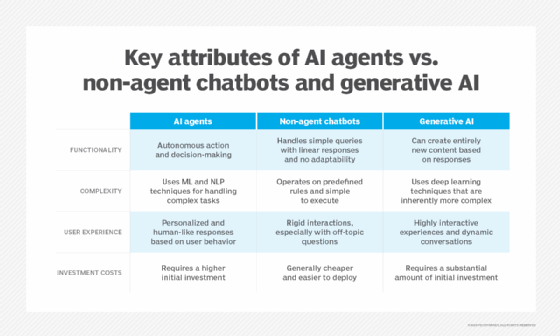
Nonagent chatbots, AI assistants, AI agents and generative AI are all forms of AI designed to assist users. However, they differ in their capabilities, complexity and real-world applications. The key features and distinctions among these AI technologies include the following:
Nonagent chatbots
Functionality. Nonagent chatbots are typically limited to predefined scripts and decision trees. They excel at handling simple queries and providing basic information, such as frequently asked questions, but their interactions are often linear and lack the depth and adaptability of AI agents.
Complexity. Chatbots are simpler to execute than the other AI technologies, but they operate on a predefined set of rules and lack intuitive understanding of human language. They're great for handling straightforward tasks, but they can struggle with complex or unexpected queries.
User experience. Chatbot interactions can feel rigid because of their scripted nature. This can also lead to less satisfying experiences when users ask questions outside their defined scope.
Investment costs. Chatbots are easier and cheaper to deploy, making them a popular choice for businesses with limited technical resources.
AI assistants
Functionality. AI assistants have more advanced conversational capabilities and context-awareness than chatbots, but they're not as independently functional as autonomous agents.
Complexity. AI assistants are more complex than nonagent chatbots. They use LLMs that let them interpret nuance and adapt dynamically to unfamiliar or complex requests.
User experience. AI assistants provide more natural, flexible interactions, often mirroring conversational tone and adjusting responses based on context.
Investment costs. AI assistants typically require higher upfront investment than chatbots, but their broader capabilities can automate more sophisticated tasks, reducing long-term operational costs.
AI agents
Functionality. AI agents are advanced systems capable of autonomously performing and adapting to a range of tasks. They're designed to augment human capabilities and operate across various domains, not just customer service.
Complexity. Agentic AI systems require more sophisticated technology, including ML and NLP, to understand context and perform tasks effectively. Since they can learn from interactions and improve over time, they're typically suitable for more complex applications.
User experience. AI agents are conversational systems that deliver a dynamic, engaging user experience by handling multiturn conversations and personalized responses based on user behavior and preferences. They learn from and respond to humans in a natural, human-like way.
Investment costs. Setting up and running AI agents requires a high initial investment and a skilled team to manage their learning and operational capabilities. This typically includes buying or developing LLMs, acquiring necessary hardware and integrating the system into the existing infrastructure. These systems need large amounts of quality data for training and improving outcomes, additional costs can include data collection, storage and processing.
Generative AI
Functionality. Generative AI focuses on generating or synthesizing new information rather than responding to user queries or performing tasks autonomously. This includes generating text, images, music and artwork using models trained on vast data sets.
Complexity. Generative AI models, such as Open AI ChatGPT, often use deep learning techniques and large data sets to learn patterns and generate outputs. This requires significant computational resources and sophisticated training processes, making them inherently more complex.
User experience. Generative AI offers an interactive experience, letting users engage in dynamic conversations that can adapt to their inputs. Users can ask open-ended questions and receive detailed, contextually relevant responses.
Investment costs. Generative AI requires substantial investment. Training and operating generative AI models, such as those based on LLMs, can cost millions. This includes expenses related to data acquisition, computational resources and ongoing maintenance.
Future of AI agents
A 2025 McKinsey and Company report said that over the next three years, 92% of companies plan to increase their investments in AI. Still, only 1% of businesses have fully integrated AI into workflows where it can drive notable business outcomes. This means AI agents are evolving quickly and are expected to follow their current arc of advancement in three major areas: capability, autonomy and integration.
Future AI agents should become even more capable of handling a wide range of tasks. Rather than building more capabilities into larger and more complex AI agents, it's likelier that AI agents will diversify and become more task-specific and specialized within well-defined vertical industries. AI workflow orchestration will tie these agents together to collaborate and perform more complex tasks.
AI agents will also become more autonomous as models and data sets become defined and explainability emerges as a key feature of AI systems. This means AI agents will be more robust, able to learn and alter behaviors with greater confidence and success without the need for human intervention or feedback.
Finally, future agents will provide greater levels of integration, allowing them to interoperate with a range of business applications, tools, systems, infrastructure and other agents. This will require some standardization around interfaces and protocols, and could pose challenges for legacy systems. However, the demand for AI capabilities is likely to far outweigh the disruption of legacy upgrades.
Continue Reading About What are AI agents? Types and examples
Dig Deeper on Enterprise AI Strategy
-
![]()
SAP Connect 2026 day #1: In the autonomous enterprise, who even needs a CEO in the future?
By: Adrian Bridgwater
-
![]()
Agentic AI in CX management: A strategic guide for business leaders
By: Beth Schultz
-
![]()
How AI agents transform UCaaS workflows and ROI
By: Jon Arnold
-
![]()
Partial automation is the real promise of AI agents
By: James Miller