AI might initially earn trust in transactional work, where narrower tasks, cleaner data and clearer oversight make procurement and manufacturing stronger proving grounds.
AI might earn trust first not in the flashiest corners of enterprise software, but in some of the most structured ones. Transactional work gives AI something a lot of other enterprise tasks do not: narrower use cases, repeatable steps, clearer rules and outcomes that are easier to measure.
If companies are looking for places where AI can start to earn trust, procurement, sourcing, manufacturing and other structured workflows look like some of the strongest candidates.
Transactional work gives AI clearer boundaries
Oracle's latest push helps explain why. Its new agentic applications are being positioned not around one giant agent trying to do everything, but around teams of agents working together toward business objectives.
Big outcomes are made up of smaller outcomes. That helps explain why transactional work matters here.
Procurement, sourcing and manufacturing are all large ERP domains made up of smaller, more repeatable tasks. They are the kinds of workflows where it is easier to imagine AI taking on narrow responsibilities without immediately asking organizations to trust it with the whole process.
Oracle's human-in-the-loop and human-in-the-lead model also feels more grounded in this context. In transactional work, the path from full oversight to partial autonomy is easier to picture because the rules are clearer and success is easier to define. In that setting, AI in ERP feels less like a moonshot and more like a controlled attempt to expand trust over time.
What still feels unresolved is how vendors or customers actually decide when the system has performed well enough to deserve more independence.
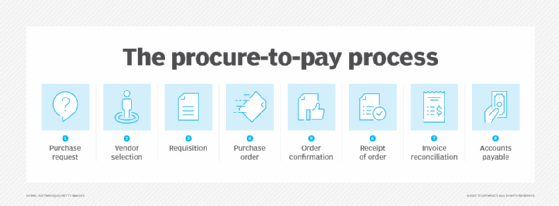
Procure-to-pay is the kind of structured, repeatable workflow where enterprise AI might be able to prove value early because the steps, handoffs and outcomes are easier to define and measure.
Procurement makes AI case more concrete
Procurement makes the case more concrete because it is one of the clearest places where AI can prove its value right now. Spend visibility, continuous risk monitoring, accounts payable and supply-chain resilience are all narrow enough to be believable and important enough to matter.
The value is also easier for executives to see. Better visibility into spend, fewer payment errors, faster responses to disruption and more proactive risk monitoring all translate into outcomes that are operationally and financially legible. In that sense, procurement feels like one of the clearest places where AI can show what it is good at without requiring companies to buy into a much broader transformation story all at once.
Procurement is also a reminder not to oversell the technology. Automation works best when the underlying data is clean and when the workflows make sense. That gets at the real limit of the transactional proving-ground idea.
AI does not rescue a bad process simply by being layered on top of it.
AI does not rescue a bad process simply by being layered on top of it. If the workflow is dysfunctional or the data is weak, automation can just scale the dysfunction.
Organizational readiness matters especially here.
Where transactional friction still hides
Some of the clearest opportunities for transactional AI still come from very old problems. In direct materials sourcing, for example, fragmented bills of materials, disconnected supplier workflows and manual coordination between engineering, procurement, suppliers, finance and manufacturing can slow product development and cut into margins. Narrower automation and AI use cases can start to show value in these environments, where the workflow gaps are often visible, expensive and repetitive enough that improvement can be measured. When AI is introduced, the question is simply whether the technology can reduce wasted motion, accelerate decisions and improve resilience without introducing new process problems.
Manufacturing strengthens the AI use case
Manufacturing pushes the same argument from a different angle. The strongest use cases are not broad claims that AI is reinventing the factory. Instead, they are practical uses tied to forecasting, documentation, computer-aided design, inventory and purchasing decisions, predictive maintenance, and coding assistance in more digitally mature environments.
The strongest projects share a few traits: clear operational or financial outcomes, high-quality and structured data, defined human oversight, and realistic deployment inside existing workflows. Those are the conditions that make AI in manufacturing feel practical rather than speculative.
The caution is part of why the manufacturing case feels more grounded. Generative AI is still not suitable for many mission-critical use cases, and many of the most realistic applications are still in the back office or in tightly bounded operational settings with human oversight. That limitation also keeps the use case from being oversold.
If AI is going to earn wider trust in manufacturing, it will likely do so first through pragmatic, time-saving applications that fit into existing processes rather than through sweeping promises of autonomy.
Sourcing points in the same direction
Direct materials sourcing has long been slowed by fragmented bills of materials, disconnected supplier workflows and manual coordination gaps between engineering, procurement, suppliers, finance and manufacturing. That kind of friction is exactly the sort of environment where narrower AI and automation use cases can start to prove value -- not by replacing the whole process at once, but by making a stubborn, expensive, highly transactional part of it move faster and with less waste.
Taken together, transactional work looks like one of the strongest early tests for enterprise AI. It is not that these areas are simple; it is that they are well-defined enough to let AI work within clearer boundaries. That gives companies a better shot at measuring results, defining oversight and deciding where more autonomy is justified.
James Alan Miller is a veteran technology editor and writer who leads Informa TechTarget's Enterprise Software group. He oversees coverage of ERP & Supply Chain, HR Software, Customer Experience, Communications & Collaboration and End-User Computing topics.