
Getty Images/iStockphoto
How containers enable AIOps: What IT leaders need to know
Containers help AIOps deliver faster issue detection, smarter automation and scalable IT management across complex hybrid environments.

AI is increasingly used to automate, streamline and optimize IT operations -- a practice dubbed AIOps. It's a powerful combination of data, machine learning, analytics, automation and orchestration. When implemented properly, AIOps enables AI to enhance complex IT operations by detecting anomalies, locating faults or root causes; recognizing and responding to incidents; and ensuring the health and availability of IT resources, services and applications.
The effectiveness of AIOps rests largely on the deployment environment. AIOps can provide value in more traditional, local, virtualized or legacy infrastructures by correlating logs, identifying bottlenecks and filtering alerts from tools. But AI only truly works when it can access and analyze large volumes of consistent, high-quality data, which is often lacking in traditional IT environments.
By comparison, containers are well suited to AIOps initiatives. Their added complexity and ephemeral nature make traditional management difficult, but containers provide consistent, high-quality data across logs, metrics and microservices that AI can use to analyze, recognize, plan and respond to the needs of complex, dynamic and increasingly distributed IT environments.
Why AIOps needs the right foundation
As with any AI platform, AIOps needs consistent, accurate, high-quality historical and real-time data for it to be effective. An AI system starved for meaningful data can't provide accurate analytics or make properly informed decisions. Without enough relevant data, the subtle nuance and complex interdependencies of the IT environment are lost, limiting the capabilities of an AIOps infrastructure.
Consider an application running in a VM. An AIOps platform can't see into the VM to gauge its performance or find issues. AIOps is typically limited to checking logs to find errors or report on the application's health. By comparison, an application composed of containers -- such as a microservices application -- uses an array of independent components, each deployed and networked together. An AIOps system can gather far more granular data on the performance and interactions between individual containerized components.
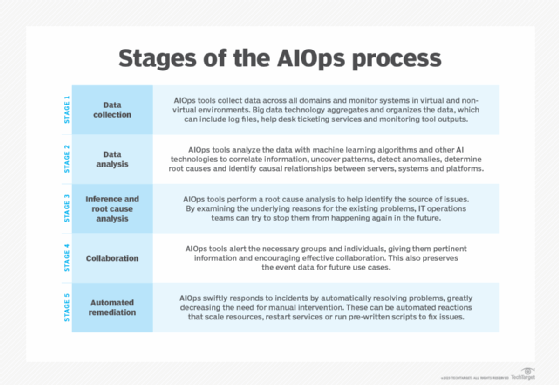
It's this added insight and observability that enables AIOps systems to support advanced capabilities. For example, a containerized environment enables AIOps to perform automated root-cause analysis, pinpointing the pod or service that caused the problem, and then perform automated remediations -- such as scaling resources or restarting services -- to resolve issues. Containers bring three principal benefits to AIOps infrastructures:
- Observability. Containerized environments provide granular real-time data about container health, performance and dependencies. This lets AIOps tools analyze and optimize with better results than traditional monolithic application environments.
- Scalability. Containerized applications and services -- including AIOps tools themselves -- rely on scaling to spin containers up or down as required to maintain application performance. AIOps provides the decision-making and automation needed to support real-time container scalability.
- Management. As containerized applications proliferate across enterprise environments, the burden of monitoring and managing ephemeral containers makes AIOps a superior choice over traditional monitoring and manual management. In effect, AIOps is better with containers, and containers are better with AIOps.
How containers make AIOps possible
Containers can enable or create ideal conditions for AIOps practices, and there are numerous benefits of containerization that business leaders must consider when implementing AIOps technologies:
- Consistent data. AI systems require detailed quality data using a consistent format. This consistency is vital for machine learning models to ingest, parse and analyze the data from many different elements across the environment. Containers readily support this kind of data uniformity by providing consistent metrics, traces and logs from each microservice. It's this alignment that makes AIOps more effective in containerized environments. Container data is uniform across local and cloud infrastructures, enabling AIOps to deliver value across local, cloud and hybrid environments.
- Rapid detection. Containers rely on automation and orchestration platforms, such as Kubernetes or OpenShift, to track the availability and health of microservices. AIOps tools can access and use this operational data in real time, enabling AIOps to quickly spot, analyze and address performance issues such as container faults, excessive latency and unexpected resource usage.
- Root cause detection. Containers use an assortment of metadata to describe context for containerized applications, such as image layers, labels, environment variables and configurations. AIOps platforms can use container metadata to understand relationships among containers, applications and resources. This enables AIOps tools to map and monitor the containerized environment, identifying issues and root causes rather than simply detecting symptoms.
- Automated remediation. AIOps can be extremely effective at identifying the source or root cause of problems in containers, services and infrastructure. AI can often remediate these issues with a high degree of automation, such as restarting a failed container or scaling resources or containers to meet performance requirements. These automated behaviors can be so effective that issues are detected and remediated before users ever notice a problem.
- Better alerting. AIOps platforms can correlate and filter alerts to create a cohesive picture of the problems and their underlying causes. This can greatly reduce alert fatigue for human staff and provide them with far greater context and insight than traditional alerting, where a fault can produce dozens -- if not hundreds -- of alerts that are difficult to prioritize or address manually.
Business value of containers and AIOps
Containers and AIOps can help move IT from a cost center to a driver of business value. The financial value of containers and AIOps is significant. A 2026 report by Fortune Business Insights said it expects the AIOps market value to grow from $2.67 billion in 2026 to $11.8 billion by 2034 -- a CAGR of 20.40%. This growth is driven by an evolving need for more efficient, accurate and proactive management of complex modern IT infrastructures, as well as increasing volumes of data generated by IT resources, systems and applications.
The following business factors outline the value proposition of containers and AIOps:
- Optimization and cost savings. As with more traditional virtualized environments, container environments are prone to overprovisioning and sprawl, which consume resources but don't release them. This uses resources without delivering value, costing organizations unnecessary cloud resources and management. AIOps can automatically scale and manage resource provisioning and container management to reduce costs and optimize containerized environment performance.
- Reduced complexity. IT management often involves a variety of disparate tools, requiring IT staff to deal with multiple dashboards, logs and systems. AIOps can tie diverse, complex systems together to provide a single resource for overseeing and managing containerized environments. Although containers are complex, AIOps effectively filters this complexity, organizing and simplifying the complex environment for more effective human attention.
- Improved reliability. AIOps can proactively monitor, identify and remediate many IT issues -- often before the issues affect the business. This reduces costly downtime, enhances customer experience (CX) and enables businesses to use AIOps as a strategic tool for IT innovation and support.
- Accelerated IT support. A containerized environment driven by AIOps can enable rapid application deployment, benefiting DevOps teams. In addition, AIOps can automate a wide range of routine tasks, reducing human involvement in help desk tickets and letting IT teams devote more time and attention to strategic business projects.
- Enhanced customer experience. Businesses depend on customer interaction to make sales and provide support. The resulting CX reflects the organization's brand and drives customer loyalty. Downtime and poor application performance can impair CX. AIOps can bring faster analysis and remediation to system problems, maintaining strong application performance, reducing downtime and improving CX.
Pitfalls of containers and AIOps
Despite the significant benefits that containers and AIOps can bring, the two technologies can sometimes prove problematic for business and technology leaders. For example, context can be lacking, automation can fail -- especially when an unexpected exception arises -- container vulnerabilities are commonplace and the data AIOps depends on can be inadequate. It's important to consider the potential limitations of AIOps in containerized environments:
- Inefficiencies of container sprawl. AIOps is intended to automate and optimize application deployment, ensure performance, address issues and handle scale. But achieving these goals effectively requires a well-trained AI system, with human feedback and oversight. Otherwise, inefficiencies in AI decision-making can result in unnecessary resource allocation and utilization, which can prove costly for the organization.
- Data silos and data quality. AIOps platforms require high-quality data that is consistent, complete, accurate, timely and relevant. Poor data, such as incomplete log files or noisy data -- full of outliers -- can reduce analytical effectiveness or cause false positives that trigger unnecessary AIOps actions. Similarly, data silos that prevent AIOps platforms from accessing critical data sources can prevent AI from seeing a complete picture of the containerized environment, leading to poor decisions or undesirable actions.
- Complexities and dependencies. Containers are tightly interconnected entities, each with detailed configurations and vital dependencies. This presents AIOps platforms with an environment that is startlingly complex to configure and manage -- the slightest configuration or dependency errors can cause serious container outages or broad systemic failures that AI might not be able to correct without human intervention.
- Lack of proper monitoring. AIOps typically relies on careful monitoring -- usually based on Kubernetes data -- to determine a container's health and performance. But these conditions must be defined clearly so that AI can readily distinguish a healthy running container from a broken one. Without well-defined monitoring, AIOps can mistake a broken container for a healthy one, failing to alert to important issues or correct application problems. This can result in inconsistent, unpredictable or unsafe AIOps actions.
- Security vulnerabilities in containers. Containers, especially established or third-party container images, can have serious vulnerabilities -- even well-documented Common Vulnerabilities and Exposures. Both image scanning and network security monitoring must be a core part of AIOps platforms to safeguard against serious security flaws in containerized environments.
Strategic takeaway for IT leaders
AIOps works well with containers, providing real-time decision-making and high levels of predictive and reactive automation for complex containerized environments. However, approach AIOps as a phased initiative, starting with a single microservice to gain expertise and demonstrate measurable benefits, and then gradually expanding AIOps coverage across the infrastructure.
Next, AIOps decision-making and automation should complement human expertise rather than replace human oversight. Rely on AIOps for mundane troubleshooting or scaling but keep a human in the loop for critical decisions or exceptions, which can pose serious costs or consequences for businesses.
Finally, approach AIOps with an emphasis on data quality and availability to facilitate accurate AI decision-making and ensure that AIOps can see the entire operational situation before analyzing and acting. This is critical as IT and cloud application infrastructures become more complex and transactional. Clear, accessible data will be vital for future AIOps platforms as AI capabilities continue to develop.
Stephen J. Bigelow, senior technology editor at TechTarget, has more than 30 years of technical writing experience in the PC and technology industry.