7 highlights from Pure Accelerate 2026
Fresh off a major rebranding, Everpure (formerly Pure Storage), rolled out a promising collection of new capabilities aimed at helping admins focus on adding business value.
Pure Storage showed up to this year's Accelerate conference as a different company, literally, with a new name (Everpure). The company has the same orange branding, but they're taking a noticeably bigger swing at the "we're not just storage anymore" pitch.
Everpure's new message: Stop managing storage and start managing data and SLAs.
At first glance, that may sound like marketing language, but the vision is compelling. Rather than spending time provisioning capacity and troubleshooting performance issues (manual infrastructure management), Pure is moving toward a model where administrators define business requirements and the platform handles much of the operational work. From AI-powered assistance to intelligent workload placement and policy-driven automation, many of the announcements at Pure Accelerate 2026 were focused on reducing day-to-day operational overhead and enabling IT teams to spend more time delivering outcomes instead of managing storage.
Here are my favorite announcements from the event, in no particular order:
1. Fusion rebalance and workload mobility
Fleet management has always been Pure's strong suit, but this pushes it further into "let the platform decide" territory.
Fusion rebalance gives users:
- Automated workload migration recommendations across the fleet.
- Pre-built move plans with projected latency and capacity impact before users commit.
- One-click cutover once users approve the plan.
Why it matters:
Organizations can spend a surprising amount of time trying to determine which storage systems have available performance and capacity headroom before provisioning new workloads. By automatically identifying the best placement for applications and proactively monitoring service levels, Everpure helps reduce the manual effort involved in capacity planning while preventing potential SLA violations before user impact. The result is more efficient utilization of existing infrastructure across the fleet, enabling organizations to maximize the value of their storage investments without relying on complex spreadsheets, manual analysis or costly hardware refreshes.
This is Everpure treating the array fleet like a single pool of resources instead of 20 individual boxes that users need to babysit separately.
2. Proactive optimization recommendations
This one ties directly into the SLA-tier story that's becoming central to how Everpure wants you to think about storage.
The image below shows in plain sight how to discover configuration drift without having to dig and compare every single array, one at a time.
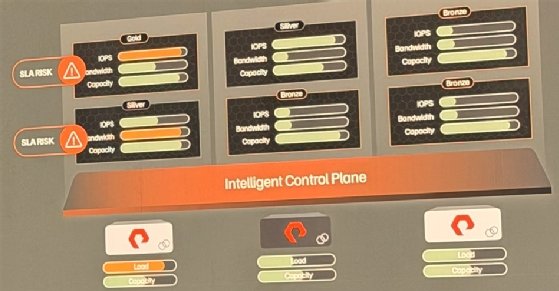
The Intelligent Control Plane now actively flags:
- SLA risk before it becomes an incident.
- IOPS, bandwidth and capacity headroom per tier.
- Which arrays are absorbing too much load relative to their tier.
Why it matters:
Storage performance has traditionally been measured using technical metrics that make sense to administrators but are difficult to translate into business outcomes. By shifting the conversation to policy-driven service levels, organizations can govern storage resources based on application requirements rather than infrastructure details. This makes it easier to justify tiering decisions in terms the business understands, such as Gold, Silver and Bronze service levels, instead of array-specific performance metrics. It also provides earlier visibility into workloads that are trending toward SLA violations, allowing teams to take corrective action proactively rather than discovering problems after users submit performance-related tickets.
3. A solution to reactive performance firefighting
Technically not a product announcement, but the slide deserves its own line because everyone in the room nodded.

This was the "before" picture: arrays full of mismatched, uncategorized workloads with no clear separation by criticality, and admins firefighting performance issues after the fact instead of before.
Why it matters:
One of the most valuable aspects of this announcement is that it acknowledges the reality of how most storage environments operate today. Many organizations still rely on manual processes, tribal knowledge and periodic reviews to balance workloads across their storage arrays. By recognizing that this approach becomes increasingly difficult to sustain as environments grow, Everpure helps frame capabilities like Fusion Rebalance and proactive optimization as solutions to a real operational challenge rather than features added for the sake of innovation. It's also a useful conversation starter with customers, as it shifts the discussion away from individual product features and toward a broader question: How much time and effort should teams continue spending on tasks that simply don't scale?
4. FlashBlade//EXA: Multi-tenancy, QoS and bigger AI job support
FlashBlade//EXA keeps adding the features large AI/ML shops have been asking for since EXA launched.
New in this round:
- Multi-tenancy support.
- Quality of service (QoS) controls.
- Security enhancements.
- SPEC concurrent AI job support, jumping from 6,300 to more than 7,200.
Why it matters:
As EXA evolves into shared infrastructure, multi-tenancy and QoS become essential for preventing noisy neighbors from impacting other teams and workloads. Support for more concurrent AI jobs improves scalability for GPU-dense environments, while the security enhancements provide the isolation and governance needed to safely operate a multi-tenant platform.
5. Everpure Cloud for Azure VMs
This native Azure storage isn't just "we need you to run some VMs in your subscription."
The picture below showcases how your VMs can simply consume storage managed by Everpure as a server, on their own tenant.
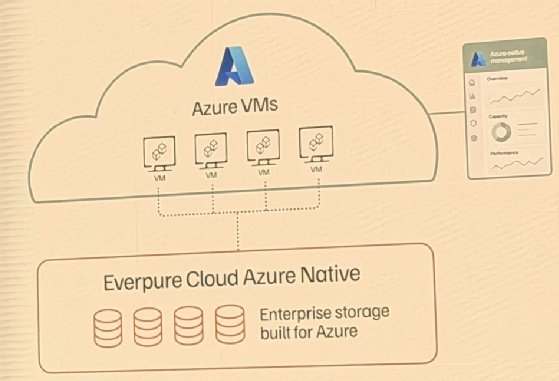
Highlights include:
- Up to 40% reduction in cloud storage costs.
- Mission-critical performance, not just "good enough for cloud."
- Native Azure experience with Azure-native management UI, not a bolted-on console.
- No storage controllers running as a VM needed -- these are managed by Everpure within its tenants, as a service.
Why it matters:
Rising cloud storage costs continue to be a concern for many organizations. Potential savings of up to 40% are the kind of numbers that quickly capture executive attention. Beyond cost reduction, this enables organizations to extend the same Purity data services they use on premises into Azure, avoiding the feature gaps and operational differences that often come with native cloud storage. For hybrid cloud environments, it also helps maintain a more consistent operational model across both on-prem and cloud deployments.
6. Evergreen//One Overdrive
This is Everpure leaning further into the "storage as a utility" model.
The graph below said it all, with a flat ~45 GB/s baseline that jumps to 120-150 GB/s the moment Overdrive kicks in, and then settles back down.
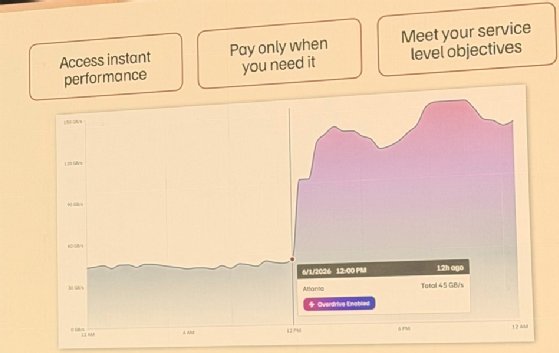
The pitch:
- Instant access to burst performance when you need it.
- Pay only for the overdrive capacity that you actually use.
- Designed specifically to help you hit SLOs under unexpected load.
Why it matters:
This addresses a common infrastructure challenge: sizing for occasional peak demand without overpaying for resources that sit idle most of the year. By scaling performance when needed, organizations can better align costs with actual usage while still supporting predictable but bursty workloads such as month-end processing, seasonal traffic spikes or AI training jobs.
7. Purity Turbo for FlashArray//XL190
The flagship array gets a software-only performance unlock.
What Purity Turbo actually does: The secondary controller, which normally just sits in standby for failover, now actively serves read I/O alongside the primary. Future versions extend that to offloading backup and analytics workloads entirely off the primary controller.
The numbers Everpure is putting next to //XL190:
- 930% more IOPS per rack unit.
- 310% more IOPS per watt.
- 460% more TB per rack unit.
- Sub-100 microsecond, DRAM-class latency.
Why it matters:
This provides additional performance headroom for workload spikes without requiring organizations to purchase and deploy more hardware. Because it's basically a software capability on existing controllers, it adds capacity where it's needed without introducing additional operational complexity. For organizations running business-critical platforms such as Oracle, SAP HANA or SQL Server, it offers a way to support continued growth and performance demands when simply adding another array is no longer the most practical solution.
My take on Pure Accelerate 2026
The announcement that resonated with me most wasn't a new array or a performance benchmark this year. It was the continued focus on eliminating boring operational work that doesn't create business value.
In most environments I've worked with, storage teams spend far too much time investigating performance issues, managing capacity, validating replication and responding to alerts. These tasks are necessary, but they don't move the business needle. I've witnessed administrators spending hours gathering data from multiple tools just to validate that the storage was not the problem. I have been that storage engineer gathering proof to show the application teams that the bottleneck was not on our side.
What stood out at Accelerate is that many of the announcements directly target those operational bottlenecks. The goal isn't simply faster storage, but also reducing the time and effort required to run it. AI-driven operations, workload intelligence and autonomous optimization enable administrators to spend less time on routine maintenance and more time on architecture, security and strategic initiatives. Ultimately, the value isn't the technology itself; it's giving IT teams their time back.
New name. Same orange. Bigger ambitions.
Danny Alvarez is an experienced principal solutions architect, translating business strategy into modern IT infrastructure.
Dig Deeper on Storage
-
![]()
Everpure lands second hyperscaler design win for DirectFlash
By: Antony Adshead
-
![]()
Everpure Data Stream preps data pipeline for enterprise AI
By: Joab Jackson
-
![]()
Conference news from Pure Accelerate 2026
By: Kate Murray
-
![]()
Everpure grows into data management with Data Intelligence update
By: Alexander Gillis