Atlassian refined its approach to cross-domain AI agent orchestration this week, but industry observers said concerns remain about the potential costs of data exchange among platforms.
New Atlassian Model Context Protocol (MCP) and CLI tools, released in beta this week, will give AI agents within Atlassian's Rovo system and third-party platforms finer-grained access to context within Atlassian's Teamwork Graph. The new tools enable all agents and human developers to explore the full graph, which also underpins Rovo AI and provides context, including relationships between data assets, to guide AI agent automation.
MCP is an open source standard that brokers AI agents' access to the context data and tools behind third-party systems. While the industry has quickly embraced MCP, it can be a noisy protocol, according to Jamil Valliani, vice president and head of AI product at Atlassian.
"It provides an easy way for an agent to get as much data as possible without understanding any of the relationships. It's just getting a bunch of raw data to stuff the context window, and then it'll try to reason over it, and that causes token burn," Valliani said. "Now, an agent can query for exactly what you want and understand the relationships between objects, so you have a lot more structured knowledge and a lot less data to capture."
Jamil Valliani
The new MCP tools will produce 44% more accurate graph search results and also reduce noisy data exchange among agents, reducing token costs by up to 48%, Valliani said.
Cross-domain AI carries cost concerns
Cost management and token consumption are increasing concerns for enterprise AI governance, said Rebecca Wettemann, CEO at independent research firm Valoir.
"The fear people have is that they could go to bed at night and wake up in the morning and find out, not that AI had caused huge amounts of damage, but that it burned through $4 million worth of AI tokens with no outcomes," Wettemann said.
Vendors' pricing models for AI agents remain a work in progress as they look to boost enterprise adoption, said Thomas Wieberneit, co-founder, CEO and principal at AheadCRM, a consulting firm specializing in customer resource management, customer experience and AI.
"How do we tie agentic services to a pricing model that is transparent enough that even the CFO not only understands it, but also likes it?" Wieberneit said. "Consumption-based pricing is not it, because this doesn't tie outcomes to prices. Actually, it's the crutch that [vendors] are using to bolster their own revenues, a way of washing [their] hands: 'Well, if you had implemented it properly, then you would have gotten the value.' The whole industry needs to come to proper working models that are working for both sides."
The need to supervise autonomous agents with other agents in autonomous systems contributes to token consumption, as does data exchange among multiple platforms, said Charles Betz, an analyst at Forrester Research.
"One of the surprising things coming up in interviews with clients is that evaluation costs are starting to become unacceptable, where you've got one agent doing a thing, and then another agent evaluating the thing," Betz said. "That can get the quality pretty much to where they need it, [but] it's also twice as expensive as [they expected]."
Data exchange among multiple vendors' agents has the potential to compound this problem, Betz said, since most vendors, including cloud hyperscalers, charge for data egress from their networks.
ServiceNow, Atlassian shift agent data access
Atlassian enterprise service management rival ServiceNow also changed how it approaches such exchanges with the launch of a new Access Fabric during its Knowledge conference this week. Access Fabric separates lighter-weight AI agent data requests from the per-gigabyte data egress charges applied when users move large volumes of data out of its platform.
ServiceNow did not disclose pricing for Access Fabric. A company spokesperson said customers can monitor data egress costs using the subscription management feature available to all customers of its AI platform. These costs are not currently reflected in the cost management reports available in the ServiceNow AI Control Tower tool.
The fear people have is that they could go to bed at night and wake up in the morning and find out, not that AI had caused huge amounts of damage, but that it burned through $4 million worth of AI tokens with no outcomes.
Rebecca WettemannCEO, Valoir
For both vendors, these costs will continue to be the source of customer questions, according to Betz.
"I just had an architecture team at a large organization express concerns to me … about ServiceNow's latest terms and conditions for data egress having to do with agentic traffic on its graph," he said. "Apparently, there's a whole bunch of startups that really, really want the data in Atlassian and ServiceNow, and so Atlassian and ServiceNow are going to be in this very difficult spot of not limiting their customers, but if their customers are bringing in some agent that wants to download the whole graph, they're going to have to put a price tag on that. There's going to be serious tension around this."
An Atlassian spokesperson pointed to token reductions enabled by the new MCP tools available for Teamwork Graph as one way Atlassian is addressing data exchange costs for customers.
"We'll always support data portability -- but the graph is far more than a copy of a customer's data," the spokesperson added in an emailed statement to Informa TechTarget. "It's an intelligence layer built on inferred relationships and semantic understanding, and that's what powers meaningfully better experiences."
Cross-domain agents still rare in production
The new access to Atlassian's Teamwork Graph was part of a bundle of product updates rolled out during Atlassian's Team conference this week. The updates also included a feature called Max in Rovo Chat that can take on complex, multistep tasks; general availability for the Rovo Studio agent builder, including a no-code interface and governance controls; general availability of AI agent support in Jira; and an incident command center and autonomous Level 1 service desk agents in Service Collection products.
Overall, Atlassian's AI product development strategy emphasizes being agnostic to the source of agents and models.
"Customers can orchestrate fleets of agents across different vendors, choose the best one for every job, and know that each agent has the organizational context to get it right," said a company statement sent to the press in March. "Better context means better outcomes, no matter whose agent is doing the work."
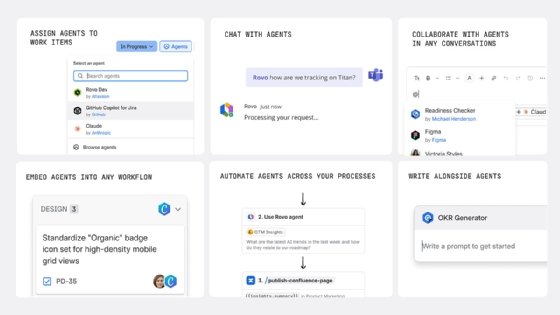
An Atlassian Infographic groups screenshots of its Rovo AI agent management updates across multiple products this week at Team 2026.
However, this type of deployment is still beyond the reach of most enterprises, according to experts, including Wettemann. The most common multi-agent orchestration deployments in production she's seen are among Salesforce Agentforce customers.
"I think it's because they were easy initial use cases -- the data was in Salesforce. It was a workflow that was probably already documented in some way," Wettemann said. "It didn't have the kind of risk of gathering data from outside systems, or even a lot of cases going outside Salesforce."
Atlassian should expand its asset discovery capabilities if it wants to compete with ServiceNow for cross-domain AI agent orchestration, according to Betz. In the past, Atlassian has partnered with Device42, which was acquired last year by competitor Freshworks.
"This remains an Atlassian weakness, really upping their game on CMDB," Betz said. "Without discovery, without a good understanding of ground truth, you're not going to be able to really control AI agentic workloads. It would start to set them up to be at least the beginnings of an AI control tower."
Atlassian now partners with other discovery vendors, including Lansweeper and Flexera, according to the company spokesperson.
"We are committed to evolving our native ITAM and CMDB functionality, including the integration of this data into our broader Teamwork Graph," the Atlassian spokesperson wrote. "Data reconciliation and data quality capabilities from our acquisition of AirTrack (now known as Data Manager) enable our customers to ingest, cleanse, and analyze data from multiple third-party sources."
Beth Pariseau, senior news writer for Informa TechTarget, is an award-winning veteran of IT journalism. Have a tip? Email her or connect on LinkedIn.

 Jamil Valliani