
sdecoret - stock.adobe.com
Salesforce releases Agentforce dev tools, updates Agent Fabric
Salesforce provides more observability, availability and some declarative control over AI agents.

Editor's note: This story was updated to reflect the final name of Agentforce Vibes.
In its continuous drive to promote agentic AI growth, Salesforce has given developers more tools that -- among other things -- enable agents to write more agents and allow developers to orchestrate, test and observe them once they go live.
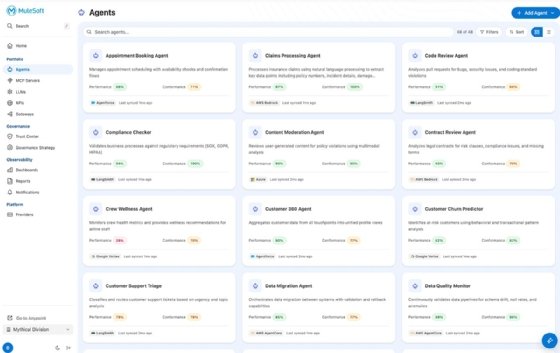
Salesforce Agent Fabric, which evolved from MuleSoft Agent Fabric, relaunches with an agent dashboard that tracks agents and MCP servers from Salesforce and other vendors such as Amazon and GoDaddy. Also added was a visual authoring canvas, which maps both agentic and human checkpoints in workflows, and governance and authentication tools to make sure that -- especially in higher-risk processes such as moving funds -- business rules can be built into agent work.
Another initiative, Headless 360, turns all Salesforce functions into MCP servers, CLI functions and APIs. It makes Salesforce more composable for developers who want to move their use cases away from the Salesforce interface into their apps and agents.
Furthermore, Salesforce updated Agentforce Vibes. The 2.0 version of the agentic vibe-coding tool is "totally rebuilt," said Stephan Chandler-Garcia, senior director of technical content engineering at Salesforce.
In aggregate, all these developer tools and platforms, according to Salesforce, address learnings from the first year and a half of Agentforce, which can be summarized as such: Users want more granular control over their agents.
While this round of rollouts promotes the fast propagation of AI agents, it also enables tighter controls over them. Salesforce recognizes that to get customers' Agentforce pilots into production, users can't be afraid that AI agents are going to run unabated and potentially overstep their boundaries, said Rebecca Wettemann, founder of Valoir, an independent research firm.
Customers must be able to manage agent behavior not just in the present, but also as the technology integrates into IT systems and users discover its intended and unintended effects.
"We went from fear of missing out -- FOMO -- two years ago to FOMU -- fear of messing up," Wettemann said. That's where governance comes in. It's not just about getting AI out the door and in production but managing and monitoring it over time."
All of this is built on Salesforce Agentforce 2dx, the latest version of the platform, which was previewed in March and is scheduled for release later this month.
Salesforce made these announcements at this week's TDX developer conference in San Francisco, where it also presented the new AgentExchange. This partner marketplace combines AppExchange, Slack Marketplace and the Agentforce ecosystem, launched in March 2025. Salesforce claims that nearly 14,000 apps, agents and Slack tools are available on AgentExchange.
Mixing the probabilistic with the deterministic
Tucked away among the Salesforce TDX feature drops was another significant change: Salesforce has open-sourced Agent Script, its language that defines agents -- and cues them when to use probabilistic LLM reasoning and when they need to follow repeatable, deterministic roadmaps.
The move enables coding engines such as Claude Code, Cursor and Agentforce Vibes to create agents that can tap into deterministic workflows. This "agents writing agents" scenario is quickly emerging and has become more commonplace, Chandler-Garcia said. Salesforce hopes to make that process smoother with MCP servers that teach coding agents how to use Salesforce -- and the user's -- metadata, along with testing environments that could shorten the process of getting agents up and running.
That's a huge deal, Wettemann said. Despite the hype around generative AI, its probabilistic approach -- in which it generates a new answer every time a question is asked -- doesn't solve every business process automation problem.
"People are realizing -- after they've played enough with the probabilistic stuff -- that it isn't always the best answer," Wettemann said. "If I'm processing an insurance claim, I want consistent, auditable results every time. A plus B should always equal C. Certain things are never open to interpretation."
Joe Inzerillo, president of Enterprise and AI Technology at Salesforce, also acknowledged the need for users to commingle both kinds of workflows when building and maintaining AI agents.
"Agents are not software," Inzerillo said. "Agents are something else. They're also not human. So, we have to be careful not to completely anthropomorphize them. What they are is a much more probabilistic, stochastic system. That means that you can't necessarily put in the exact same input and get the exact same output every time -- and that requires different tooling, a different development cycle."
Don Fluckinger is a senior news writer for Informa TechTarget. He covers customer experience, digital experience management and end-user computing. Got a tip? Email him.
Dig Deeper on Customer Experience
-
![]()
The AI handshake: More MCP interoperability for Salesforce's Slackbot
By: Don Fluckinger
-
![]()
Salesforce productizes its own customer service AI agent for users
By: Don Fluckinger
-
![]()
Salesforce plans to acquire Fin agentic customer service AI
By: Don Fluckinger
-
![]()
Agentforce Operations tackles workflow orchestration
By: Don Fluckinger