
putilov_denis - stock.adobe.com
Agentic orchestration, the next AI issue for CIOs to tackle
Salesforce, ServiceNow, AWS and others would like to manage all of your AI agents.

When two employees have conflicting goals, they can work it out, perhaps by seeking counsel from a supervisor, playing a game of rock-paper-scissors, or even engaging in a friendly arm-wrestling match. But who wins when it's two generative AI agents in conflict?
That will become a problem for most enterprises, Salesforce predicts in its "2025 MuleSoft Connectivity Benchmark Report." It found that the average enterprise runs 897 apps. Many, if not most, software vendors are incorporating agentic AI tools to automate their workflows.
"There are some smaller players out there that are just focusing on perfecting the single agent, but that can only get you so far," said Mike Szilagyi, senior vice president and general manager of product management at Genesys. "Agentic orchestration is [less about routing customers and] more about understanding customer intents and business intents, and then facilitating an outcome, whether it involves humans, AI or back-end systems."
These are early days, with many companies either deploying their first AI agent or evaluating which of their business processes are ripe for automation. As agentic AI proliferates, however, CIOs can anticipate software conflicts that the environment can introduce, potentially over issues such as data access and security, resource usage and data synchronization.
Vendors know this, and they would all like to own a piece of the agentic AI management layer, which could potentially control both their own and everyone else's AI agents. CX leaders can choose among a growing number of agent orchestration tools to manage agent interactions: ServiceNow's AI Control Tower, AWS's Amazon Bedrock multi-agent collaboration, Salesforce's MuleSoft Agent Fabric, IBM's Watsonx Orchestrate, OpenText AI Data Platform, Pegasystems' Pega Agentic Process Fabric, Adobe Agent Orchestrator, to name a few of a rapidly expanding list.
Even PwC released its own, called Agent OS.
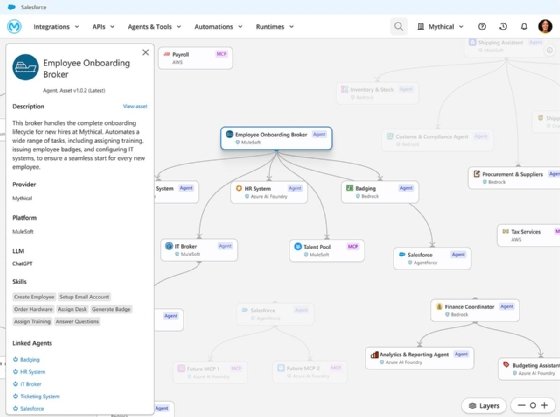
"In the enterprise space, there's no client that's going to be on a single AI tool, single platform, wall to wall," said Derek Santana, U.S. Salesforce Alliance Leader at PwC. "You're not going to use Agentforce for everything. You're not going to use all Copilot, or you name it, OpenAI."
It's a complicated puzzle to solve, as AI agents are granted more autonomy to do work. Tools such as ServiceNow's AI Control Tower can help CIOs grasp how AI is being deployed across their organizations and apply standards and governance to it, said Terence Chesire, vice president of Product Management, CRM & Industry Workflows at ServiceNow.
"The challenges are around putting together the strategy, the processes and the awareness across the organization," Chesire said. "This provides the tooling and capabilities to turn that into meaningful insight, so, as a leader, you can actually understand all the places where AI is being utilized and what the goals are for those use cases -- even though they're not ServiceNow use cases."
Vendors are vying for control of the agentic AI orchestration layer because IT spend will be moving in that direction over the next few years -- and away from traditional seat licensing -- said Keith Kirkpatrick, research director for the Futurum Group.
"ServiceNow realizes that the real value is going to be in gaining access to the entire tech stack," Kirkpatrick said. "The way they're going to do that is through AI agents, or at least that's the way they believe it's going to be -- managing not only their agents, but everybody else's as well."
Customers still deploying first agents
Orchestration issues are predictive of a future state of enterprise IT. Currently, all but a few users are still perfecting their first agents.
For PepsiCo, that first agent was a triumph, marking a five-year data migration to the cloud for its six million global customers, as well as a concurrent data and process harmonization initiative that enabled the use of data to analyze sales trends and costs at a neighborhood level. The agent can generate data-informed suggestions of what those customers could stock most profitably in their refrigerators.
Now that PepsiCo has laid the foundation for agentic AI, there will be more agents to come, said Dave Dohnalik, senior vice president of technology strategy and enterprise products at PepsiCo.
"We're early in our journey, for sure," Dohnalik said. "We see opportunity in terms of expanding some of the use cases around how aggressive we want to be with new product innovation, how aggressive we want to be with loyalty and incenting customers. We're testing and learning as we're working through this."
PepsiCo's agent was built on Salesforce. For now, the agent is tightly controlled with human supervision -- "the hand on the wheel," as he puts it. But Dohnalik sees potential agents from other vendors coming online in the next few years. When it comes to the orchestration layer, he imagines PepsiCo developing something out of components from several different vendors, so the company is not beholden to "one large logo."
"As we think about our AI strategy, we want to control that orchestration layer," Dohnalik said. "Everyone's 'Oh, I can do that on your behalf. I've got the control tower, I've got the orchestration layer.' We have a massive footprint, and so the way we think about it … we want to control that control plane."
While multi-agent orchestration might be in the realm of theoretical -- or vendor wishful thinking -- for most users at the moment, the consultants charged with making this work say it's coming.
"We're already having conversations where we're talking about taking Agentforce with a client who has decided to standardize on Gemini and Google's platform," said Chuck Tomanek, director of solutions delivery at Perficient. "So, taking Agentforce and having our agents be able to communicate back with Gemini and agents that might be built on other platforms is a very real thing -- through Gemini, through APIs, or through hopefully, what's coming up in the not too distant future [such as] Agent2Agent."
Some vendors are helping to drive the adoption of agentic AI by embedding employees in their customers' IT organizations. Salesforce does it with what it calls "forward-deployed engineering."
While Salesforce would like to be the single agentic AI vendor for its customers, it understands that isn't necessarily realistic and that some use cases will require agents outside the Salesforce platform, said Jennifer Cramer, senior vice president of forward deployed engineering and customer success for AI products at Salesforce.
"We want to be the single agentic solution. But where they're having point agent solutions [from other companies], we want to be the layer that connects them all," Cramer said. "I don't think that multi-agent situations are that far out in our future, if they're not already here. Things happen so fast in this space, things we didn't think were at all possible this time last year."
Don Fluckinger is a senior news writer for Informa TechTarget. He covers customer experience, digital experience management and end-user computing. Got a tip? Email him.
Dig Deeper on Customer Experience
-
![]()
Informatica wants AI agents to stop making up the numbers
By: Aaron Tan
-
![]()
AI control is becoming an architecture problem for CIOs
By: James Miller
-
![]()
Salesforce Enterprise AI Harness latest salvo aimed at ServiceNow
By: Don Fluckinger
-
![]()
All agentic AI data access, orchestration hinges on these two standards
By: Don Fluckinger