How CIOs should architect trust in AI -- not just govern it
When designing trustworthy enterprise AI applications, platform architecture, not policy alone, is the best way to minimize long-term risk and ensure compliance and sustainability.
As enterprises accelerate the adoption of generative and autonomous AI, CIOs in regulated industries such as healthcare and financial services are confronting a familiar tension: how to scale innovation without undermining trust, compliance or operational control. Governance frameworks and ethical guidelines are often positioned as the answer. In practice, many organizations are discovering that trust failures rarely originate in policy documents.
Instead, trust breaks down through architectural decisions embedded deep within AI platforms -- how data is retrieved, how decisions are made, how actions are constrained and how behavior is observed over time. In regulated environments, AI systems don't fail loudly. They fail quietly, through opaque reasoning, uncontrolled context assembly or governance mechanisms that can't keep pace with autonomy.
This article reframes trust in enterprise AI as an architectural responsibility rather than a governance afterthought. It presents a reference architecture for designing AI platforms that continuously enforce trust through system design, enabling CIOs to scale AI responsibly while maintaining regulatory confidence and operational resilience.
Why trust breaks down at scale
Early AI pilots often succeed because risk is implicitly managed by scope. Data sources are narrow, workflows are supervised and failures are surfaced through human review. As systems move into production, this careful management and the assumptions around it collapse.
This happens as enterprise AI platforms increasingly do the following:
Retrieve sensitive data across domains.
Reason over long-lived and evolving context.
Influence clinical, financial or operational decisions.
Operate continuously with limited human oversight.
In regulated environments, AI systems don't fail loudly. They fail quietly, through opaque reasoning, uncontrolled context assembly or governance mechanisms that can't keep pace with autonomy.
In these environments, traditional controls -- access reviews, approval workflows and post-hoc audits -- become misaligned with system behavior. Decisions are executed faster than they can be reviewed and accountability becomes difficult to construct after the fact.
The result is rarely immediate noncompliance. Instead, organizations experience gradual erosion: uncertainty about why a system acted the way it did, whether it should have acted and whether similar behavior will recur. These are architectural failures, not policy gaps.
Trust as a system property, not a governance checklist
CIOs operating in regulated environments must enforce trust at runtime rather than infer it retroactively as one more item to check off. Trust must be treated as a system property embedded in the AI platform rather than layered externally.
Decisions are explainable within a system's context.
Data access is constrained semantically, not just technically.
Model behavior is observable beyond outputs.
Governance controls are enforceable dynamically.
These properties don't emerge from individual tools or frameworks. They emerge from how architectural layers interact across the platform.
Core architectural layers CIOs must get right
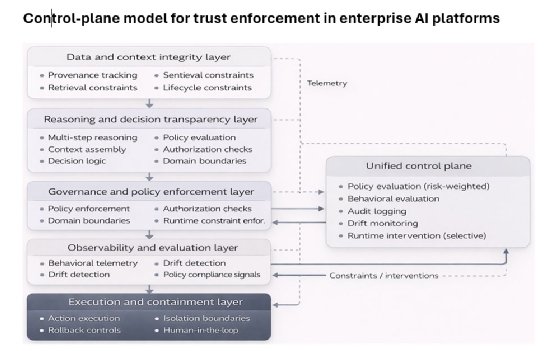
The following are the five key layers in a trustworthy AI architecture to consider:
1. Data and context integrity layer
Trust begins with controlling what information enters the system. In regulated industries, this requires more than access control lists. Data must carry provenance, sensitivity and lifecycle constraints that persist through retrieval and reasoning. Without this layer, AI systems could comply with technical access rules while still assembling unsafe or noncompliant context during inference.
2. Reasoning and decision transparency layer
As AI systems move beyond prediction into decision-making, CIOs must ensure that platforms can reconstruct why a system acted -- not merely what it produced. This layer captures decision paths, uncertainty signals and contextual influences, so that outcomes can be reviewed, audited and defended when required by regulators or internal risk teams.
3. Governance and policy enforcement layer
Governance can't rely solely on static approvals or documentation. Policies must be dynamically enforceable during retrieval, reasoning and action execution. This layer separates governance logic from application logic, enabling consistent controls across models, workflows and business units without embedding brittle constraints into every use case.
Separating execution from governance in a control plane architecture enables continuous policy enforcement, behavioral evaluation and auditability without entangling application logic.
4. Observability and evaluation layer
Traditional observability focuses on system health metrics. Trustworthy AI requires observability of behavior. CIOs need visibility in the following areas:
What data influenced a decision.
Which policies were evaluated or bypassed.
Where uncertainty increased over time.
How system behavior drifts across deployments.
Evaluation must measure consistency, compliance and drift, and not just answer correctness.
5. Execution and containment layer
Finally, trustworthy platforms limit blast radius by design. Actions must be scoped, reversible and isolated. In regulated environments, the ability to constrain or halt behavior safely is as important as model accuracy. Architectural containment determines whether failures remain manageable or escalate into systemic risk.
What this means for CIO decision-making
For CIOs, the implication is structural rather than tactical. Trust can't be retrofitted through additional oversight committees, documentation or downstream audits. It must be engineered into the AI platform itself.
Organizations that embed trust into data flows, reasoning paths, governance mechanisms and observability layers will be positioned to scale AI with confidence.
As AI systems evolve from advisory tools into operational actors, architectural decisions made today will determine whether organizations can scale responsibly or face regulatory, legal and reputational challenges later. Investing in platform-level trust architecture is no longer optional; it's foundational to sustainable AI adoption.
Enterprise AI trust isn't achieved by selecting the right model or expanding governance checklists. Instead, it's achieved by designing platforms that continuously enforce trust through architecture.
Organizations that embed trust into data flows, reasoning paths, governance mechanisms and observability layers will be positioned to scale AI with confidence. Those that treat trust as an external concern will find themselves constrained not by regulation, but by the limits of their own systems.
Varun Raj is a cloud and AI engineering executive specializing in enterprise-scale cloud modernization, AI-native architectures and large-scale distributed systems. His work focuses on designing and operationalizing cloud- and AI-native platforms, including generative AI and multi-agent systems, in highly regulated industries such as healthcare and financial services.