Open source AI: What it means for enterprise innovation
Open source AI is transforming enterprise innovation with greater flexibility and control, but organizations must address governance, security and operational challenges to scale effectively.
Organizations embracing open source AI models are redefining how innovation happens in the enterprise. By building, fine-tuning and deploying AI on their own terms, they reduce reliance on vendors while accelerating development and lowering costs.
That shift is driven in part by how far open source models have come. Once seen as lagging behind proprietary systems, many models now deliver enterprise-grade performance and, in some cases, rival closed alternatives. A 2025 report by McKinsey & Company found that leading open models are rapidly closing the performance gap, with some demonstrating competitive results on industry benchmarks. The report also found that more than half of organizations are using open source AI across models, data or tools in their stack, underscoring how quickly it has entered the mainstream.
Enterprises are also rethinking AI economics and control, making open source adoption a more viable option. "We're entering the age of inference, where the economics of running AI systems at scale really matter," said Hugo Huang, director of the public cloud alliance at Canonical, the company behind the Linux Ubuntu OS. He added that open source AI models can be significantly more cost-effective than proprietary APIs while also giving enterprises greater control over data, deployment and long-term strategy.
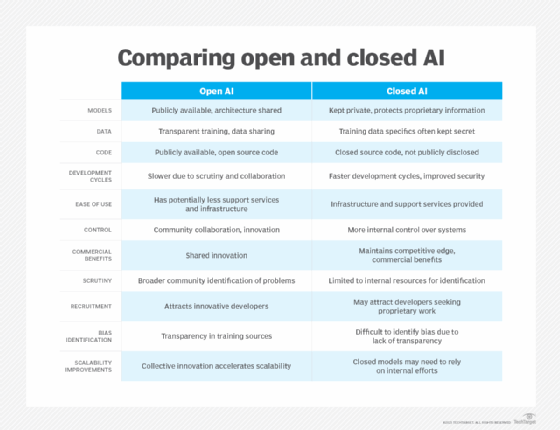
A side-by-side comparison of open and closed AI highlights differences in transparency, control, development speed and enterprise benefits.
How open source AI is transforming enterprise innovation
Open source AI is helping organizations rethink how they test, build and scale applications. For CIOs and technology leaders, it has become an important part of shaping a successful AI strategy, offering greater control and flexibility than proprietary, black box models. Beyond cost and accessibility, it gives organizations more influence over how systems are developed, deployed and governed.
Here are some of the key ways open source AI is transforming enterprise innovation.
Lower barrier to entry
With open source AI, enterprises don't need to build models from scratch or rely exclusively on proprietary vendors. Instead, they can tap into a growing ecosystem of pretrained models, frameworks and tools that speed up development. This is especially helpful for organizations that don't have deep in-house AI expertise. Teams can experiment more quickly, test ideas at lower costs and refine models without the large upfront investment typically required for AI projects.
Sonu Kapoor, software engineer and founder of Solid Software Solutions, a company that builds bespoke mobile and web applications, said this accessibility is as much about control as it is about cost. He explained that enterprises are increasingly drawn to open source because it gives them more influence over how systems are designed, deployed and managed, pushing them beyond simple, plug-and-play vendor options.
As a result, AI is no longer limited to specialized innovation teams. Business units across the organization, from marketing to operations, can begin exploring and applying AI within their own workflows.
Accelerated innovation through community
Open source AI thrives on collaboration. A global community of developers, researchers and organizations continuously improves models, fixes issues and adds new features -- often faster than proprietary development cycles.
For enterprises, open source is now strategic.
Mayank KumarFounding AI engineer, DeepTempo
"For enterprises, open source is now strategic," said Mayank Kumar, founding AI engineer at DeepTempo, a cybersecurity company that provides AI-powered threat detection. He noted that it helps eliminate vendor lock-in, supports greater customization and enables faster iteration without licensing constraints. It also makes it easier to attract talent, he said, as many engineers prefer working in open ecosystems driven by community collaboration.
This approach is reflected in DeepTempo's own work. The company recently introduced Vigil, an open source, AI-native SOC that enables organizations to customize models, workflows and integrations, highlighting how open source innovation is expanding beyond models to full enterprise systems.
Transparency and experimentation
Open source AI encourages transparency because its models and training methods are openly available. This enables organizations to better understand how systems work, which is especially important as AI becomes part of critical business operations.
Solid Software Solutions' Kapoor noted that open source is changing how companies innovate by making it easier to experiment and by encouraging more modular system designs. Instead of relying on one monolithic platform, companies can build systems in smaller parts that can be updated and improved independently.
Canonical's Huang described this as "permissionless innovation," where teams are no longer limited by vendor timelines. "Instead of waiting for a single provider to release new capabilities, enterprises can experiment, adapt and integrate improvements continuously," he added. This shifts innovation from a centralized process to one that happens across different teams in the organization.
Flexibility and architectural freedom
Unlike many closed AI platforms, open source tools offer a high degree of flexibility. Enterprises can customize models to fit specific business needs, integrate them with existing systems and deploy them in environments that meet their regulatory or operational requirements.
This is especially important in industries with strict data governance rules, as open source can often be deployed on-premises or within private cloud environments, giving organizations greater control over sensitive data.
Open source AI gives enterprises more freedom to choose where systems run and how much of the surrounding stack they want to own.
Sonu KapoorSoftware engineer and founder, Solid Software Solutions
Solid Software Solutions' Kapoor framed this advantage as architectural freedom. "Open source AI gives enterprises more freedom to choose where systems run and how much of the surrounding stack they want to own, " he said.
Canonical's Huang also pointed to control as a defining advantage. "Open source AI gives enterprises architectural independence," he said. "Models can run across cloud, on-premises or hybrid environments, enabling organizations to align deployments with data residency, security and cost requirements while avoiding long-term lock-in."
This flexibility extends further through fine-tuning, which enables companies to adapt open source models to their own data and workflows. By tailoring systems to specific use cases, organizations can make AI more context-aware and practical, improving customer experiences, supporting internal operations and enabling more informed decision-making across the business.
The talent and ecosystem effect
One advantage of open source AI that is often overlooked is its effect on talent. The global developer community is actively building and contributing to open source AI frameworks, such as PyTorch, LangChain and Hugging Face, at a scale that no single vendor can match. Because of this, it's often easier for companies to hire engineers who already have experience working with these widely used tools than to find specialists in proprietary platforms.
This broader ecosystem also speeds up innovation in ways that are easy to see in practice. When new capabilities, such as retrieval-augmented generation, multimodal processing or more efficient inference techniques, emerge in the open source community, companies using open source tools can adopt them quickly. In contrast, organizations tied to proprietary platforms might have to wait for vendors to release those same features.
Kapoor noted that this advantage is especially clear in real-world deployments. Most enterprise AI use cases are not large, general-purpose systems, but more focused applications such as internal assistants, document processing tools, coding support and retrieval-based systems. In these cases, he said success depends not just on the model, but on how the entire system is managed, monitored and kept secure.
DeepTempo's Kumar also emphasized the value of open collaboration. He explained that while companies can't share sensitive data, such as cybersecurity threats, open source communities still help create shared knowledge across industries. By learning from community tools and different use cases, organizations can improve their systems and benefit from collective experience.
Challenges and risks of open source AI
While open source AI offers significant opportunities, it also comes with limitations. Organizations need the right skills and governance to manage open source, and success isn't guaranteed by adoption alone.
Here are some key challenges and risks that open source AI can introduce.
The challenge of complexity
The flexibility that makes open source AI appealing can also make it harder to manage. Instead of relying on ready-made vendor options, enterprises are responsible for integrating, maintaining and securing these systems themselves.
Adopting open source AI is not always easy.
Mayank KumarFounding AI engineer, DeepTempo
DeepTempo's Kumar warned that many organizations underestimate this gap. "Adopting open source AI is not always easy," he said. "While it lowers entry barriers, production use requires significant infrastructure, reliability and maintenance work, making it complex to run at scale."
Canonical's Huang emphasized that the biggest hurdle is not the models themselves, but the surrounding systems. "Running open source AI requires operational maturity across MLOps, data engineering and infrastructure." Without a clear architecture, he said, organizations risk fragmented deployments that are difficult to scale, secure and maintain.
Therefore, having access to a powerful open model doesn't mean an enterprise is ready for production. Governance, evaluation, observability and performance tuning are often harder than selecting the model itself.
Hidden costs of open source AI
While open source AI can lower upfront costs, it can also introduce hidden expenses. Although organizations avoid paying for software licenses, they often need to invest in infrastructure, monitoring, maintenance and skilled talent to keep systems running reliably and securely.
Solid Software Solutions' Kapoor noted that it's easy to underestimate these hidden costs. "Access to a model doesn't mean it's ready for real-world use; organizations still need to put systems in place for governance, performance tuning, monitoring and ongoing support."
Huang explained that the cost model changes rather than disappears. "The economics shift from paying for APIs to owning the full lifecycle of the system," he said. While this can lower costs over time, it requires upfront investment in infrastructure, talent and platform capabilities that many organizations initially overlook.
In practice, open source AI moves costs from licensing to ongoing operations, making it important for leaders to plan for both technical and resource demands before scaling.
Ownership and governance challenges
Without clear ownership, organizations can struggle to manage model updates, track usage or enforce standards across teams. Kapoor pointed out that this is where many initiatives stall. Since open source AI shifts responsibility onto the enterprise, teams must decide how models are evaluated, how failures are traced, how data is protected and who owns the system long term. In practice, Kapoor said, these questions are often harder to solve than the technical setup itself.
DeepTempo's Kumar highlighted that not every organization is ready for open source adoption. "LLMs can do amazing things, but they need to be fine-tuned to fit specific workflows." He explained how companies that lack the budget or in-house expertise to manage this might be better off using proprietary options in the short term and exploring open source later. For those with the right capabilities, however, open source AI can be highly effective, especially with careful planning around governance, security and long-term ownership.
Security, risk and compliance considerations
While the transparency of open source AI can improve trust, it can also expose vulnerabilities if not managed properly. Organizations need to carefully evaluate the provenance of models, ensure compliance with licensing requirements and implement strong security practices. This includes monitoring for bias, making sure systems are explainable and keeping records of how AI-driven decisions are made.
Kumar emphasized that security is a major concern, especially when it comes to supply chain risks. Open source tools often rely on many dependencies, and if one is compromised, it can affect the entire system. He noted that organizations need continuous monitoring and safeguards to catch vulnerabilities early.
Open source AI introduces new layers of complexity around model provenance, licensing and dependency management.
Hugo HuangDirector of public cloud alliance, Canonical
Canonical's Huang also pointed to compliance and supply chain risk as key concerns. "Open source AI introduces new layers of complexity around model provenance, licensing and dependency management." Without strong controls, he said, organizations might expose themselves to security and compliance risks that are harder to detect than in traditional software environments.
Moving toward hybrid AI strategies
As companies move from experimenting with AI to using it at scale, many are realizing that the choice between open source and proprietary AI is not binary. Instead, they are adopting hybrid strategies that balance flexibility, control and performance. For example, they might use open source tools for experimentation and customization, while relying on commercial platforms for stability, scalability and support in production.
Solid Software Solutions' Kapoor noted this as a sign that enterprises are becoming more practical in how they adopt AI. Instead of committing to one approach, companies are choosing tools based on what each use case requires -- for example, using proprietary systems when they need managed infrastructure or high performance and open source models when they want more control or lower costs.
Canonical's Huang echoed the view that hybrid adoption is becoming the norm and that most organizations are designing systems where different models can be swapped in and out depending on the need. "The decision is less about ideology and more about selecting the right model for each workload," he said.
This hybrid strategy reflects a broader shift toward practical AI adoption, where enterprises make decisions based on real-world requirements, such as cost, control, performance and scalability, rather than committing to a single approach.
What open source AI means for enterprise leaders
For enterprise leaders, the rise of open source AI requires a shift in mindset. It's no longer just about choosing the right vendor; they must also consider whether they can build, manage and scale AI systems themselves and how those systems align with broader business goals.
Before adopting open source AI, enterprise leaders should ask the following questions:
Does the organization have the talent and infrastructure to support open source AI?
How will the organization govern and secure these systems?
Where does open source provide the most strategic value?
Kapoor argued that this evaluation often pushes leaders to think beyond individual models and focus on the bigger picture. He noted that AI adoption quickly becomes an architectural challenge, requiring thoughtful design decisions, trade-offs and long-term ownership of systems.
For many organizations, the best way to start is small and practical. Identifying a few high-impact use cases, where speed and customization matter most, can help teams test what works, understand requirements and build internal expertise before scaling further.
Ultimately, open source AI is not just a lower-cost option or a technical choice. It represents a shift in how companies build their capabilities. Organizations that take it seriously today are not just experimenting, but they're shaping how they will compete in the years ahead.
"The key is matching the tool to the workload," DeepTempo's Kumar noted. "Open source AI offers freedom and flexibility, but success requires operational readiness, governance and full ownership to drive enterprise innovation."