Why AI systems need a boundary between reasoning and execution
Tightly coupled AI systems create control gaps. A reasoning-execution boundary enables policy-bound, traceable and auditable execution at scale across enterprise workflows.
Enterprise AI systems are no longer confined to generating insights. They increasingly retrieve context, make decisions and trigger actions across enterprise systems, APIs and workflows. In many deployments, these functions are tightly coupled within a single execution path and that creates a structural limitation.
While businesses can observe outcomes after execution, they often lack a reliable way to inspect or validate decisions before they become actions. As systems scale, traceability diminishes, controls weaken and operational risk increases, particularly in environments where decisions have downstream effects.
Separating reasoning from execution introduces a control boundary, so decisions can be evaluated before execution. This approach enables policy-bound execution, clearer traceability and stronger auditability across enterprise workflows.
For CIOs and chief AI officers, it's not only a matter of improving explainability but also a prerequisite for running enterprise AI systems in production with confidence.
Autonomous AI outpaces enterprise control
In most businesses, AI systems have already moved beyond passive inference. They now participate in operational flows. A system might retrieve data from multiple sources, synthesize it into a decision, select an action and trigger a downstream process -- sometimes in milliseconds. These flows can span multiple systems, including internal platforms, third-party APIs and business-critical workflows.
The challenge isn't that these systems act but rather how they act. When reasoning and execution are tightly coupled, the transition from decision to action is implicit. There's no clean checkpoint where the organization can validate whether the proposed action is appropriate in context. Over time, the system could be active and productive but not fully governable.
In early-stage deployments, this situation can go unnoticed. As use increases and systems become more autonomous, the lack of a control boundary becomes more visible -- and more consequential.
Why the risk is at the system level
A system can produce outputs that are technically valid and still create outcomes that are misaligned with business intent.
Enterprise AI risk is often framed in terms of model performance. In practice, many of the more important risks emerge at the system level, not within the model itself.
A system can produce outputs that are technically valid and still create outcomes that are misaligned with business intent. For example, a model might correctly interpret a query, select a permitted tool, and execute a valid action. Yet the overall sequence of decisions can lead to an operationally incorrect or contextually inappropriate result.
That's where behavioral drift becomes relevant. Behavioral drift doesn't manifest as a failure in a single step. Instead, it appears as a gradual divergence between what the system is doing and what the organization expects it to do. Each step appears correct in isolation, but the system as a whole begins to move away from the intended behavior.
Without a clear separation between reasoning and execution, this drift is difficult to detect before it translates into action. By the time it becomes visible, the effect has already propagated through downstream systems.
The reasoning-execution boundary
A practical way to address this challenge is to introduce a clear architectural separation between decision-making and execution. This separation can be referred to as the reasoning-execution boundary.
The reasoning side of the boundary includes context retrieval, model inference and decision formation. The execution side is where those decisions translate into tool calls, API interactions and business actions.
The boundary between these two functions introduces a control point that didn't previously exist. With this boundary in place, decisions are no longer implicit transitions within a workflow. They become explicit artifacts that can be evaluated independent of execution. Businesses can therefore introduce validation, policy checks and approval logic before any action is carried out. In effect, the system moves from "decide and act" to "decide, validate and then act."
What changes when reasoning and execution are separated
The reasoning-execution boundary directly affects how enterprise AI systems behave in production. Decisions become observable in a way that wasn't previously possible. Instead of being buried within execution logs, they're captured, inspected and stored as discrete events so teams can more easily understand how an outcome was derived.
Execution also becomes conditional. Actions are no longer triggered automatically as a byproduct of model output. Instead, they're evaluated against policies and contextual constraints before being allowed to proceed, thus creating a natural mechanism for enforcing governance without slowing down the entire system.
Equally important, the boundary introduces a point of intervention. Teams can approve, modify and block actions based on real-time conditions; this is particularly important in environments where decisions have financial, operational or regulatory implications. Over time, these changes reduce the likelihood that incorrect or misaligned decisions will propagate through enterprise systems.
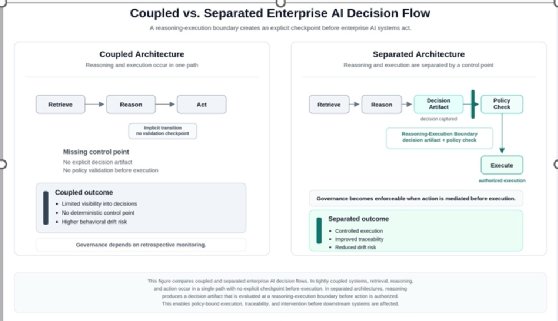
Figure 1. The reasoning–execution boundary is the control point enterprise AI systems are missing.
Figure 1 compares two enterprise AI architectures. In tightly coupled systems, retrieval, reasoning and action occur in a single execution path, leaving no explicit checkpoint for validation or intervention before execution. In separated architectures, a reasoning-execution boundary introduces an explicit decision artifact and a control layer between reasoning and action. This boundary enables policy-bound execution, improved traceability and reduced behavioral drift risk.
Moving from observability to control
Most enterprise AI systems rely on observability. Logs, traces and monitoring systems provide visibility into what has already happened. Though necessary, it isn't sufficient.
Observability is retrospective. It explains the outcomes after execution. In many cases, that's too late to prevent impact. Separating reasoning from execution enables the introduction of a control layer that operates before execution. This layer can be implemented as a control-plane-mediated governance mechanism that evaluates decisions in real time.
Within this model, actions are subject to policy-bound execution. That means every action must satisfy defined policy conditions before it's allowed to proceed. These conditions might include access controls, contextual constraints, confidence thresholds and approval requirements. This approach changes governance from something that's applied externally to something that's embedded in the system's execution path.
Execution lineage and traceability
As systems become more complex, understanding how decisions lead to actions becomes increasingly important. Separating reasoning from execution enables a structured approach to capturing this relationship through execution lineage.
Execution lineage provides a continuous trace from the context the system uses to the decision it produces to the action that's ultimately executed. It goes beyond traditional logging and lets teams reconstruct the exact sequence of events that led to a particular outcome.
For businesses, execution lineage has several implications, including the following:
It provides clear evidence of how decisions were made, improving auditability.
It supports replayability, letting teams analyze decisions without rerunning actions in production.
It makes system behavior more transparent, strengthening operational understanding.
It's useful in regulated environments where traceability is increasingly expected rather than optional.
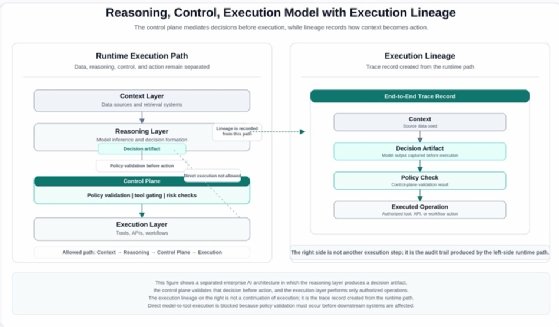
Figure 2. Policy-bound execution and verifiable lineage are achieved in enterprise AI systems.
Figure 2 shows a control-plane-mediated enterprise AI architecture in which reasoning is separated from execution. The reasoning layer produces an explicit decision artifact that the control plane must validate before any action is executed. Execution lineage captures the full path from context to decision to action, enabling auditability, traceability and policy-bound execution.
Tool gating in agentic systems
The importance of this boundary increases in agentic systems, where AI components operate with greater autonomy. In these environments, systems dynamically select tools, interact across multiple services and execute multistep workflows. This flexibility creates value, but it also increases the risk of unintended actions.
Tool gating helps manage this risk. Instead of allowing unrestricted execution, the system enforces controls around which tools can be used, under what conditions and with what level of authorization; reasoning remains flexible while execution is constrained. The system can explore multiple options at the reasoning level, but it only executes actions that meet enterprise-defined policies.
Why the boundary matters
Enterprise AI is entering a phase where systems are expected to act, not just analyze. As this transition continues, the challenge isn't only about model performance, but also about maintaining control over how decisions translate into actions.
Separating reasoning from execution establishes the architectural boundary required for that control. Decisions are evaluated before execution, ensuring that actions are policy-bound and providing traceability across the entire decision-to-action lifecycle. This approach isn't an incremental improvement. It's a structural shift that lets enterprise AI systems operate safely, predictably and at scale.
For business leaders, the implications are immediate. Separating reasoning from execution improves risk management by preventing incorrect actions before they occur. Clear traceability from decision to action strengthens compliance and introduces a deterministic point of intervention, enhancing operational control.
Perhaps most importantly, separating reasoning and execution enables scalability. As AI systems become more autonomous, manual oversight is impractical, and control must be built into the system itself. Without this boundary, businesses face increasing opacity as systems become more complex. With it, they retain the ability to govern how AI interacts with critical systems and processes.
Varun Raj is a cloud and AI engineering executive with nearly two decades of experience designing large-scale cloud computing and AI platforms. His work focuses on governance architectures that enable generative AI systems to operate safely and reliably in production environments. Raj contributes expert perspectives on cloud platform architecture, AI governance and operational trust through industry publications, technical forums and invited discussions.