Where enterprise sustainability reporting often breaks down
Despite evolving into a core business priority, many sustainability initiatives fail. Leaders can circumvent this by integrating the right software and implementing best practices.
As recently as the 1990s, many organizations viewed sustainability as nothing more than a public relations exercise. But as the third millennium arrived, an international coalition of scientists produced compelling evidence that emissions of greenhouse gas emissions into the atmosphere by companies were creating an adverse -- and perhaps dire -- impact on the environment. Recognizing this worrying trend, governments and regulators around the world tightened climate regulations and encouraged firms to prioritize sustainability. Simultaneously, investors started to demand that firms make environmental, social and governance (ESG) disclosures, while an increasing number of environmentally conscious consumers started to favor purpose-driven brands.
With all these tailwinds blowing in unison, sustainability has evolved into a core business priority, which is why organizations worldwide are investing heavily in sustainability initiatives. Per one source, the global green technology and sustainability market size is projected to triple in less than a decade, increasing from $23.10 billion in 2024 to $79.65 billion by 2030.
But within this landscape, a strange paradox has emerged: Despite increased investments, many sustainability efforts end up failing. And a major reason for failure is misalignment between enterprise data and systems.
Common sustainability reporting challenges
Sustainability reporting software helps organizations accurately measure, monitor and communicate their ESG performance and progress. Companies need accurate data to track critical ESG metrics, such as their carbon footprint, waste reduction, water usage, renewable energy consumption, ethical sourcing and workforce diversity. These metrics enable them to demonstrate that they satisfy sustainability reporting requirements and standards, including the European Union's Corporate Sustainability Reporting Directive and standards from the International Sustainability Standards Board.
But even when organizations have all the data they need to accurately represent and communicate their ESG progress, they often still struggle with sustainability reporting. There are many reasons for this, including the following:
Data fragmentation. ESG data is often scattered across different facilities, departments and systems. Consider a manufacturer that sources environmental data from IoT sensors and logistics platforms, social data from ERP and HRIS platforms, and governance metrics from internal audits and compliance teams. These different sources provide data in different formats. This fragmented data environment does not provide a single source of truth (SSOT) about the firm's overall sustainability performance that key decision-makers can rely on.
Inconsistent and incomplete data. Suppose a retail company collects emissions data from multiple external vendors, subsidiaries and partners, but these entities use different reporting methods or provide incomplete information. In both cases, the organization may struggle to aggregate and analyze supply chain emissions data and fail to meet its Scope 3 emissions reporting requirements.
Poor data quality. Many firms still use disconnected spreadsheets and manual inputs to inform ESG tracking and reporting. But over-reliance on these methods increases the risk of errors, duplication and outdated information. These issues affect the quality and integrity of the final report, which can erode stakeholders' confidence in reported results.
Insufficient real-time data visibility. It can take months to collect supply chain and emissions data, so companies are often forced to rely on lagging indicators and generalized estimates. As a result, sustainability reports often present a distorted, incomplete or outdated narrative of a company's environmental and social impact.
How ERP and SCM support sustainability reporting -- and create visibility gaps
Modern ERP and supply chain management (SCM) systems provide the data foundation needed for accurate ESG reporting and, more broadly, help organizations achieve their sustainability goals. These systems transform sustainability reporting from a manual, time-consuming task into an automated, data-driven, continuous process. This enables companies to easily capture and publish ESG metrics, proactively identify operational inefficiencies, reduce waste and mitigate supply chain risks.
That said, legacy ERP and SCM platforms present some data visibility challenges for sustainability reporting.
For one, traditional ERP systems often lack integration with sustainability metrics. These systems were designed to track and manage operational, procurement and financial workflows -- not sustainability performance. Since they cannot capture and analyze ESG-specific metrics, firms have to rely on other data sources and spreadsheets to track and document ESG progress. This results in a fragmented data environment that limits real-time visibility into sustainability performance, hindering both reporting and decision-making.
Secondly, legacy SCM systems cannot measure environmental impact at a detailed level. While they can increase transparency into aspects like supplier practices, material origins, transportation efficiency and inventory management, they cannot provide granular insights into, for example, supply chain emissions or resource usage. Consequently, companies often have to rely on incomplete or inconsistent data, generalized estimates or industry averages for sustainability reporting. But as we have already seen, this can reduce the precision and reliability of the reports.
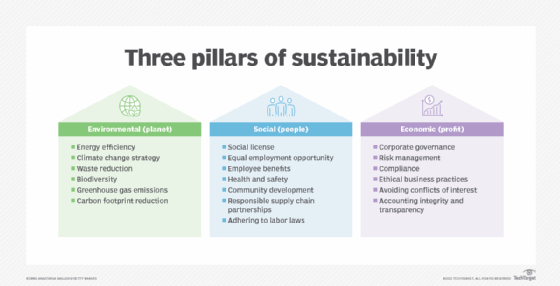
Sustainability encompasses more than just environmental concerns. Social and economic sustainability are also important components that can influence whether sustainability initiatives ultimately fail or succeed.
Important operational metrics and the sustainability software stack
In the current business landscape, sustainability is increasingly linked to vital business outcomes like profitability, innovation, supply chain resilience, competitive advantage and even brand value. For this reason, it is especially important for enterprise leaders to align sustainability goals with business performance.
In the current business landscape, sustainability is increasingly linked to vital business outcomes like profitability, innovation, supply chain resilience, competitive advantage and even brand value.
Such alignment enables organizations to calculate the ROI of sustainability initiatives -- that is, to establish the extent they influence day-to-day operations and long-term financial outcomes. This can help leaders prioritize investments into initiatives that deliver the greatest environmental, operational and economic value.
Alignment between sustainability goals and business performance is also essential for managing regulatory and market risks, enabling companies to consistently meet evolving compliance obligations and avoid penalties.
But to achieve alignment between these aspects of the business, while providing the data needed for investor reporting, regulatory compliance and strategic decision-making, organizations need to track these key operational metrics:
Energy usage.
Waste reduction.
Carbon intensity per unit produced.
Water consumption per unit produced.
Supply chain emissions.
Material efficiency.
Equipment utilization and efficiency.
Transportation efficiency.
To pull these metrics together into a coherent narrative, the software stack should include the following systems:
ERP. Enterprise resource planning systems connect sustainability initiatives with operational efficiency and financial outcomes.
SCM. Supply chain management software provides visibility into supplier operations, logistics performance, and inventory movement.
IoT sensors and industrial monitoring. These systems capture real-time environmental data.
Sustainability management. These platforms manage disclosures, track compliance requirements, align reporting with frameworks and automate ESG reporting workflows.
Data management. Data warehouses, data lakes, and extract, transform and load (ETL) tools consolidate information from various data sources and provide an SSOT for sustainability reporting.
Analytics, business intelligence and machine learning. BI tools and ML models provide real-time insights for measuring sustainability performance against business goals.
Moreover, these solutions must integrate with each other. This can help organizations collect and aggregate operational and ESG data from across the enterprise and supply chain. APIs and middleware facilitate such integration and ensure system interoperability, thus helping firms build a seamless technology architecture for sustainability measurements and reporting.
Sustainability reporting best practices
As we have seen, fragmented data makes it difficult for businesses to capture a unified, accurate view of sustainability performance and progress. Moreover, a poorly integrated software stack can hinder them from connecting sustainability goals with operational performance and from taking data-driven decisions to drive business growth as well as ease environmental impact.
The following practices can help organizations improve sustainability reporting:
Collaborate with suppliers to improve supply chain visibility and ensure supply chain transparency.
Establish a strong data governance structure with clear ownership, accountability, validation procedures and audit controls.
Connect sustainability KPIswith financial KPIs to incorporate sustainability considerations into strategic decision-making.
Include traceability and verification mechanisms into the reporting system to improve accountability and audit-readiness.
Encourage internal cross-functional collaboration to ensure data consistency and organization-wide alignment on sustainability priorities.
Numerous companies have implemented many of these practices to align data and systems -- and streamline sustainability management and reporting.
A Case Study
ESG solutions provider Tact integrated Microsoft Cloud for Sustainability to automatically collect, manage and process complex and dispersed ESG data.
According to Chayut Sakunkoo, CEO of Tact, "Due to the novelty of ESG reporting, many companies face a shortage of expertise, alongside the challenge of managing complex and dispersed data, often recorded manually or residing outside their direct oversight." Microsoft's platform uses optical character recognition to extract data from digitized fuel and electricity bills, then integrate it into their ESG data management platform; AI-powered analytics to predict carbon emission reductions arising from sustainability initiatives; and AI-powered benchmarking to give companies a view of their sustainability position relative to competitors as well as various industry standards.
The capabilities bundled into Microsoft's platform enable Tact to "efficiently process diverse and fragmented data sets, uncover key insights and generate sustainability reports that comply with global standards," Sakunkoo said.
Aligning systems for successful sustainability reporting
Today, companies can choose from many tools to ease sustainability reporting: Workiva, IBM Envizi, Sphera and EcoVadis are among the top sustainability management software providers. These tools are important. However, sustainability success also depends on system integration and interoperability, systems-data alignment, centralized data management and cross-functional collaboration. Once all these pieces are in place, sustainability reporting becomes easier and more accurate. It also empowers organizations to achieve and demonstrate meaningful sustainability outcomes.
Rahul Awati is a PMP-certified project manager with IT infrastructure experience spanning storage, compute and enterprise networking.