AI hiring tools can speed interviews and assessments, but employers need a decision trail that shows what AI shaped, what humans reviewed and who owned the final call.
AI hiring tools are moving closer to the interview itself.
For years, recruiting software has helped employers post jobs, manage applicants, schedule interviews and organize candidate information. Newer tools go further. They can conduct interviews, analyze answers, create transcripts, score or summarize candidates and show recruiters dashboards that shape what they review next.
Amazon Connect Talent is a useful example of where the market is heading. The tool is not just helping recruiters schedule interviews or organize applicants. It can also conduct interviews, analyze candidate answers, create transcripts and show recruiters dashboards and deeper analysis they can use to move candidates through the process faster.
That makes sense for high-volume hiring. Employers filling warehouse, retail, restaurant, truck driver or contact center roles often need to screen large numbers of candidates quickly. Candidates in those markets might also move on if they do not hear back fast enough. AI interviewing can help recruiters keep up with that volume.
But there is a difference between using AI around the hiring process and putting AI inside the interview itself.
Once software is conducting, summarizing or analyzing the interview, employers need to know how much the AI shaped what the recruiter sees next. A human interviewer might notice context, follow-up nuance, unusual experience, candidate questions or role-specific judgment that an automated process could miss.
That does not mean AI interviewing lacks value. It does mean employers need a clear decision trail.
If an AI tool summarizes answers or presents candidates in a dashboard, the company should be able to reconstruct what was asked, what the candidate said, what the AI highlighted, what the recruiter reviewed and where the final human judgment entered the process.
The risk is not only that AI could contribute to the wrong hiring decision. It is that the employer might not be able to explain how the decision was shaped.
Human judgment needs a boundary
As with nearly every part of the enterprise software stack, AI is becoming a mainstay in HR software. And, as the Amazon Connect Talent example shows, major vendors are moving deeper into hiring workflows.
But there is a big difference between using AI to widen recruiting bandwidth and using AI to make final hiring decisions.
Tools such as Amazon Connect Talent can help speed up scheduling, screening, interview analysis and recruiter review. That can be valuable, especially when companies are dealing with high-volume hiring.
The risk is not only that AI could contribute to the wrong hiring decision. It is that the employer might not be able to explain how the decision was shaped.
But responsible enterprises and HR software vendors should not position AI as the final decision-maker. Nor should they treat human review as a rubber stamp on an AI recommendation.
Recruiters and hiring managers need to be involved before the AI interview, after it and at any major point where a candidate advances, stalls or leaves the process.
That matters because AI helps shape what humans see. Depending on the tool and its settings, software can summarize answers, highlight certain responses, score candidates or package interview results in ways that influence the next step.
Keeping humans in the loop should mean more than passive oversight. It should mean active review, follow-up questions and responsibility for the final call.
The decision trail should show not only what the AI did, but what the human reviewed and decided. That human justification is necessary because hiring decisions affect real candidates, carry legal and bias risks and can be challenged by applicants, managers, HR leaders or regulators after the fact.
In AI hiring, "human in the loop" only matters if the human role is specific enough to see, document and defend.
Assessments need evidence, not black-box trust
There is a difference between using AI as part of a useful hiring assessment and using it as a black-box hiring shortcut.
The first approach plays more to AI's strengths: pattern recognition, structured analysis, scoring support and statistical comparison. The second gets much more uncomfortable, especially if AI starts carrying most of the weight in decisions that should still involve human judgment.
Assessments can be helpful, particularly for high-volume or high-turnover roles. But their usefulness depends on whether employers understand what is being measured, how the assessment was built and how the results should be interpreted. A score by itself is not enough.
That is where the decision trail begins before the final hiring decision. It should run from the science behind the assessment to the job description, assessment design, scoring settings, recruiter review, exceptions, overrides and the final human decision.
HireVue's Assessment Builder is a useful example. The company says it uses AI to help recruiters and hiring managers create role-specific assessments, while grounding that work in industrial-organizational psychology and validation studies. The point is not that AI disappears from the process. It is that AI must be used within a system that employers understand well enough to explain.
A validated assessment can still be misused if recruiters or managers do not understand what the score means, what it does not mean and how much weight it should carry. The decision trail should make that visible. It should show whether the assessment was used as one input, as a screening cutoff, as a ranking mechanism or as a major factor in deciding who moved forward.
The issue is not whether AI can support hiring. The issue is whether employers can explain the evidence, the process and the human judgment around it.
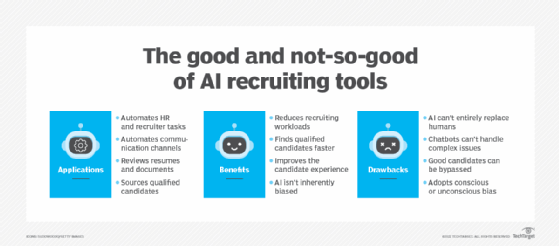
AI recruiting tools can automate screening, communication and candidate sourcing, but employers still need human review, bias controls and a clear record of how candidates move through the process.
Buyer responsibility starts before the first interview
In the end, the responsibility for when and how to use AI in hiring belongs to the organization doing the hiring.
AI now shows up throughout recruiting in the form of chatbots, GenAI tools, copilots, semi-agentic tools and more autonomous agents. These tools can answer candidate questions, draft job descriptions, summarize resumes, generate interview questions, schedule interviews, screen applicants, rank candidates and recommend next steps.
But the more those tools touch the hiring process, the more employers need to understand what the AI is doing and how much influence it has. That responsibility starts before implementation.
Employers need to know what kind of AI is embedded in the recruiting tool, what role it plays, what level of autonomy it has and where human review is required. A chatbot that answers candidate questions creates a different risk profile than a tool that ranks applicants or summarizes AI-led interviews for recruiter review.
This is why the decision trail begins before the first candidate enters the system. It starts with buying and configuration decisions: What hiring problem is the tool supposed to solve? Where is the company comfortable using AI? What decisions should always stay with people? What outputs must be documented? And who is responsible for explaining how the tool was used?
Transparency must also extend within the organization. HR often supports hiring managers in other departments, so CHROs and recruiting leaders need to ensure managers understand where AI is being used, what they can rely on, and what they still need to judge for themselves.
AI hiring governance should begin during product selection and configuration. HR leaders need to know what the tool does, managers need to understand what they can rely on, and recruiters need enough context to evaluate the evidence they are using. Otherwise, AI can become part of the hiring process before anyone has clearly defined how much influence it should have.
How AI shows up in recruiting tools
AI hiring tools do not all work the same way. Employers should understand which type of AI is being used and the level of autonomy it has.
Chatbots can answer candidate questions, guide applicants through basic steps, screen for minimum qualifications and schedule interviews.
Copilots can help recruiters draft job descriptions, generate interview questions, summarize candidate information and suggest next steps.
GenAI tools can create job postings, emails, offer letters, rejection letters, interview guides and candidate summaries.
Semi-agentic tools can run multi-step recruiting workflows with human approval, such as sourcing, outreach, screening and scheduling.
More autonomous agents can act across multiple recruiting steps with less direct prompting, which raises the stakes for oversight, permissions and auditability.
The more autonomy a tool has, the more important it becomes to document what the AI did, what humans reviewed and who owned the final hiring decision.
Applicant data is part of the decision trail
Gathering and protecting sensitive applicant data is already part of recruiting, whether or not AI is involved. Employers need to know where that data lives, who can access it, how long it is retained and how it is protected.
AI raises the stakes because hiring tools can now create transcripts, summaries, scores, dashboards and other records that shape how candidates are evaluated. If those processes are opaque, highly automated or weakly supervised, the organization has more than a data protection issue. It also has an accountability issue.
That makes applicant data governance part of the decision trail. HR, IT, security and legal teams need to help define the rules before the tool is deployed, then maintain and enforce them throughout the hiring process. That includes access controls, retention policies, vendor requirements, security reviews and clear accountability for how AI-generated hiring records are handled.
This is not the same as deciding whether a candidate should be hired. But it is part of the governance foundation that allows AI hiring tools to be used responsibly in the first place.
The final call still needs an owner
AI hiring tools can make recruiting faster, more scalable and, in some cases, more structured. They can help recruiters manage large applicant pools, standardize parts of the interview process and surface information that might otherwise take days or weeks to collect.
But faster hiring still needs to be explainable. If AI conducts an interview, summarizes a transcript, scores an assessment or recommends the next step, the employer needs more than a dashboard. It needs a record of what the tool did and how people used it. That means knowing how the tool was configured, what the candidate experienced, what the AI highlighted, what the recruiter questioned and what evidence supported the final decision.
Those are not just compliance questions. They are hiring quality questions.
A decision trail does not have to slow hiring to a crawl. Done well, it should make the process easier to trust. Recruiters get a clearer record. Hiring managers get better context. HR leaders get more consistency. Candidates get a process that is easier to explain if questions arise.
AI might help hiring move faster, but the final decision still needs a human owner. The more AI shapes the path to that decision, the more important it becomes to show how the decision was made.
James Alan Miller is a veteran technology editor and writer who leads Informa TechTarget's Enterprise Software group. He oversees coverage of ERP & Supply Chain, HR Software, Customer Experience, Communications & Collaboration and End-User Computing topics.