Sustainable procurement strategies and policies for CIOs
Sustainable procurement is crucial for CIOs to manage risks, comply with ESG regulations and enhance digital resilience amid rising energy costs and emissions.
Sustainable IT procurement has shifted from a nice-to-have corporate social responsibility topic to a core concern for technology leaders.
For CIOs, CTOs and technology sourcing executives, procurement decisions link directly to regulatory exposure, financial risk, operational resilience and whether the business lives up to its sustainability commitments. Technology supply chains rely on energy-intensive infrastructure, complex hardware manufacturing and opaque multi-vendor ecosystems. They represent one of the largest and least visible sources of environmental and social risk within businesses.
Meanwhile, cloud adoption, AI workloads, data and device growth are expanding IT footprints faster than traditional efficiency gains can offset. Businesses must determine how to decarbonize while still scaling digital capabilities.
Today's IT sourcing decisions will lock in carbon intensity, energy demand and ethical exposure for years to come. Procurement policies that only focus on cost and performance can undermine enterprise risk management and long-term value creation.
Sustainable IT procurement is not about altruism or branding; it controls material risk, ensures continuity and aligns IT investments with corporate sustainability and resilience objectives.
Why sustainable procurement is a CIO mandate
CIOs are accountable for environmental, social and governance (ESG) outcomes through Scope 3 emissions, supply chain labor practices and technology's lifecycle. These factors place the onus on technology leadership to create and execute a sustainable procurement strategy.
ESG regulations, investor pressure and brand reputation
Regulatory frameworks require businesses to disclose and manage environmental and social impacts across their technology supply chains. Climate disclosure rules and due diligence laws extend accountability well beyond internal IT ops to vendors, cloud providers and hardware manufacturers.
Because most tech-related emissions sit in Scope 3, procurement decisions determine whether the business meets mandated reporting and reduction targets. Failure to embed ESG criteria into sourcing exposes the organization to fines, legal liability, investor backlash and reputational damage.
Today's IT sourcing decisions will lock in carbon intensity, energy demand and ethical exposure for years to come.
Rising energy and disposal costs
Energy-intensive infrastructure and short hardware refresh cycles place sustained pressure on budgets. Data center energy consumption, cloud compute pricing and market volatility directly affect IT budgets.
Simultaneously, unmanaged end-of-life disposal creates hidden liabilities through e-waste handling, regulatory non-compliance and lost asset value.
Effect on enterprise digital resilience
Supply chains that rely on carbon-intensive energy, single-source components or ethically compromised vendors are more vulnerable to regulatory disruptions, climate events and geopolitical shocks. Sustainable procurement improves resilience, as it diversifies suppliers, increases transparency into lower tiers, extends asset lifecycles and reduces dependency on fragile or non-compliant sources.
The hidden environmental footprint of IT
Many businesses underestimate the environmental impact of IT because it is fragmented across infrastructure layers, multiple tiers of vendors and accounting categories. What appears efficient or intangible at the service level often carries a substantial physical and carbon-intensive footprint upstream.
For CIOs, this hidden footprint represents unmanaged risk embedded in cloud contracts, hardware refresh cycles and vendor portfolios.
Cloud energy use and data center emissions
Many businesses assume cloud computing to be sustainable due to scale efficiencies and hyperscaler decarbonization commitments. Yet, data centers are among the fastest-growing sources of global electricity demand, driven by AI workloads, always-on services and exponential data growth. While hyperscalers typically operate more efficient facilities than most enterprise-owned data centers, absolute energy consumption is rising sharply.
Renewable energy offsets are often market-based rather than location-based, masking real-world dependence on fossil-heavy grids at specific times and locations. For businesses, this means cloud migration can shift emissions off their balance sheets without reducing actual atmospheric impact unless procurement explicitly requires low-carbon regions, transparent energy sourcing and workload-level carbon reporting.
Hardware lifecycle emissions and e-waste supply chains
For most IT hardware, most emissions occur before the device is powered on. Semiconductor fabrication, component manufacturing and global logistics embed significant carbon into servers, laptops and network equipment.
Short refresh cycles accelerate this effect. Replacing devices every two to three years repeatedly incurs the same manufacturing emissions while generating large volumes of electronic waste. Downstream, e-waste handling often occurs in poorly regulated markets, resulting in environmental contamination and social harm that ultimately manifests as regulatory or reputational risk.
Vendor emissions vs. internal emissions (Scope 3)
Internal IT ops typically represent a minority of total technology-related emissions. The dominant share sits in vendor operations, upstream manufacturing, logistics and outsourced services. These Scope 3 emissions are harder to measure. Vendors without credible carbon data, emission reduction targets or lifecycle transparency transfer risk to the buyer.
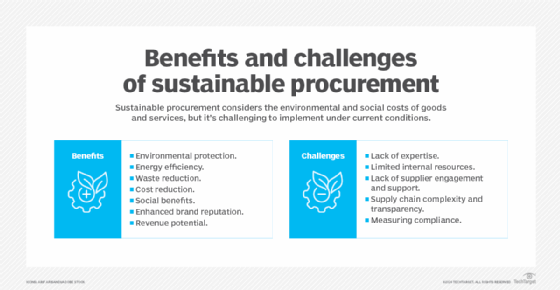
Despite the benefits this strategy brings, sustainable procurement can be challenging to implement.
Key principles of sustainable IT procurement
Sustainable IT procurement is governed by a core set of principles, which include the following:
Carbon-aware sourcing.
Ethical labor and supply chain transparency.
Lifecycle-based purchasing.
1. Carbon-aware sourcing
Carbon-aware procurement treats emissions as a first-class decision variable, not just another reporting artifact. This requires moving beyond vendor-wide sustainability statements to asset- and service-level carbon data.
For hardware, this means evaluating embodied carbon alongside energy efficiency ratings. For cloud and digital infrastructure, it requires access to granular carbon reporting tied to workload, region and time of use. Carbon-aware sourcing also accounts for location-based emissions, recognizing that identical workloads can have materially different carbon impacts depending on where and when they run.
2. Ethical labor and supply chain transparency
Sustainable IT procurement requires visibility into labor conditions, human rights practices and governance controls across vendor ecosystems. This extends beyond Tier 1 suppliers into manufacturing, assembly and raw material extraction tiers. Codes of conduct, audit rights and traceability requirements must be baked into contracts.
Transparency is the driving principle: Vendors that are unable or unwilling to disclose sourcing practices, audit outcomes or corrective actions represent unmanaged risk.
3. Lifecycle-based purchasing
Lifecycle-based procurement replaces unit price optimization with total lifecycle impact management. This principle recognizes that lifespan, utilization and end-of-life handling drive the environmental and financial costs of IT assets as much as acquisition costs.
Durable design, repairability, modular upgrades and support for refurbishment materially reduce both emissions and spend over time. Circular economy models, such as leasing, take-back programs, redeployment and reuse, convert end-of-life from a liability into a controlled process.
Technology leaders who operationalize these principles can integrate sustainability into technology sourcing.
Building a sustainable procurement policy
The core elements of a sustainable IT procurement policy to convert strategic intent into enforceable controls include the following.
1. Set a minimum ESG criteria for vendors
The policy must define non-negotiable ESG thresholds for all technology suppliers. These typically include adherence to a supplier code of conduct, disclosure of environmental and social metrics, compliance with applicable labor and environmental laws, and absence of unresolved severe violations.
Minimum criteria function as eligibility gates, not scoring preferences. Vendors that cannot meet baseline ESG requirements are excluded, regardless of price or technical merit. This establishes a sustainability floor across the supplier base and prevents risk concentration in non-compliant vendors.
2. Renewable and low-carbon cloud requirements
Cloud and hosting services require explicit carbon and energy requirements. Policies should mandate transparency on data center energy, power usage effectiveness and location-based emissions. Businesses can set their preferences or minimum thresholds for renewable energy use, low-carbon regions and participation in credible power purchase agreements.
Where possible, policies should require access to workload-level carbon reporting and support for carbon-aware workload placement.
3. E-waste return and recycling clauses in contracts
Businesses must address end-of-life management at a contract's inception. Sustainable procurement policies should require vendors to provide take-back, certified recycling or refurbishment services for hardware.
Contracts should also specify data destruction standards, audit rights and documentation of recycling or reuse outcomes. These clauses prevent uncontrolled disposal, reduce regulatory exposure and ensure that decommissioned assets are treated as managed materials rather than waste liabilities.
4. Circular economy provisions
Policies should explicitly support circular models, such as leasing, device as a service, refurbishment, redeployment and reuse. Procurement language can require vendors to design products for durability, modular repair and material recovery. Circular provisions align vendor incentives with asset longevity and residual value, reducing both emissions and long-term spend.
5. Accessibility and ethical sourcing checks
Sustainable procurement policies must incorporate accessibility and ethical sourcing as standard controls, not optional extras. They should ensure technology meets accessibility standards, avoids exclusionary design and verifies that sourcing practices do not rely on forced labor, unsafe working conditions or conflict materials. Embedding these checks at the policy level ensures consistent application across regions and sourcing teams, reducing reputational and legal risk.
KPIs and metrics for sustainable procurement
Businesses with successful procurement strategies rely on metrics that define success and identify areas of improvement.
1. Carbon emissions per IT dollar spent
Tracking emissions per dollar forces procurement to consider carbon productivity, not just absolute reductions. This metric normalizes emissions against technology investments, so CIOs can track whether digital growth becomes more or less carbon-intensive over time. It exposes hidden inefficiencies where spending increases mask disproportionate emissions growth, particularly in cloud, data center expansion and hardware refresh programs.
2. Percentage of renewable energy in cloud and hosted environments
This KPI measures the actual energy profile supporting enterprise workloads, not vendor marketing claims. It should use location-based energy data wherever possible, supplemented by transparent market-based instruments. Rising percentages indicate progress toward decarbonized digital infrastructure; stagnation signals reliance on offsets rather than structural change. This metric can validate cloud migration strategies against sustainability goals.
3. Device lifecycle extension metrics
Average device lifespan, refresh cycle length and redeployment rates directly indicate procurement discipline. Longer lifecycles reduce embedded carbon, procurement volume and e-waste generation. Tracking lifecycle extension forces explicit tradeoff decisions between performance upgrades and environmental impact, instead of defaulting to routine replacement.
4. Percentage of reused or refurbished equipment
This metric captures circular economy execution rather than intent. It applies to end-user devices, data center equipment and network assets. Increasing reuse and refurbishment rates demonstrate effective asset recovery, reduced dependence on new manufacturing and improved resilience during supply constraints. Low reuse rates indicate missed value and higher emissions.
5. Responsible disposal and recycling rates
This KPI measures the portion of retired assets that are securely wiped, recovered, reused or recycled through certified channels. It mitigates regulatory, data security and reputational risk associated with e-waste leakage. Documentation and auditability matter more than headline percentages. Unverifiable disposal is functionally non-compliant.
CIOs who institutionalize these metrics gain visibility into carbon efficiency, supplier quality and lifecycle performance, so they can make more informed tradeoffs and continuously improve.
Roadmap: How CIOs can get started
A focused roadmap establishes control quickly while avoiding analysis paralysis. The objective here is to create strong momentum through governance, data and early proof points.
30-day focus: Establish baseline control
Within the first 30 days, CIOs should inventory current IT spending across hardware, cloud and services, and identify the largest environmental and supplier risk exposures. This includes mapping top vendors by spend and carbon intensity, assessing existing ESG clauses in contracts and reviewing current device refresh and disposal practices.
CIOs must also explicitly assign governance ownership, with procurement, IT, sustainability and legal teams aligned on decision rights. The outcome of this phase is establishing baselines and clarity regarding emissions, compliance gaps and lifecycle waste.
60-day focus: Align functions and embed requirements
By day 60, CIOs should have embedded sustainability requirements into procurement processes. Standard request for proposal templates should include ESG and carbon disclosure requirements. They should also define and approve minimum vendor criteria and evaluation weightings.
Contract language for carbon reporting, ethical sourcing and end-of-life management should be standardized with legal review. Cross-functional alignment is critical. While procurement teams are responsible for execution, IT teams validate and sign off on technical feasibility, sustainability teams define metrics and legal teams enforce compliance. This phase converts strategy into an executable, repeatable process.
90-day focus: Pilot a low-carbon procurement initiative
Sustainable procurement maturity is built through controlled iteration. It's anchored in policy, metrics and early execution wins. Within 90 days, CIOs should launch a visible pilot to validate the model and generate internal credibility.
Examples include sourcing devices through a refurbishment-first program, selecting a low-carbon cloud region for a non-critical workload, or renegotiating a major vendor contract to include carbon transparency and recycling clauses. CIOs should measure the pilot against defined KPIs, and executive stakeholders should review it.
Overall, sustainable IT procurement is now a core responsibility of technology leadership, not a discretionary initiative. CIOs who embed carbon awareness, ethical governance and lifecycle discipline into sourcing policies gain control over regulatory exposure, cost volatility and digital resilience.
Kashyap Kompella, founder of RPA2AI Research, is an AI industry analyst and advisor to leading companies across the U.S., Europe and the Asia-Pacific region. Kashyap is the co-author of three books, Practical Artificial Intelligence, Artificial Intelligence for Lawyers and AI Governance and Regulation.