Dell pushes in-place storage upgrades in PowerStore Elite
Dell makes multiple storage-centric updates at Dell Technologies World 2026, including the introduction of PowerStore Elite, which features in-place upgrades.
Dell Technologies this week introduced PowerStore Elite, a major update to the PowerStore storage platform that enables customers to upgrade at their own pace, without a traditional forklift refresh.
Dell Technologies' emphasis on in-place upgrades follows similar moves by competitors such as Everpure, reflecting a broader recognition that traditional storage refresh cycles need to keep up with the demands of an AI infrastructure environment.
"Data growth isn't slowing down. Storage has got to keep up, and it's got to become more and more efficient as well," said Sam Grocott, senior vice president of product marketing at Dell Technologies.
Improvements made to PowerStore in the Elite edition include faster memory and networking, support for next-generation CPUs, enhanced compression and deduplication, and other software enhancements that provide three times the IOPS, throughput and density compared to Dell’s previous-generation systems, according to the vendor.
"The biggest use case for this right now is that it reduces the cost. ... You don't have to junk everything in order to do the replacement," said Brent Ellis, principal analyst at Forrester Research.
PowerStore Elite's in-place upgrades mean customers can avoid the costs and downtime associated with de-racking systems, full infrastructure swaps and the logistics of decommissioning older systems. A Dell Technologies spokesperson describes this as "in-place modernization," where users can swap in controller upgrades within PowerStore Elite to grow their environment continuously without replacing the chassis and E3 NVMe drives or migrating data.
Similarly, PowerStore's clustering architecture also enables current PowerStore users to join existing deployments directly with no downtime -- enabling older arrays to be repurposed for secondary uses. Both methods enable customers to modernize at their own pace rather than performing a single, higher-risk refresh.
Elite's improvements to PowerStore
"PowerStore Elite represents the biggest leap forward in the platform's history," said Varun Chhabra, senior vice president of infrastructure and telecom marketing at Dell Technologies. "It is a full refresh of hardware and software, building on the success of PowerStore Prime from two years ago."
The three times increase in performance and throughput comes from several improvements. A 40-drive slot chassis can hold up to 5.8 petabytes in a 3U system. PowerStore Elite is also moving to the now industry-standard low-profile E3 NVMe drives, while supporting both QLC and TLC NAND flash memory. These improvements enable the consolidation of more workloads into fewer systems. PowerStore Elite also supports both file and block workloads and provides mobility across clusters.
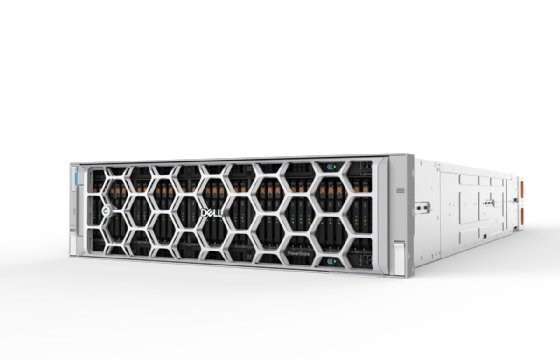
This image shows the hardware behind the new version of PowerStore, PowerStore Elite.
Elite features twice as many workload ports as the current PowerStore generation and supports up to 64-gigabit Fibre Channel and 100-gigabit Ethernet speeds. Dell's Lifecycle Extension program ties this together, aiming to simplify upgrades. Elite is built modularly, meaning organizations make upgrades to improve performance, I/O, capacity or software as needed.
"Our Lifecycle Extension program simplifies both the economics and the upgrade process, so modernization really goes on autopilot," said Chhabra.
The larger trend
"Dell's not the first to market with this," Ellis said.
Other vendors with comparable features include Everpure (formerly Pure Storage) and Lenovo Infinidat. Ellis expects similar services to go in the direction of in-place upgrades.
People don't want to do full infrastructure swaps. They just want to gradually upgrade as they see fit.
Brent EllisPrincipal analyst, Forrester Research
Evergreen, Everpure's storage-as-a-service platform, for example, is designed to enable continuous storage upgrades without disruptions. Evergreen is componentized, meaning users just have to replace the direct components they need.
The upgrade model is becoming more incremental, with measured upgrades tied to actual capability needs, rather than replacing large storage systems all at once. This approach is preferred by organizations building out AI training infrastructure, where high-speed storage performance and capacity requirements are changing faster than traditional refresh cycles.
"PowerStore’s container-based architecture means that everything is modular and upgradable, which means that it will evolve as workloads evolve and adapt as new technologies emerge. PowerStore Elite is the definition of future-proofed," said Jeff Clarke, vice chairman and chief operating officer for Dell Technologies, speaking at Dell Technologies World 2026.
"It's also a larger capital outlay," Ellis said. "If you're in an environment like we are now, where the supply chain and the cost of things is going up, people don't want to do full infrastructure swaps. They just want to gradually upgrade as they see fit."
Alexander Gillis is a Technical Writer and Editor at Informa TechTarget, with more than 8 years of experience writing about technology.