Dell's AI Factory added networking and storage stacks this week that company officials claim will do for other aspects of AI infrastructure what the product has already done for compute.
In the compute arena, Dell AI Factory with Nvidia leads the pack in sales of similar enterprise systems so far. First out of the gate with its Nvidia partnership more than two years ago, Dell led worldwide server sales in 2025 with a 10% market share, according to IDC's Quarterly Server Tracker Report for the fourth quarter. The report attributed Dell's 126.7% revenue growth that quarter to sales of accelerated servers, which it defines as systems that include specialized processors, including GPUs. As of this week during its annual Dell Technologies World conference, Dell reported that AI Factory has 5,000 customers.
That number accounts for entirely separate companies, not multiple accounts within the same company, according to Varun Chhabra, senior vice president of product marketing in Dell Technologies' Infrastructure Solutions Group business unit.
"I'd say the vast majority of those are enterprises, but we also have two other relatively large segments of customers … [in] large neoclouds and also sovereign AI efforts," Chhabra said in a podcast interview with TechTarget.
Industry analysts said they were surprised by that number, especially given that hardware resources have become increasingly difficult to obtain amid a massive global AI infrastructure buildout.
"I think it surprised everybody, just looking at the comments that were going by [during a pre-briefing for press and analysts]," said Rob Strechay, an analyst at TheCube Research and Smuget Consulting. "I think Dell could be leading because it has the GPUs and the flash memory, and it can ship them, even though [company execs] said they had a massive backlog there, which everybody does."
Mike Leone
The 5,000-customer milestone indicates that a modular, use-case-first approach is attracting buyers well beyond the emerging rack-scale crowd, said Mike Leone, an analyst at Moor Insights & Strategy.
Meanwhile, a bevy of new partnerships with AI and IT automation software companies unveiled this week for the AI Factory stood out as significant in Leone's view. These include support for Nvidia's NemoClaw AI agent sandbox and frontier AI models such as Grok and Gemini on private infrastructure, along with a catalog of pre-integrated agentic automation tools from third-party vendors such as ServiceNow.
"Getting Grok, OpenAI and Gemini [models] running on private infrastructure means enterprises can keep the frontier models they actually want behind their own walls instead of routing sensitive data out to a public endpoint," Leone said. "Bring Palantir and ServiceNow into that same managed catalog and you get much closer to a public cloud experience without the public cloud, which is far harder to replicate than a reference design."
PowerRack boosts network, cooling and automation
This week, Dell looked to expand on its AI Factory momentum with the rollout of new PowerRack systems for networking, storage and data center cooling. Dell has sold rack-scale systems in the past, but the new units are tested and delivered as a single system, supported entirely through Dell professional services, that can be up and running in a little over six hours, according to Chhabra.
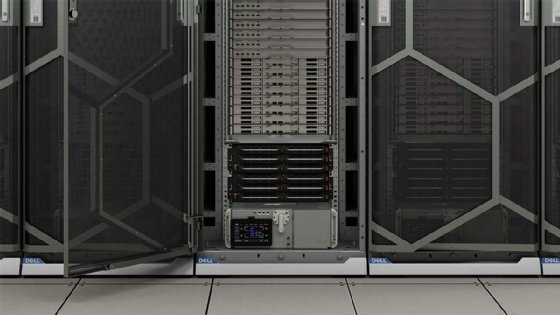
The new PowerRack for networking features more than 800 Tbps of switching capacity, powered by eight new Dell PowerSwitch SN 6600 LD Ethernet switches that incorporate the Nvidia Spectrum-6 ASIC introduced with the chipmaker's Vera Rubin systems earlier this year. A new PowerCool C7000 cooling distribution unit (CDU) is also designed to support Vera Rubin systems with more than 220 kilowatts of cooling capacity, enabling warmer liquid cooling up to 40 degrees Fahrenheit. The C7000 is an in-rack unit rather than a floor-mounted unit, which could save data center space, according to Chhabra's comments during the pre-briefing.
"Additionally, the C7000 features advanced manageability … and leak detection capabilities [with] additional sensor layers and alerts that are integrated via the IRC [Integrated Rack Controller] and [Dell] OpenManage [software]," Chhabra said. "We've expanded remote connectivity and orchestration across servers, CDUs, PowerShells and switches. This means that the whole rack can be controlled with a single UI."
IRC and OpenManage now automatically respond to power, thermal or hardware issues by isolating the faulty components and shutting down impacted nodes, Chhabra said.
The Dell PowerCool C7000 system is among refreshed rack-scale systems Dell rolled out for its AI Factory this week.
PowerRack roadmap focused on integration
People are going to have CPUs, GPUs and quantum chips. … At some point, you're going to be bringing them all together, and that is something that very few people are actively talking about.
Roy Illsley, Analyst, Omdia
Dell's new PowerRack for storage adds support for its PowerFlex scale-out file storage to the Exascale storage system launched during the Nvidia GTC conference in March. This opens up the product to demanding enterprise storage workloads alongside the AI and HPC applications they were initially designed for. Customers will also be able to swap storage "personalities" at the array level as they grow, according to Chhabra's comments during the pre-briefing.
Industry analysts said it will be crucial for this expanded integration with non-AI systems to continue with Dell AI Factory in the future.
"IBM made the point the other week that people are going to have CPUs, GPUs and quantum chips. … At some point you're going to be bringing them all together, and that is something that very few people are actively talking about," said Roy Illsley, an analyst at Omdia, a division of Informa TechTarget. "You've got agentic management and orchestration, but you'll also need a higher-level operational management view to get all of these disparate things to work along with the security, governance, sovereignty and cost management."
Infrastructure automation tools such as IRC and OpenManage help manage individual racks but will need to expand to encompass entire data centers and tools from multiple data center operational technology and IT vendors, Illsley said.
"What happens if this place that you're connecting to has got your competitor's software, but somebody wants to manage the power, the cooling and the workloads between them, and wants to make sure they're optimized and working effectively?" he said. "They'd have to have two different tools and put it together on a spreadsheet, and that's not going to work."
Strechay said he expects agentic AIOps, which Dell also expanded for infrastructure management this week, to play a role in cross-vendor and cross-site data center orchestration.
"I would assume in the future the automation will obfuscate different systems through an MCP server or API set that will enable AI to make the determination of where the workload should sit," he said.
A Dell spokesperson declined to share roadmap specifics but said in a statement emailed to Informa TechTarget this week that certain principles will guide its infrastructure integration plans.
"First, data gravity wins," the spokesperson said. "Customers shouldn't have to move data to get AI value from it, so we're focused on letting AI Factories reason over data wherever it lives."
The spokesperson added that Dell's management plane development will focus on simplifying the orchestration of heterogeneous systems, and that "open ecosystems matter as much at the infrastructure layer as they do at the agent layer."
Beth Pariseau, senior news writer for Informa TechTarget, is an award-winning veteran of IT journalism. Have a tip? Email her or connect on LinkedIn.

 Mike Leone